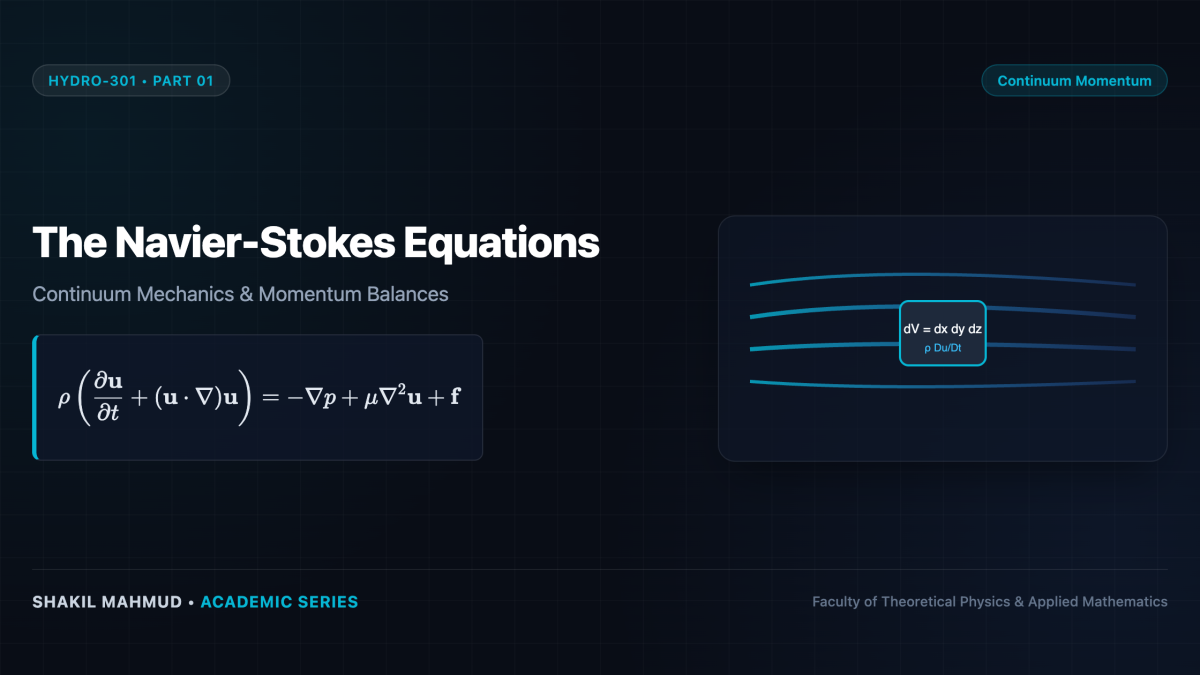
At the bedrock of macroscopic fluid mechanics lies the continuum hypothesis: treating discrete molecular swarms as a differentiable mathematical continuum endowed with smooth spatial distributions of density, velocity, and pressure. From this macroscopic continuum perspective emerge the Navier-Stokes equations—the non-linear partial differential equations governing fluid momentum balance across the cosmos.
1. The Continuum Hypothesis and Reynolds Transport Theorem
The continuum approximation is valid when the Knudsen number (( ext{Kn}))—the ratio of the molecular mean free path (lambda) to the characteristic macroscopic physical length scale (L)—is negligibly small:
[
mathrm{Kn} = rac{lambda}{L} ll 10^{-2}
]
To establish dynamic conservation laws for an arbitrary, moving, deformable material control volume (Omega(t)) bounded by the closed surface (partial Omega(t)), we invoke the Reynolds Transport Theorem for any intensive field property (psi(mathbf{x}, t)):
[
rac{d}{dt} int_{Omega(t)}
ho psi , dV = int_{Omega(t)} left[ rac{partial(
ho psi)}{partial t} +
abla cdot (
ho psi mathbf{u})
ight] dV
]
Applying this theorem to mass conservation ((psi = 1)) with zero mass generation immediately yields the Eulerian continuity equation:
[
rac{partial
ho}{partial t} +
abla cdot (
ho mathbf{u}) = 0
]
For an incompressible fluid where material density is invariant along streamlines ((D
ho/Dt = 0)), the velocity field is strictly solenoidal:
[
abla cdot mathbf{u} = 0
]
2. The Cauchy Stress Tensor and Momentum Conservation
Newton’s second law applied to a continuum material element dictates that the rate of change of linear momentum equals the sum of surface traction forces and body forces (mathbf{f}). Surface forces acting across an arbitrary planar interface with normal (mathbf{n}) are quantified by the symmetric second-rank Cauchy stress tensor (boldsymbol{sigma}):
[
ho rac{Dmathbf{u}}{Dt} =
abla cdot boldsymbol{sigma} + mathbf{f}
]
where (D/Dt = partial/partial t + (mathbf{u} cdot
abla)) represents the non-linear material (substantial) derivative. The stress tensor is partitioned into an isotropic thermodynamic pressure (p) and a deviatoric viscous stress tensor (boldsymbol{ au}):
[
sigma_{ij} = -p , delta_{ij} + au_{ij}
]
3. The Newtonian Constitutive Law
For a Newtonian fluid, viscous stresses are assumed to be linearly proportional to the rate of spatial deformation. Kinematically, the velocity gradient tensor (
abla mathbf{u}) decomposes into a symmetric rate-of-strain tensor (mathbf{S}) and an antisymmetric spin (rotation) tensor (boldsymbol{Omega}):
[
rac{partial u_i}{partial x_j} = S_{ij} + Omega_{ij} = rac{1}{2}left( rac{partial u_i}{partial x_j} + rac{partial u_j}{partial x_i}
ight) + rac{1}{2}left( rac{partial u_i}{partial x_j} – rac{partial u_j}{partial x_i}
ight)
]
Assuming spatial isotropy, the constitutive relationship between deviatoric stress and rate-of-strain takes the generalized linear form:
[
au_{ij} = 2mu S_{ij} + lambda_v (
abla cdot mathbf{u}) , delta_{ij}
]
where (mu) is the dynamic shear viscosity and (lambda_v) is the second coefficient of viscosity. Invoking Stokes’ hypothesis (which assumes the bulk viscosity (zeta = lambda_v + rac{2}{3}mu = 0) for monoatomic gases):
[
au_{ij} = 2mu left( S_{ij} – rac{1}{3}(
abla cdot mathbf{u})delta_{ij}
ight)
]
4. The Incompressible Navier-Stokes Equations
Substituting the Newtonian constitutive tensor into Cauchy’s momentum balance under constant viscosity (mu) and density (
ho) yields the celebrated Navier-Stokes equations:
[
ho left( rac{partial mathbf{u}}{partial t} + (mathbf{u} cdot
abla)mathbf{u}
ight) = –
abla p + mu
abla^2 mathbf{u} +
ho mathbf{g}
]
Dividing through by density (
ho) and defining kinematic viscosity (
u = mu /
ho):
[
rac{partial mathbf{u}}{partial t} + (mathbf{u} cdot
abla)mathbf{u} = -rac{1}{
ho}
abla p +
u
abla^2 mathbf{u} + mathbf{g}
]
This deceptively compact vector equation conceals monumental mathematical depth. The convective acceleration term ((mathbf{u} cdot
abla)mathbf{u}) introduces quadratic non-linearity, breaking superposition and giving rise to boundary-layer separation, chaotic instabilities, vortex stretching, and fully developed hydrodynamic turbulence—representing one of the Clay Millennium Prize open problems.