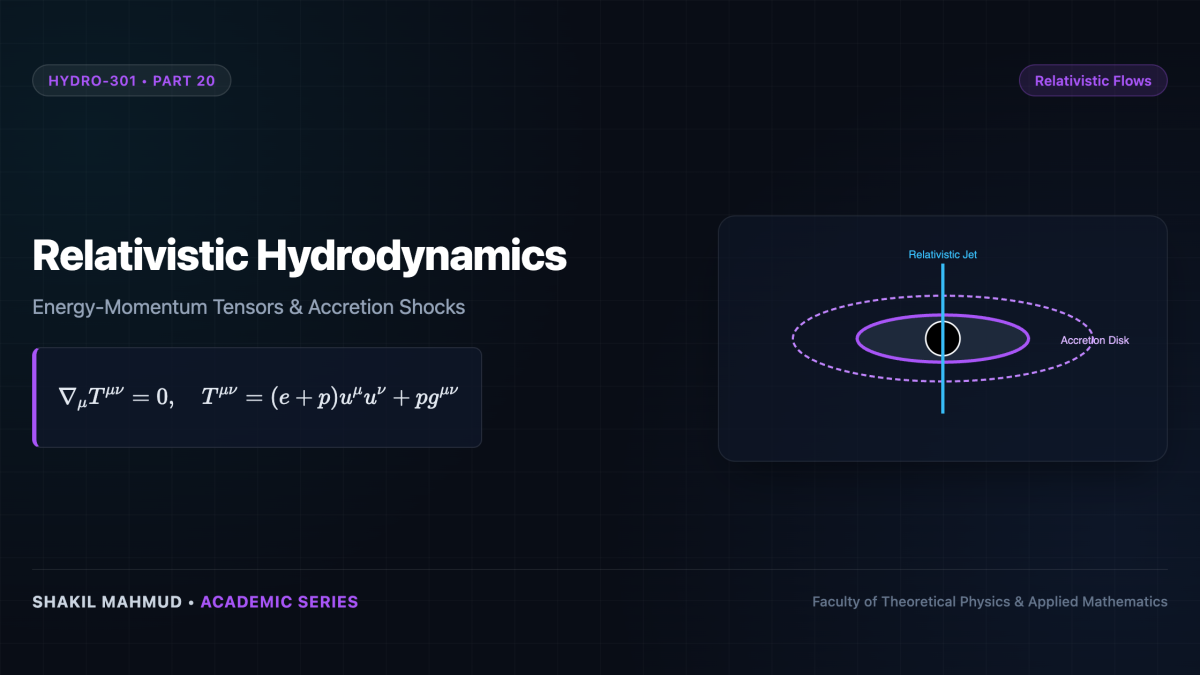
At the cosmic frontiers of general relativity—in the swirling accretion disks of supermassive black holes, gamma-ray bursts, and colliding neutron star mergers—matter moves at velocities approaching the speed of light ((u sim c)) in gravitational fields where spacetime itself is warped. Here, classical fluid mechanics culminates in relativistic hydrodynamics.
1. The Relativistic Energy-Momentum Tensor
In special and general relativity, the classical separation between mass density, energy, and momentum breaks down. The state of a perfect fluid is completely encapsulated by the symmetric second-rank Stress-Energy-Momentum Tensor (T^{mu
u}):
[
T^{mu
u} = (e + p) u^mu u^
u + p g^{mu
u}
]
where (e =
ho c^2 + psilon) is the total proper energy density (rest-mass plus internal energy), (p) is the proper thermodynamic pressure, (g^{mu
u}) is the spacetime metric tensor (with signature (-+++)), and (u^mu = gamma(c, mathbf{v})) is the fluid four-velocity satisfying the normalization constraint:
[
u^mu u_mu = -c^2
]
The relativistic laws of motion are encapsulated in the covariant conservation laws of particle number and four-momentum:
[
abla_mu (n u^mu) = 0, quad
abla_mu T^{mu
u} = 0
]
Projecting (
abla_mu T^{mu
u} = 0) parallel and perpendicular to (u^
u) yields the relativistic energy equation and the relativistic Euler equations:
[
(e + p) u^mu
abla_mu u^
u = -(g^{
umu} + u^
u u^mu / c^2)
abla_mu p
]
Notice that the effective inertial mass density is not merely rest-mass (
ho), but the relativistic enthalpy ((e + p)/c^2), demonstrating that thermal pressure itself possesses gravitational and inertial mass.
2. Black Hole Accretion Disks: The Shakura-Sunyaev Paradigm
Gas orbiting a compact object (such as a Kerr black hole) must shed angular momentum to spiral downward across the event horizon. In 1973, Rashid Shakura and Rashid Sunyaev formulated the standard thin accretion disk model ((alpha)-disk model). Assuming the disk is geometrically thin ((H/R ll 1)) and radiatively efficient, the orbital velocity is strictly Keplerian:
[
Omega_K(R) = sqrt{rac{G M}{R^3}}
]
Because inner orbits move faster than outer orbits ((dOmega_K / dR < 0)), shear friction between adjacent orbits generates heat and transports angular momentum outward. Shakura and Sunyaev parameterized the unknown turbulent viscosity via the dimensionless (alpha) prescription:
[
u_{ ext{turb}} = alpha c_s H, quad (alpha le 1)
]
where (c_s) is the local speed of sound and (H) is the disk vertical scale height.
3. The Magnetorotational Instability (MRI): The Dynamo Engine
For decades, a profound crisis troubled astrophysics: molecular viscosity in astrophysical disks is (10^{14}) times too weak to drive observed accretion rates, and pure hydrodynamic Keplerian rotation is strictly stable according to Rayleigh’s criterion ((d(R^2 Omega)/dR > 0)). What generates the intense turbulent viscosity (alpha)?
In 1991, Steven Balbus and John Hawley discovered the answer: the Magnetorotational Instability (MRI). Even an infinitesimally weak seed magnetic field completely shatters Rayleigh stability. If two orbiting fluid elements connected by a weak magnetic field line are displaced:
- The inner parcel moves to a faster orbit; the outer parcel moves to a slower orbit.
- The connecting magnetic field line stretches, exerting a restorative magnetic tension that acts as a tether: it decelerates the inner parcel and accelerates the outer parcel.
- Decelerating the inner parcel robs it of angular momentum, causing it to fall deeper into the gravitational well; accelerating the outer parcel gives it angular momentum, pushing it further outward.
This runaway feedback loop is exponentially unstable with a maximum growth rate on the order of the orbital frequency: (gamma_{max} approx rac{3}{4}Omega), driving violent, sustained MHD turbulence that transports angular momentum outward at prodigious rates.
4. Relativistic Jets and Blandford-Znajek Power
In the innermost regions of spinning Kerr black hole magnetospheres, framedragging twists magnetic field lines into an ultra-dense helical magnetic funnel. The Blandford-Znajek mechanism extracts rotational energy directly from the spinning black hole’s ergosphere, launching collimated, ultra-relativistic plasma jets that propagate across millions of light-years at Lorentz factors (gamma > 10 ext{–}50), completing the grand synthesis of relativistic fluid dynamics, electrodynamics, and gravitation.