Laminar flows do not transition into turbulence abruptly or arbitrarily; they succumb through precise mathematical instabilities. When infinitesimal perturbations superposed onto an equilibrium base flow experience exponential amplification due to shear, density stratification, or thermal buoyancy, the laminar regime ruptures into complex nonlinear structures.
1. Linearized Stability Theory and Normal Modes
Hydrodynamic stability analyzes the evolution of an infinitesimal perturbation (mathbf{u}'(mathbf{x}, t)), (p'(mathbf{x}, t)) superposed onto a steady laminar base flow (mathbf{U}(mathbf{x})), (P(mathbf{x})):
[
mathbf{u}(mathbf{x}, t) = mathbf{U}(mathbf{x}) + mathbf{u}'(mathbf{x}, t), quad p(mathbf{x}, t) = P(mathbf{x}) + p'(mathbf{x}, t)
]
Substituting into the Navier-Stokes equations and discarding second-order quadratic perturbation terms (mathcal{O}(|mathbf{u}’|^2)) yields the linearized perturbation equations. Decomposing perturbations into temporal Fourier normal modes:
[
mathbf{u}'(mathbf{x}, t) = hat{mathbf{u}}(mathbf{x}) xp(i(mathbf{k} cdot mathbf{x} – omega t))
]
The complex frequency (omega = omega_r + i omega_i) determines stability:
- (omega_i < 0): Stable (perturbations decay exponentially as (e^{omega_i t})).
- (omega_i = 0): Marginally / Neutrally Stable.
- (omega_i > 0): Unstable (perturbations grow exponentially, triggering bifurcation).
2. The Kelvin-Helmholtz Instability: Interfacial Shear
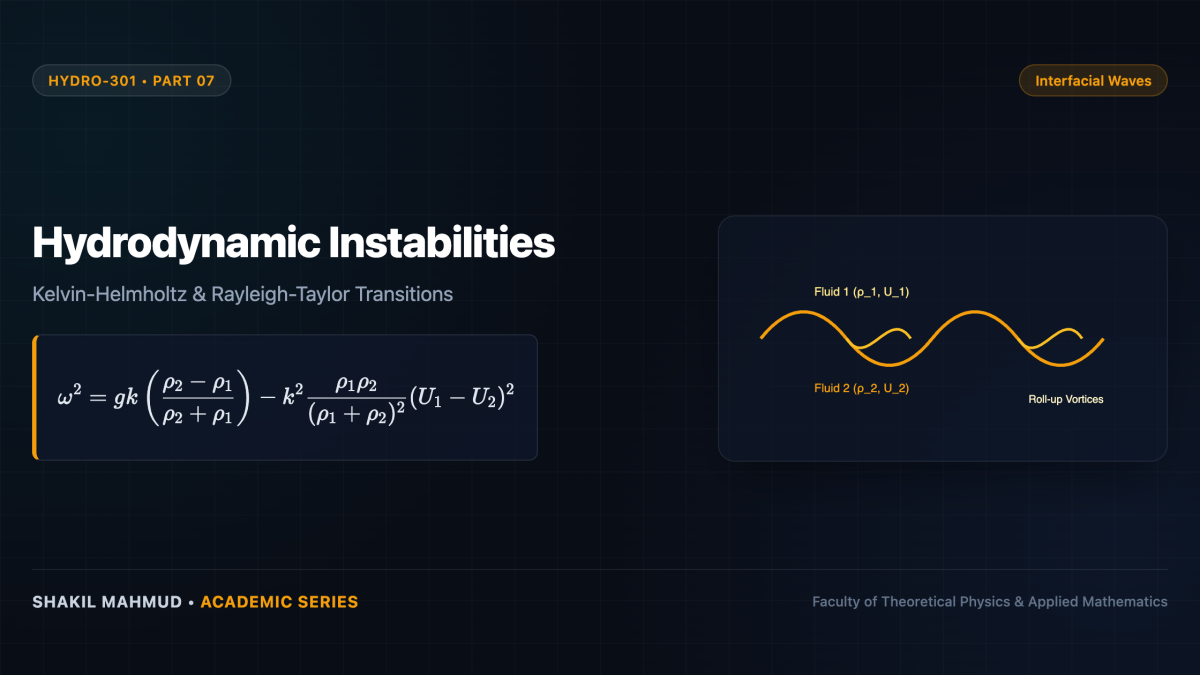
Consider two superposed, immiscible, inviscid fluids under gravity (g). Fluid 1 (density (
ho_1)) moves horizontally with velocity (U_1) above Fluid 2 (density (
ho_2)) moving with velocity (U_2). Imposing interfacial kinematic and dynamic pressure boundary conditions yields the canonical dispersion relation:
[
omega = k rac{
ho_1 U_1 +
ho_2 U_2}{
ho_1 +
ho_2} pm sqrt{ rac{g k (
ho_2 –
ho_1)}{
ho_1 +
ho_2} – rac{k^2
ho_1
ho_2 (U_1 – U_2)^2}{(
ho_1 +
ho_2)^2} }
]
If the term inside the square root becomes negative, the frequency develops a positive imaginary component (omega_i > 0), triggering instability. Instability occurs whenever the relative velocity exceeds the critical threshold:
[
(U_1 – U_2)^2 > rac{g}{k} rac{
ho_2^2 –
ho_1^2}{
ho_1
ho_2}
]
The interface rolls up into characteristic billows—frequently observed in atmospheric cirrus cloud layers, planetary atmospheres (Jupiter’s Great Red Spot periphery), and oceanic pycnoclines.
3. The Rayleigh-Taylor Instability: Density Inversion
Setting relative velocity to zero ((U_1 = U_2 = 0)) in the dispersion relation, we examine purely density-driven behavior:
[
omega^2 = g k left( rac{
ho_2 –
ho_1}{
ho_2 +
ho_1}
ight) = g k A_t
]
where (A_t = (
ho_2 –
ho_1)/(
ho_2 +
ho_1)) is the dimensionless Atwood number.
- If the heavier fluid is underneath ((
ho_2 >
ho_1 implies A_t > 0)), (omega^2 > 0); perturbations oscillate as stable gravity waves. - If the heavier fluid rests above the lighter fluid ((
ho_1 >
ho_2 implies A_t < 0)), (omega^2 < 0 implies omega = pm i gamma), where the growth rate is:
[
gamma = sqrt{g k |A_t|}
]
Infinitesimal ripples grow exponentially into mushroom-shaped plumes and falling spikes. This instability governs supernova mantle ejections, inertial confinement fusion capsule implosions, and volcanic ash plumes.
4. Rayleigh-Bénard Convection: Thermal Buoyancy vs. Diffusion
When a horizontal fluid layer of depth (d) is heated from below, warm buoyant fluid at the bottom attempts to rise while cool dense fluid at the top sinks. This motion is resisted by thermal diffusivity (kappa) and kinematic viscosity (
u). The instability is governed by the dimensionless Rayleigh number ((mathrm{Ra})):
[
mathrm{Ra} = rac{g beta Delta T d^3}{
u kappa}
]
where (beta) is the volumetric thermal expansion coefficient and (Delta T) is the vertical temperature difference. Linear stability analysis reveals that steady conduction breaks down into organized, rotating hexagonal convective rolls once (mathrm{Ra}) surpasses the critical threshold: (mathrm{Ra}_c approx 1708). As (mathrm{Ra}) escalates past (10^8), the regular rolls undergo a cascade of period-doubling bifurcations into chaotic, fully turbulent Rayleigh-Bénard convection.