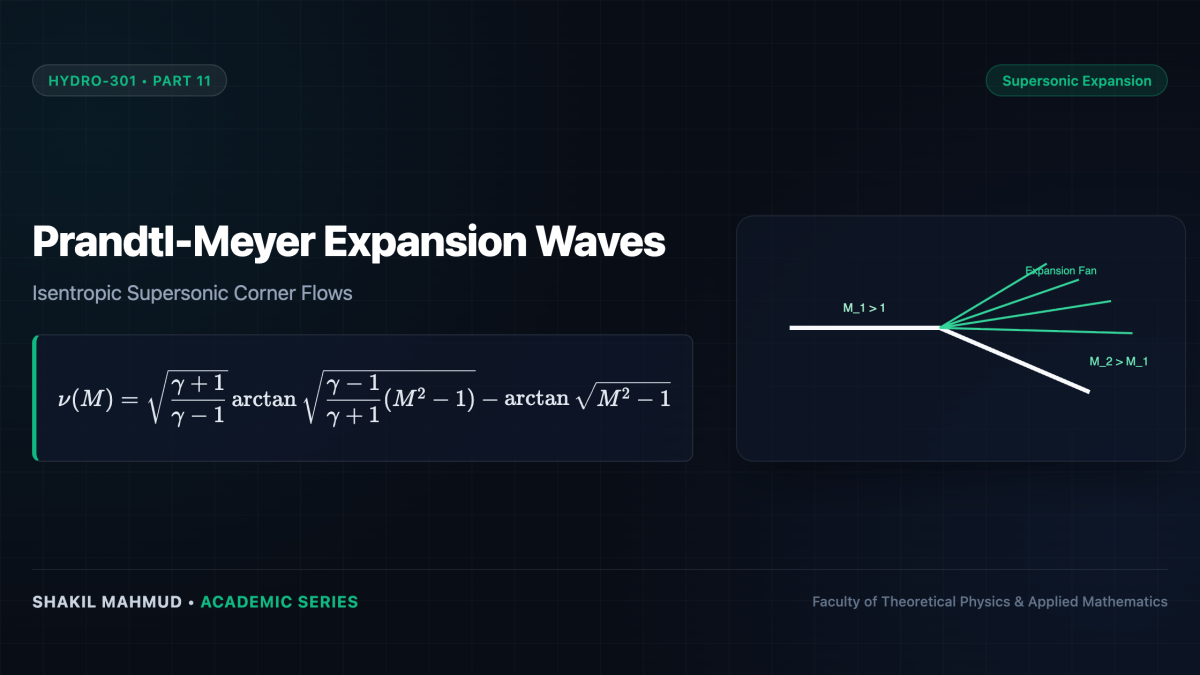
While compressive supersonic turning generates abrupt, dissipative shock waves, supersonic expansion around convex surfaces exhibits a radically different physical nature: an infinite, continuous fan of centered isentropic Mach waves that smoothly accelerates supersonic gas to higher Mach numbers while lowering pressure and temperature without generating entropy.
1. The Physics of Prandtl-Meyer Expansion
When supersonic flow at Mach (M_1 > 1) passes over a smooth convex bend or sharp convex corner of angle ( heta), the fluid must turn to follow the wall. Because the flow area expands, acoustic disturbances cannot coalesce into a shock wave. Instead, the expansion manifests as a centered Prandtl-Meyer expansion fan: an infinite continuum of Mach waves diverging from the corner apex.
Across each infinitesimal wave, flow turns by (d heta), Mach number increases ((dM > 0)), and pressure drops ((dp < 0)). Crucially, because each wave is an infinitesimal Mach wave, the entire expansion process is strictly isentropic ((s = ext{const})):
[
Delta s = 0, quad p_0 = ext{const}, quad T_0 = ext{const}
]
2. The Prandtl-Meyer Function
By resolving the velocity components parallel and perpendicular to an infinitesimal Mach wave, the differential turning angle relates to the Mach number via:
[
d
u = rac{sqrt{M^2 – 1}}{1 + rac{gamma – 1}{2}M^2} rac{dM}{M}
]
Integrating from (M = 1) (where (
u = 0)) yields the analytical Prandtl-Meyer function (
u(M)):
[
u(M) = sqrt{rac{gamma + 1}{gamma – 1}} arctan sqrt{rac{gamma – 1}{gamma + 1}(M^2 – 1)} – arctan sqrt{M^2 – 1}
]
To compute the downstream state after turning through an angle ( heta):
[
u(M_2) =
u(M_1) + heta
]
Knowing (
u(M_2)), the downstream Mach number (M_2) is found by numerical inversion. The downstream thermodynamic state is then computed using standard isentropic relations:
[
rac{p_2}{p_1} = left( rac{1 + rac{gamma – 1}{2}M_1^2}{1 + rac{gamma – 1}{2}M_2^2}
ight)^{rac{gamma}{gamma – 1}}, quad rac{T_2}{T_1} = rac{1 + rac{gamma – 1}{2}M_1^2}{1 + rac{gamma – 1}{2}M_2^2}
]
3. Converging-Diverging Nozzles: The de Laval Engine
To accelerate a gas from stationary reservoir stagnation conditions ((M approx 0)) to supersonic velocities ((M > 1)), we examine the area-velocity relation derived from differential 1D continuity and momentum:
[
rac{dA}{A} = (M^2 – 1) rac{du}{u}
]
This differential equation reveals a profound geometric duality:
- Subsonic Flow ((M < 1)): (M^2 – 1 0)) when area contracts ((dA < 0)). A converging duct accelerates subsonic flow.
- Sonic Throat ((M = 1)): At the minimum area cross-section ((dA = 0)), the Mach number must be identically unity: (M = 1).
- Supersonic Flow ((M > 1)): (M^2 – 1 > 0 implies) flow accelerates ((du > 0)) when area expands ((dA > 0)). A diverging duct accelerates supersonic flow!
This establishes the converging-diverging (de Laval) nozzle invented by Gustaf de Laval in 1888, the universal design of all rocket engines and supersonic wind tunnels.
4. Choked Mass Flow and Critical Pressure
When the pressure ratio across the nozzle drops sufficiently, the throat reaches sonic velocity ((M_t = 1)). The mass flow rate saturates at its theoretical maximum—a state called choked flow:
[
dot{m}_{max} = rac{A_t p_0}{sqrt{T_0}} sqrt{rac{gamma}{R}} left( rac{2}{gamma + 1}
ight)^{rac{gamma + 1}{2(gamma – 1)}}
]
Once choked, lowering downstream back-pressure further has zero impact on mass flow rate or upstream conditions—the throat acts as an absolute information horizon shielding the combustion chamber from downstream acoustic communication.
5. Over-Expanded vs. Under-Expanded Rocket Exhaust Plumes
As supersonic gas exits the nozzle at pressure (p_e) into ambient atmospheric pressure (p_a):
- Correctly Expanded ((p_e = p_a)): The exhaust jet exits as a smooth parallel cylinder, achieving maximum propulsive efficiency.
- Over-Expanded ((p_e < p_a)): Ambient pressure compresses the jet, forcing oblique shock waves into the plume that reflect internally, forming alternating shock diamonds. Extreme over-expansion triggers flow separation inside the nozzle bell, generating destructive side-loads.
- Under-Expanded ((p_e > p_a)): Exhaust pressure exceeds ambient; the plume flares outward through external Prandtl-Meyer expansion fans, ballooning dramatically in near-vacuum upper atmospheres.