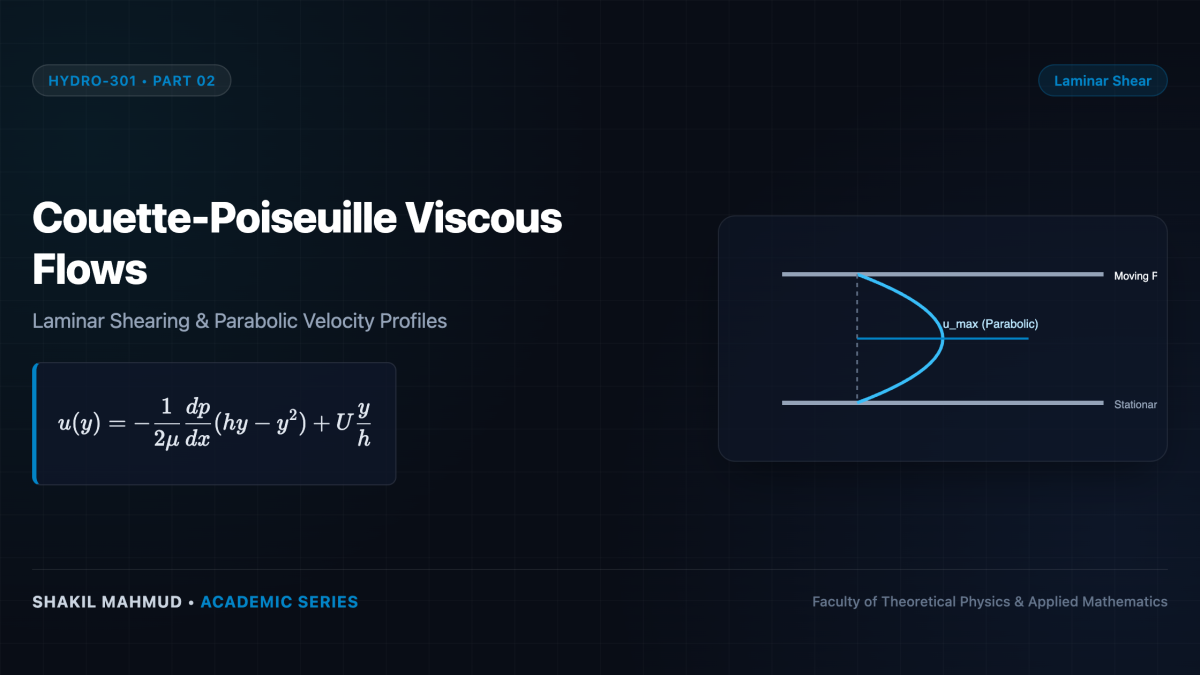
Before confronting the intractable non-linear complexities of turbulent eddies, fluid dynamics establishes its foundational footing upon exact analytical solutions of laminar viscous flows. When convective acceleration vanishes identically due to geometric symmetry, the Navier-Stokes equations simplify into linear balances between pressure gradients and viscous diffusion.
1. Hydrostatic Equilibrium and Barometric Stratification
When a fluid is at rest ((mathbf{u} = mathbf{0})), viscous shear stresses vanish identically ((boldsymbol{ au} = mathbf{0})). The momentum equation collapses into the static balance between pressure gradients and gravitational body forces:
[
abla p =
ho mathbf{g} implies rac{dp}{dz} = –
ho g
]
For an incompressible liquid ((
ho = ext{const})), integration yields the classical linear hydrostatic relation: (p(z) = p_0 –
ho g z). For an isothermal compressible ideal gas ((p =
ho R T)), separation of variables yields the exponential barometric formula:
[
rac{dp}{p} = -rac{g}{RT} dz implies p(z) = p_0 xpleft( -rac{z}{H}
ight), quad H = rac{RT}{g}
]
where (H) is the atmospheric scale height ((sim 8.5 ext{ km}) for Earth’s troposphere).
2. Planar Couette Flow: Pure Shear Mechanics
Consider steady, laminar, incompressible flow between two infinite parallel plates separated by distance (h). The lower plate at (y=0) is stationary, while the upper plate at (y=h) translates horizontally at constant velocity (U). Assuming zero streamwise pressure gradient ((dp/dx = 0)) and unidirectional flow (mathbf{u} = (u(y), 0, 0)):
[
mu rac{d^2 u}{dy^2} = 0
]
Applying the no-slip boundary conditions at the solid walls ((u(0) = 0) and (u(h) = U)):
[
u(y) = U rac{y}{h}
]
The velocity profile is strictly linear. Consequently, the shear stress ( au_{xy} = mu rac{du}{dy} = mu rac{U}{h}) is uniform throughout the fluid layer, making planar Couette flow the theoretical archetype for dynamic viscosity measurement.
3. Hagen-Poiseuille Pipe Flow: Pressure-Driven Conduits
In pressure-driven flow through an axisymmetric circular pipe of radius (R) and length (L), a constant pressure drop (Delta p = p_1 – p_2) drives the flow against viscous wall resistance. In cylindrical coordinates ((r, heta, z)), steady fully developed flow satisfies:
[
rac{1}{r} rac{d}{dr}left( r rac{du}{dr}
ight) = rac{1}{mu} rac{dp}{dz} = -rac{Delta p}{mu L}
]
Integrating twice and applying regularity at the centerline ((du/dr|_{r=0} = 0)) and the no-slip condition at the pipe wall ((u(R) = 0)):
[
u(r) = rac{Delta p}{4mu L} (R^2 – r^2) = u_{max} left( 1 – rac{r^2}{R^2}
ight)
]
The velocity profile is a classical paraboloid of revolution, with maximum centerline velocity (u_{max} = rac{Delta p R^2}{4mu L}). The mean bulk velocity is exactly half the maximum: (bar{u} = rac{1}{2} u_{max}).
4. Volumetric Flow Rate and Hydraulic Resistance
Integrating the parabolic velocity profile across the circular cross-section yields the renowned Hagen-Poiseuille equation for volumetric flow rate (Q):
[
Q = int_0^R u(r) cdot 2pi r , dr = rac{pi R^4 Delta p}{8mu L}
]
Expressing this in terms of hydraulic resistance (R_H = Delta p / Q):
[
R_H = rac{8mu L}{pi R^4}
]
The profound inverse-fourth-power dependence on radius ((R_H propto R^{-4})) reveals why biological vascular systems can dramatically alter local hemodynamic perfusion through microscopic arteriolar vasoconstriction, and why pipe friction escalates catastrophically under bore narrowing.