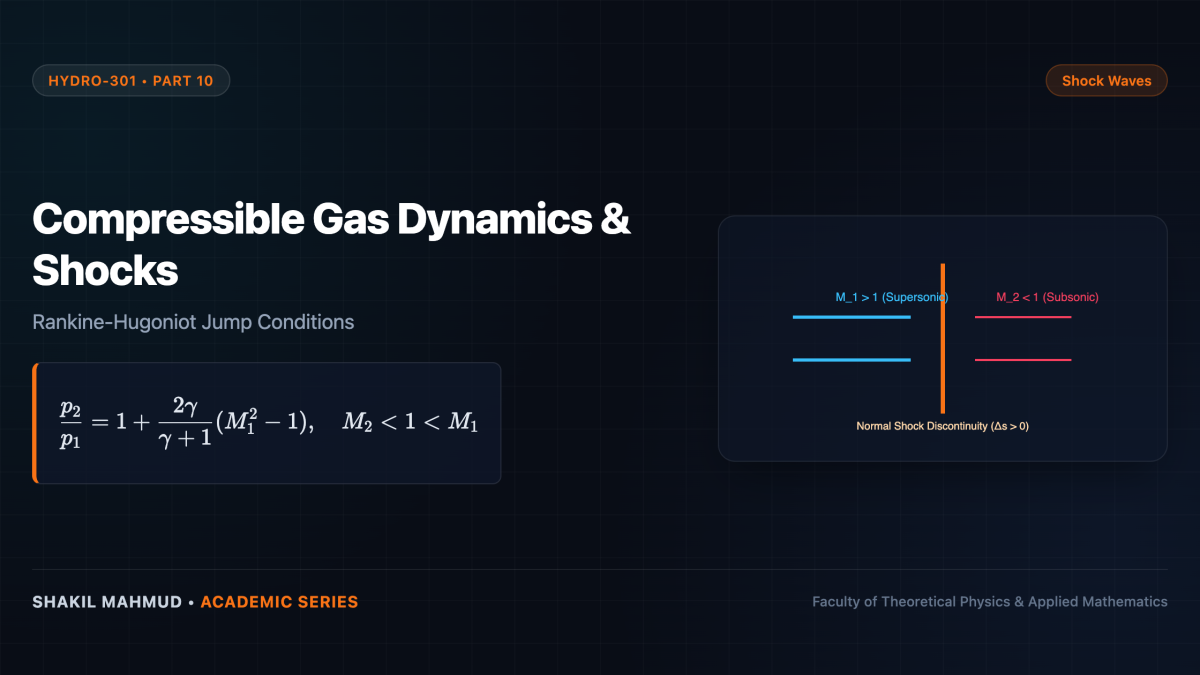
When a fluid’s velocity approaches or surpasses the speed of sound ((mathrm{Ma} ge 0.3)), density can no longer be treated as invariant. Compressibility effects radically reshape the governing physics: infinitesimal acoustic disturbances coalesce into discontinuous thermodynamic shock fronts across which pressure, temperature, and entropy jump precipitously over mean-free-path thickness scales.
1. The Speed of Sound and Mach Waves
The speed of sound (a) is the phase speed at which infinitesimal isentropic pressure perturbations propagate through a compressible medium:
[
a^2 = left( rac{partial p}{partial
ho}
ight)_s = rac{gamma p}{
ho} = gamma R T
]
where (gamma = c_p / c_v) is the heat capacity ratio ((1.4) for diatomic air). When a body travels at supersonic speed ((mathrm{Ma} = U / a > 1)), disturbances cannot propagate upstream. Sound waves are confined within a conical envelope—the Mach cone—with half-angle (mu_M):
[
sin mu_M = rac{1}{mathrm{Ma}}
]
2. Non-Linear Wave Steepening and Shock Formation
Because sound speed increases with temperature ((a propto sqrt{T})) and compressive compression raises local temperature isentropically, the peak of a high-amplitude compressive wave travels faster than its trough. The trailing part of the wave continuously overtakes the leading edge:
[
left( rac{partial u}{partial t}
ight) + (u + a) rac{partial u}{partial x} = 0
]
The wavefront steepens indefinitely until balance is struck with microscopic viscous and thermal conduction gradients, collapsing into a macroscopic discontinuity: a shock wave with a physical thickness on the order of several molecular mean free paths ((sim 10^{-7} ext{ m})).
3. The Rankine-Hugoniot Jump Conditions
Applying the 1D integral conservation equations of mass, momentum, and energy across a stationary normal shock discontinuity for a calorically perfect gas:
[
begin{aligned}
ext{Mass:} quad &
ho_1 u_1 =
ho_2 u_2
ext{Momentum:} quad & p_1 +
ho_1 u_1^2 = p_2 +
ho_2 u_2^2
ext{Energy:} quad & h_1 + rac{1}{2}u_1^2 = h_2 + rac{1}{2}u_2^2 implies T_{01} = T_{02}
nd{aligned}
]
Algebraic solution yields the classic Rankine-Hugoniot relations as functions of upstream Mach number (M_1 > 1):
Downstream Mach Number
[
M_2^2 = rac{(gamma – 1)M_1^2 + 2}{2gamma M_1^2 – (gamma – 1)} < 1 quad ( ext{Supersonic to Subsonic})
]
Static Pressure Ratio
[
rac{p_2}{p_1} = 1 + rac{2gamma}{gamma + 1}(M_1^2 – 1) > 1
]
Density and Temperature Ratios
[
rac{
ho_2}{
ho_1} = rac{(gamma + 1)M_1^2}{(gamma – 1)M_1^2 + 2}, quad rac{T_2}{T_1} = left(rac{p_2}{p_1}
ight)left(rac{
ho_1}{
ho_2}
ight)
]
4. Thermodynamic Irreversibility and Stagnation Pressure Loss
A shock wave is fundamentally an irreversible process driven by intense internal viscous dissipation and heat conduction. The second law of thermodynamics requires the entropy change across the shock to be strictly positive ((Delta s > 0)):
[
rac{Delta s}{c_v} = lnleft( rac{p_2}{p_1} left(rac{
ho_1}{
ho_2}
ight)^gamma
ight) > 0 quad ( ext{strictly for } M_1 > 1)
]
Rarefaction shocks ((M_1 < 1)) would violate (Delta s ge 0) and are physically impossible. As a consequence of entropy production, total (stagnation) pressure drops across the shock:
[
rac{p_{02}}{p_{01}} = xpleft( -rac{Delta s}{R}
ight) < 1
]
This stagnation pressure loss manifests macroscopically as wave drag—the formidable aerodynamic penalty paid by supersonic aircraft.
5. Oblique Shock Waves and Deflection Angles
When a supersonic flow encounters a concave corner of deflection angle ( heta), an oblique shock wave inclined at shock angle (beta) forms. Decomposing velocity into normal and tangential components to the shock front reveals that only the normal Mach component (M_{1n} = M_1 sinbeta) undergoes shock compression. The relationship between Mach number (M_1), deflection angle ( heta), and shock angle (beta) is governed by the famous ( heta ext{-}beta ext{-}M) equation:
[
an heta = 2 cotbeta left[ rac{M_1^2 sin^2beta – 1}{M_1^2 (gamma + cos 2beta) + 2}
ight]
]
For any given (M_1), there exists a maximum deflection angle ( heta_{max}). If the corner angle exceeds ( heta_{max}), the oblique shock detaches from the wedge tip, transforming into a detached bow shock positioned upstream of the body.