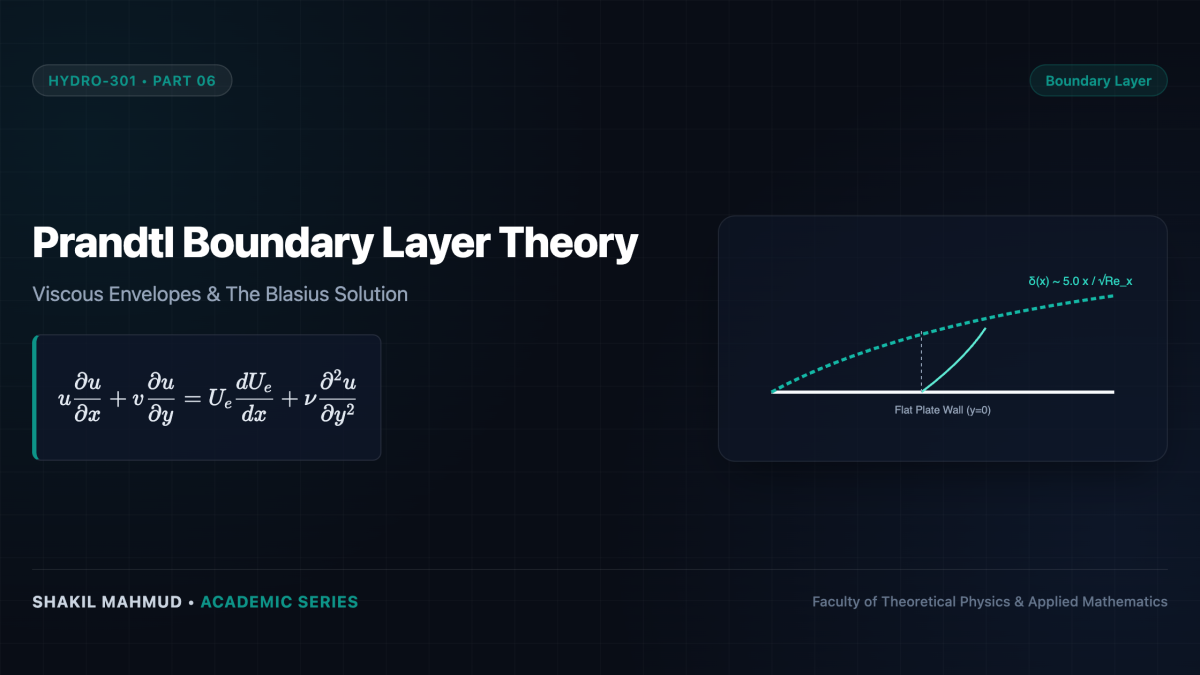
At the 1904 Third International Congress of Mathematicians in Heidelberg, Ludwig Prandtl delivered an 8-page paper that resolved the deep schism between theoretical hydrodynamics and empirical engineering. By recognizing that viscous friction is strictly confined to an infinitesimally thin sheet clinging to solid boundaries, Prandtl birthed modern aerodynamics.
1. The Boundary Layer Approximation
At high Reynolds numbers ((mathrm{Re} = U_infty L /
u gg 1)), viscous forces are utterly negligible across the vast majority of the flow field—except inside a razor-thin layer of thickness (delta(x) ll L) adjacent to solid walls, where steep velocity gradients enforce the no-slip boundary condition ((u=v=0)).
Performing an asymptotic order-of-magnitude scaling analysis on the steady 2D Navier-Stokes equations:
- Streamwise coordinate: (x sim L), Transverse coordinate: (y sim delta)
- Streamwise velocity: (u sim U_infty), Transverse velocity: (v sim U_infty (delta / L))
Balancing convective inertia with viscous diffusion across the boundary layer: (U_infty^2 / L sim
u U_infty / delta^2) immediately reveals the universal boundary layer scaling:
[
rac{delta}{L} sim rac{1}{sqrt{mathrm{Re}_L}} implies delta(x) sim sqrt{rac{
u x}{U_infty}}
]
The (y)-momentum equation reduces to (partial p / partial y approx 0), establishing that the pressure across the boundary layer is constant and impressed directly by the outer inviscid flow: (p(x, y) approx P_e(x)).
2. The Prandtl Boundary Layer Equations
The simplified system of non-linear parabolic partial differential equations governing 2D planar boundary layers is:
[
begin{aligned}
rac{partial u}{partial x} + rac{partial v}{partial y} &= 0
u rac{partial u}{partial x} + v rac{partial u}{partial y} &= U_e(x) rac{dU_e}{dx} +
u rac{partial^2 u}{partial y^2}
nd{aligned}
]
subject to boundary conditions:
[
u(x, 0) = 0, quad v(x, 0) = 0, quad lim_{y o infty} u(x, y) = U_e(x)
]
where (-rac{1}{
ho}rac{dp}{dx} = U_e rac{dU_e}{dx}) via Bernoulli’s equation in the outer inviscid flow.
3. The Blasius Similarity Solution for Flat Plates
For uniform flow over a zero-incidence flat plate ((U_e(x) = U_infty = ext{const} implies dp/dx = 0)), Heinrich Blasius (Prandtl’s student) showed that the velocity profiles at different streamwise stations (x) are self-similar when scaled by the dimensionless similarity variable (ta):
[
ta = y sqrt{rac{U_infty}{
u x}}
]
Defining a stream function (psi(x, y) = sqrt{
u x U_infty} f(ta)) automatically satisfies continuity ((u = partialpsi/partial y = U_infty f'(ta)), (v = -partialpsi/partial x = rac{1}{2}sqrt{rac{
u U_infty}{x}}(ta f’ – f))). Substituting these into Prandtl’s momentum equation transforms the PDE into the celebrated non-linear third-order ordinary differential equation: The Blasius Equation:
[
2 f”'(ta) + f(ta) f”(ta) = 0
]
with boundary conditions: (f(0) = 0), (f'(0) = 0), and (f'(infty) = 1).
Physical Quantities Derived from Blasius
- Boundary Layer Thickness ((u/U_infty = 0.99) at (ta approx 4.91)):
[
delta(x) approx 4.91 sqrt{rac{
u x}{U_infty}} = rac{4.91 x}{sqrt{mathrm{Re}_x}}
] - Displacement Thickness ((delta^*)) (apparent displacement of outer streamlines due to mass deficit):
[
delta^*(x) = int_0^infty left( 1 – rac{u}{U_infty}
ight) dy approx rac{1.72 x}{sqrt{mathrm{Re}_x}}
] - Skin Friction Coefficient ((c_f)):
[
c_f(x) = rac{ au_w}{rac{1}{2}
ho U_infty^2} = rac{0.664}{sqrt{mathrm{Re}_x}}
]
4. Falkner-Skan Wedge Flows: Pressure Gradients
When the outer potential flow obeys a power law (U_e(x) = C x^m) (representing flow past a wedge with included angle (betapi = rac{2m}{m+1}pi)), the similarity formulation generalizes to the Falkner-Skan equation:
[
f”’ + f f” + beta left( 1 – (f’)^2
ight) = 0
]
- (beta > 0) ((m > 0)): Favorable pressure gradient ((dp/dx < 0)). The flow accelerates, the boundary layer thins, and stability against separation is strongly reinforced.
- (beta = 0) ((m = 0)): The Blasius flat plate solution.
- (beta < 0) ((m < 0)): Adverse pressure gradient ((dp/dx > 0)). The flow decelerates until (beta = -0.1988), at which point the wall shear stress vanishes ((f”(0) = 0)), triggering boundary layer separation.