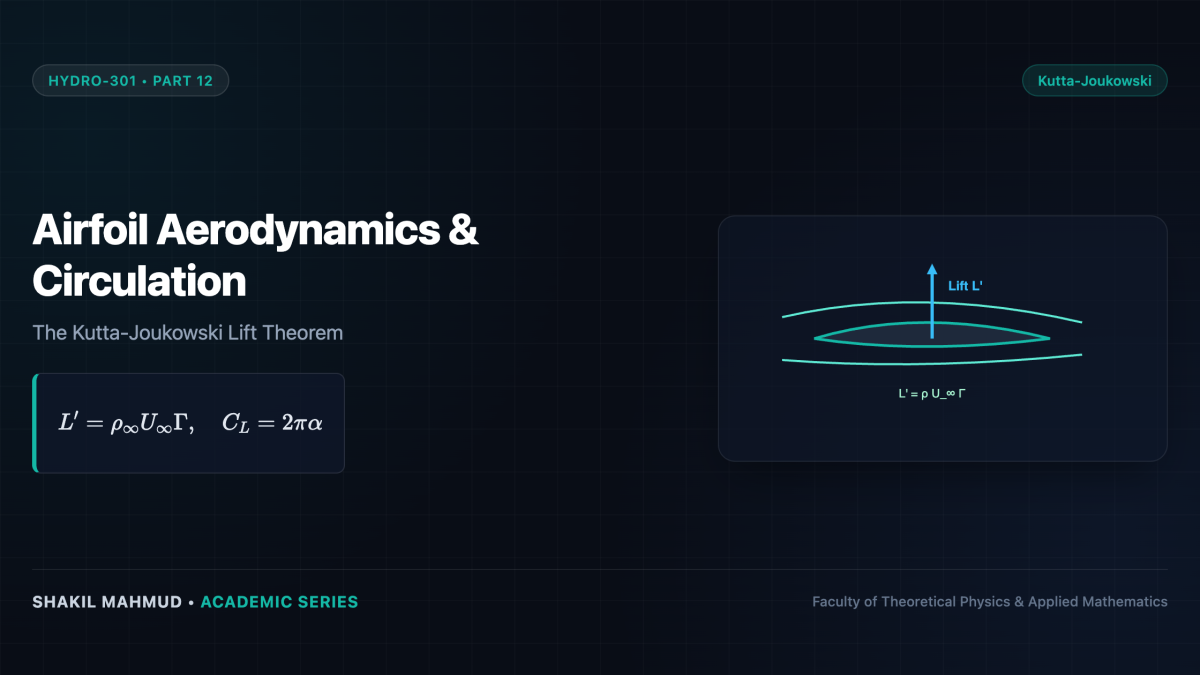
How heavy aircraft conquer gravity to cruise through the upper troposphere remains one of modern technology’s most pervasive triumphs. Far from simple Newtonian deflection, aerodynamic lift is a delicate manifestation of fluid circulation and pressure differentials governed by the Kutta-Joukowski theorem and refined by transonic supercritical aerodynamics.
1. The Generation of Aerodynamic Lift
As an airfoil moves through air with freestream velocity (U_infty) at an angle of attack (alpha), the asymmetric geometry forces streamlines to curve over the upper suction surface and under the lower pressure surface. By the Euler momentum equation normal to curved streamlines:
[
rac{partial p}{partial n} = rac{
ho u^2}{R_c}
]
where (R_c) is the local radius of streamline curvature. Convex curvature over the upper surface forces a transverse pressure gradient pointing toward the center of curvature, dramatically lowering static pressure on the upper surface while raising it on the lower surface. Integrating the net pressure difference ((p_{ ext{lower}} – p_{ ext{upper}})) across the chord yields the aerodynamic lift force.
2. The Kutta Condition: Establishing Bound Circulation
In pure potential theory, flow past a sharp trailing edge predicts infinite velocity as fluid attempts to whip around the zero-radius corner from the lower to the upper surface. In reality, viscosity creates an infinitesimally thin boundary layer that cannot withstand this infinite pressure gradient.
Nature enforces the Kutta Condition: the flow leaves the sharp trailing edge smoothly, with zero velocity discontinuity and finite velocity:
[
u_{ ext{upper, trailing}} = u_{ ext{lower, trailing}}, quad Delta p_{ ext{trailing}} = 0
]
To satisfy this condition, a starting vortex is shed into the wake at takeoff. By Kelvin’s circulation theorem ((DGamma_{ ext{total}}/Dt = 0)), shedding a clockwise starting vortex into the wake creates an equal and opposite counter-clockwise bound circulation (Gamma) around the airfoil wing.
3. The Kutta-Joukowski Lift Theorem
Martin Kutta (1902) and Nikolai Joukowski (1906) independently proved that the two-dimensional lift force per unit span (L’) is strictly determined by this bound circulation (Gamma):
[
L’ =
ho_infty U_infty Gamma
]
From thin airfoil theory (linearizing boundary conditions on the chord line), the circulation around a thin symmetric airfoil at angle of attack (alpha) is (Gamma = pi c U_infty alpha), where (c) is the chord length. This yields the universal theoretical lift coefficient:
[
C_L = rac{L’}{rac{1}{2}
ho_infty U_infty^2 c} = 2pi alpha
]
The theoretical lift-curve slope of any thin 2D airfoil is universally (dC_L/dalpha = 2pi approx 6.28 ext{ rad}^{-1} approx 0.11 ext{ deg}^{-1}).
4. Transonic Flow and the Critical Mach Number
Commercial airliners cruise in the transonic regime ((mathrm{Ma}_infty approx 0.75 ext{–}0.85)). Even though the aircraft itself flies subsonically, the air accelerating over the upper cambered suction surface reaches supersonic velocities locally.
The freestream Mach number at which sonic flow ((M=1)) first appears at a single point on the airfoil surface is the Critical Mach Number ((mathrm{Ma}_{ ext{crit}})):
[
mathrm{Ma}_infty < mathrm{Ma}_{ ext{crit}} implies ext{Completely Subsonic}
]
As flight speed increases beyond (mathrm{Ma}_{ ext{crit}}), a supersonic pocket expands over the upper surface, terminated at its downstream boundary by a strong recompression shock wave. This shock wave interacts destructively with the boundary layer, inducing flow separation, severe acoustic buffet vibrations, and an explosive surge in drag called the drag divergence Mach number ((mathrm{Ma}_{ ext{dd}})).
5. Supercritical Airfoils: The Whitcomb Revolution
In the late 1960s, NASA aerodynamicist Richard Whitcomb invented the supercritical airfoil to conquer transonic drag divergence. Unlike classical airfoils with rounded upper cambers, a supercritical airfoil features:
- A flattened upper surface: Prevents excessive expansion, keeping the supersonic pocket weak and delaying shock formation.
- A blunt, generous leading edge: Enhances low-speed stall margin.
- Substantial aft camber (rear downward cusping): Generates the majority of lift efficiently in the subsonic trailing-edge region via pressure recovery.
Supercritical airfoils delay drag divergence by (Delta mathrm{Ma} approx 0.1), enabling modern commercial airliners to cruise economically at (mathrm{Ma} approx 0.82 ext{–}0.85), saving billions of liters of aviation fuel annually.