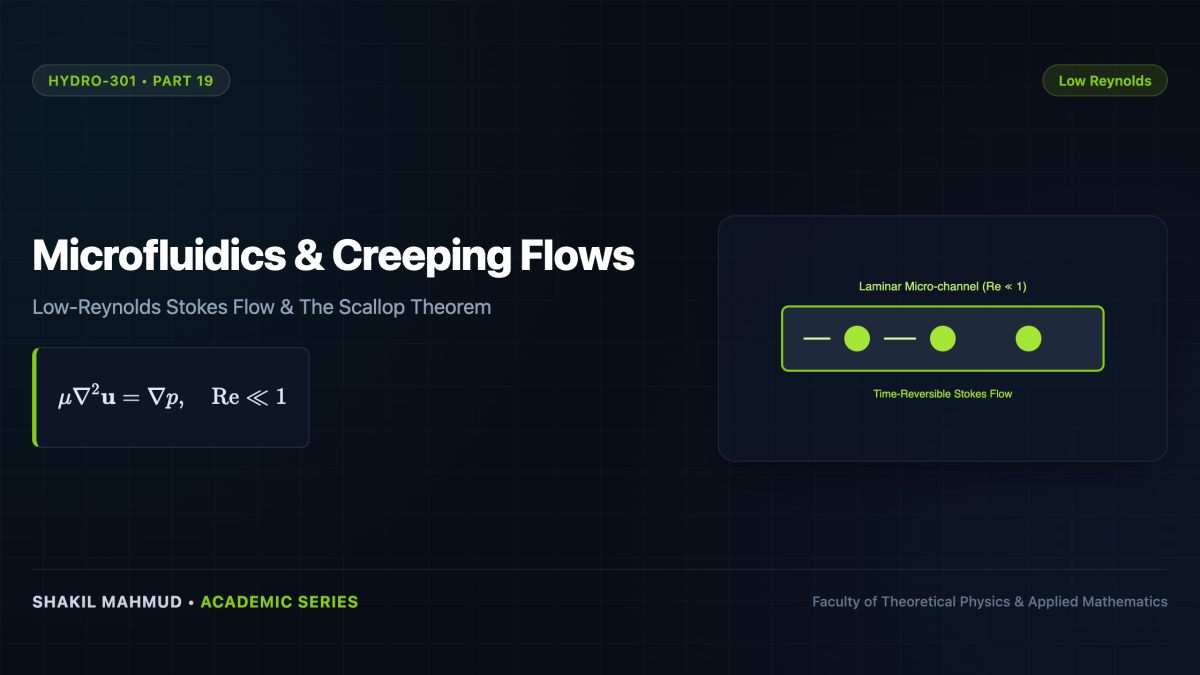
When fluid channels shrink to sub-millimeter scales ((1 ext{–}100 mu ext{m})), the physical hierarchy governing fluid dynamics undergoes an inversion. Inertial forces and turbulence vanish into irrelevance, while molecular viscosity, laminar diffusion, and surface tension seize absolute dominance—opening the frontier of microfluidics and lab-on-a-chip bioengineering.
1. The Creeping Flow Regime: Stokes Flow
At micro-scales, the Reynolds number plunges dramatically: (mathrm{Re} =
ho U L / mu sim 10^{-4} ext{–}10^{-1} ll 1). Neglecting the non-linear convective acceleration term ((mathbf{u} cdot
abla)mathbf{u} sim mathcal{O}(mathrm{Re})) reduces the Navier-Stokes equations to the linear, time-independent Stokes equations:
[
mu
abla^2 mathbf{u} =
abla p, quad
abla cdot mathbf{u} = 0
]
Taking the curl yields the biharmonic equation for the stream function: (
abla^4 psi = 0). Stokes flow possesses three profound mathematical properties:
- Instantaneity: Flow reacts instantaneously to boundary motion without temporal lag or inertial memory.
- Linearity: Solutions can be superposed linearly. Drag force scales strictly linearly with velocity ((F_{ ext{drag}} propto U)).
- Kinematic Time Reversibility: If boundary velocities are reversed in time ((mathbf{u}_{ ext{wall}}(t) o -mathbf{u}_{ ext{wall}}(t))), fluid streamlines retrace their exact historical trajectories backwards—beautifully demonstrated in Taylor-Couette dye dispersion un-mixing experiments.
2. Purcell’s Scallop Theorem and Micro-Swimmers
In his 1977 landmark paper Life at Low Reynolds Number, Edward Mills Purcell proved a fundamental evolutionary constraint facing microscopic organisms (bacteria, spermatozoa):
The Scallop Theorem: A microscopic swimmer in a Stokes flow that executes reciprocal motion (a motion that is identical under time reversal, such as a hinged scallop opening and closing its shell) achieves zero net forward displacement over a complete cycle:
[
oint dmathbf{x}_{ ext{cm}} = mathbf{0}
]
To achieve propulsion at (mathrm{Re} ll 1), biological swimmers must break kinematic time-reversal symmetry: E. coli bacteria spin helical flagellar bundles acting as Archimedean corkscrews, while eukaryotic cilia propagate non-reciprocal whip-like power and recovery strokes.
3. Surface Tension and Capillary Phenomena
At micro-scales, the surface-area-to-volume ratio scales as (1/L), elevating interfacial surface tension (gamma_s) into the dominant physical force. The pressure jump across a curved fluid-fluid interface is governed by the Young-Laplace Equation:
[
Delta p = gamma_s left( rac{1}{R_1} + rac{1}{R_2}
ight)
]
where (R_1, R_2) are the principal radii of curvature. The balance between surface tension and viscous forces is quantified by the dimensionless Capillary Number ((mathrm{Ca})):
[
mathrm{Ca} = rac{mu U}{gamma_s}
]
Capillary Action and Jurin’s Law
When a narrow cylindrical capillary tube of radius (r) is immersed in a liquid that wets the wall at contact angle ( heta_c), the curved meniscus creates a negative Laplace pressure that pulls liquid upward against gravity until reaching equilibrium height (h) (Jurin’s Law):
[
2pi r gamma_s cos heta_c =
ho g (pi r^2 h) implies h = rac{2gamma_s cos heta_c}{
ho g r}
]
4. Lab-on-a-Chip Architecture and Droplet Microfluidics
Microfluidics exploits laminar immobility to perform clinical biochemistry on microchips:
- Diffusion-Controlled Mixing: Because turbulence is impossible at (mathrm{Re} ll 1), two adjacent parallel streams do not mix convective-chaotically; mixing occurs exclusively by molecular diffusion, governed by the Péclet number ((mathrm{Pe} = U L / D_{ ext{diff}})).
- Droplet Generation: Flow-focusing cross-junctions inject water streams into immiscible oil, exploiting Rayleigh-Plateau interfacial instabilities to generate monodisperse picoliter droplet reactors at kilohertz frequencies, enabling single-cell genomic sequencing and digital PCR.