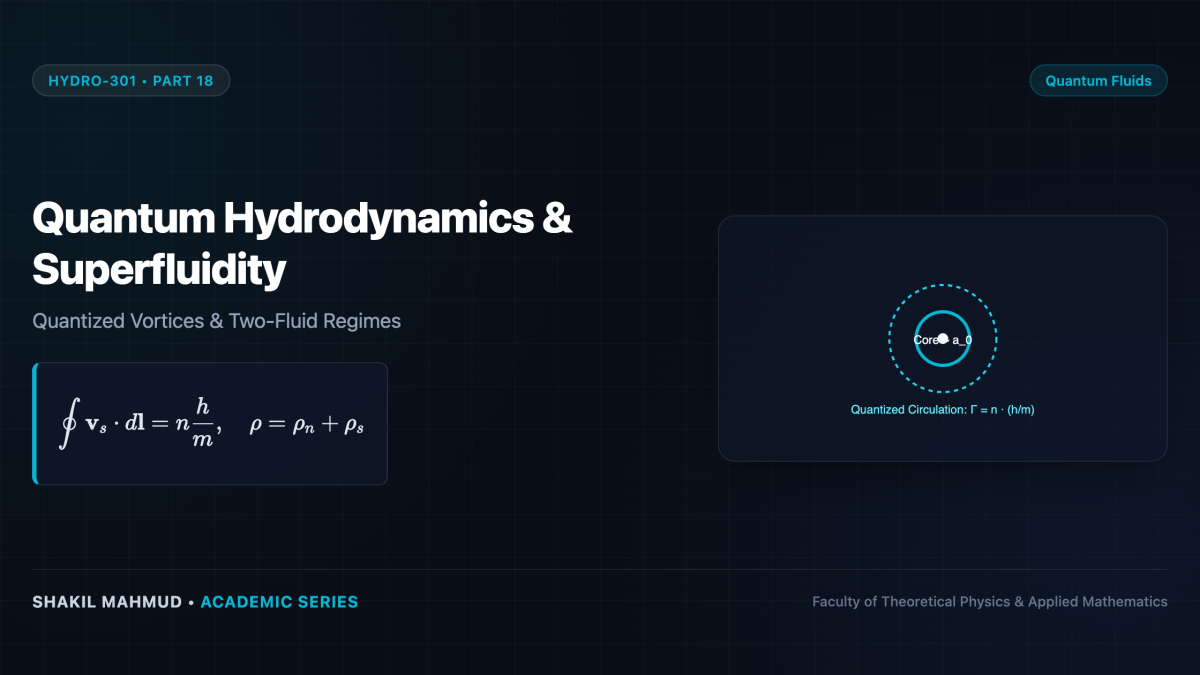
When liquid Helium-4 is cooled below its lambda transition temperature ((T_lambda = 2.17 ext{ K})), quantum mechanical phase coherence ceases to be confined to atomic dimensions. The fluid undergoes Bose-Einstein condensation into a macroscopic quantum fluid—a superfluid that flows through sub-nanometer capillaries with zero measurable viscosity, crawls up container walls in Rollin films, and supports quantized vortices.
1. Tisza and Landau’s Two-Fluid Model
To capture the dual quantum-classical nature of Helium II, László Tisza and Lev Landau formulated the phenomenological two-fluid hydrodynamics model. The total density (
ho) is partitioned into two interpenetrating fluid components:
[
ho =
ho_n +
ho_s
]
- Normal Fluid Component ((
ho_n)): Composed of thermal excitations (phonons and rotons). Possesses non-zero viscosity (mu_n) and carries the entire thermal entropy (S) of the liquid ((S_s quiv 0)). - Superfluid Component ((
ho_s)): The macroscopic ground-state Bose condensate. Possesses strictly zero viscosity ((mu_s quiv 0)), zero entropy, and exhibits irrotational flow.
As temperature drops toward absolute zero ((T o 0)), thermal excitations freeze out: (
ho_n o 0) and (
ho_s o
ho), transforming the entire liquid into a pure superfluid.
2. The Hydrodynamics of Zero Viscosity
The superfluid velocity field (mathbf{v}_s) is governed by the gradient of the macroscopic quantum wavefunction phase (Psi(mathbf{x}, t) = sqrt{
ho_s/m} e^{i heta(mathbf{x}, t)}):
[
mathbf{v}_s = rac{hbar}{m_4}
abla heta
]
Because the curl of any mathematical gradient is identically zero, the superfluid flow is fundamentally irrotational:
[
abla imes mathbf{v}_s quiv mathbf{0}
]
The momentum equation for the superfluid component is completely inviscid, driven purely by gradients of chemical potential (mu_{ ext{chem}}):
[
rac{partial mathbf{v}_s}{partial t} + (mathbf{v}_s cdot
abla)mathbf{v}_s = –
abla mu_{ ext{chem}} = -rac{1}{
ho}
abla p + S T
abla T
]
The Fountain Effect and Second Sound
Notice the term (S T
abla T): a temperature gradient acts as a direct mechanical pressure force driving superfluid toward warm regions! If two chambers connected by a porous superleak are heated, superfluid rushes into the warmer chamber, building enormous hydrostatic pressure that erupts as a continuous liquid fountain.
Furthermore, while classical fluids support only longitudinal pressure waves (first sound), superfluids support second sound: temperature-entropy waves where the normal and superfluid components oscillate out of phase ((
ho_n mathbf{v}_n +
ho_s mathbf{v}_s = mathbf{0})), propagating thermal signals at acoustic speeds without net mass transfer.
3. Quantized Vortices: The Onsager-Feynman Discovery
If superfluid flow is strictly irrotational ((
abla imes mathbf{v}_s = mathbf{0})), how can liquid helium rotate when spun in a bucket? In 1949, Lars Onsager and Richard Feynman resolved this paradox: the fluid creates line singularities where the condensate density drops to zero over the coherence length ((xi approx 0.1 ext{ nm})).
Because the macroscopic quantum wavefunction (Psi = |Psi| e^{i heta}) must remain single-valued upon traversing any closed loop encircling a vortex core, the phase change must equal an integer multiple of (2pi):
[
Delta heta = oint
abla heta cdot dmathbf{l} = 2pi n, quad n in mathbb{Z}
]
Substituting (mathbf{v}_s = rac{hbar}{m_4}
abla heta) yields the remarkable result: circulation in a superfluid is quantized in discrete packets:
[
Gamma = oint mathbf{v}_s cdot dmathbf{l} = n rac{h}{m_4} = n kappa_0
]
where (kappa_0 = h / m_4 approx 9.97 imes 10^{-8} ext{ m}^2/ ext{s}) is the quantum of circulation. When liquid helium rotates, it forms a triangular Abrikosov-like array of microscopic quantized vortex lines whose macroscopic density mimics rigid-body rotation: (n_v = 2Omega / kappa_0).
4. Quantum Turbulence
When quantized vortex lines become dense and interact, they undergo reconnections, producing a chaotic, tangled vortex knot termed quantum turbulence. At scales larger than the inter-vortex spacing (ll), the tangled vortex lines act collectively as classical eddies, reproducing Kolmogorov’s universal (E(k) propto k^{-5/3}) spectrum even in a fluid with zero molecular viscosity!