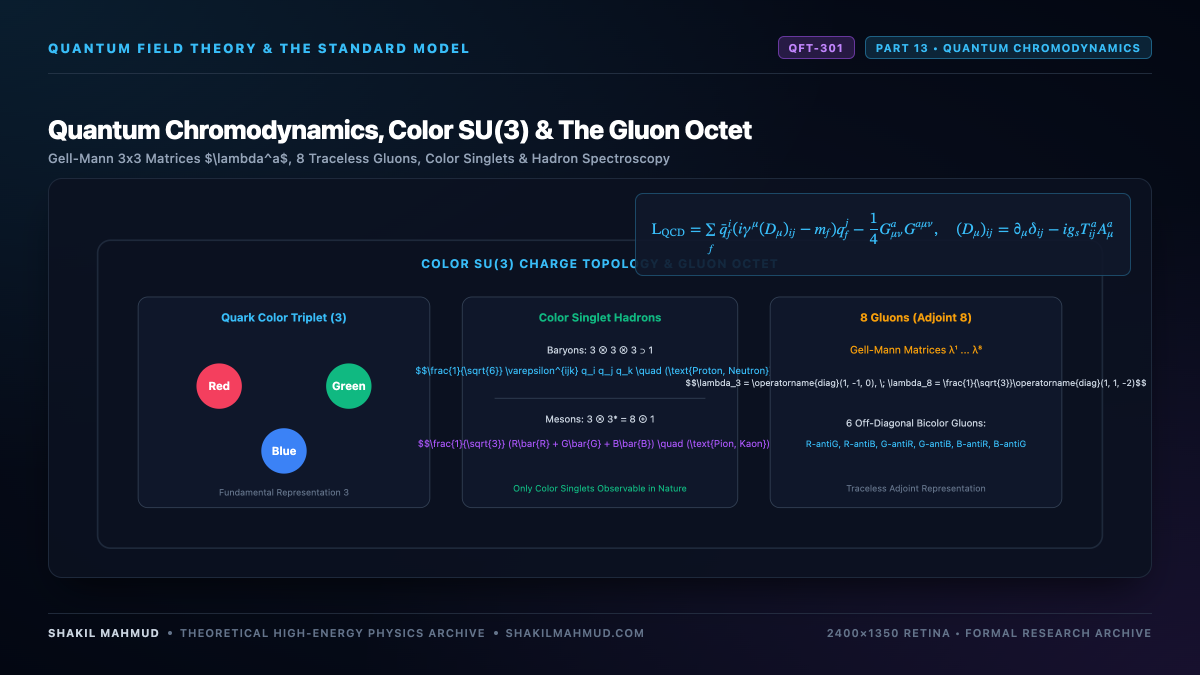
Inside every atomic nucleus in the universe, protons and neutrons are held together not by an elementary fundamental force, but by the powerful remnants of a deeper, subatomic interaction: The Strong Force. Governed by non-Abelian Yang-Mills gauge symmetry with group $SU(3)_C$, Quantum Chromodynamics (QCD) dictates that quarks carry a three-valued quantum charge termed “Color” (Red, Green, Blue), exchanging an octet of eight colored vector gluons. QCD is the ultimate architectural theory of nuclear matter.
1. The Quark Model and the Color Hypothesis
In 1964, Murray Gell-Mann and George Zweig introduced the constituent quark model to classify the explosion of newly discovered hadrons. However, the model encountered a severe theoretical contradiction with the discovery of the $Delta^{++}$ baryon, a spin-$3/2$ resonance composed of three identical up quarks ($uuu$) in a totally symmetric ground-state spatial and spin wavefunction ($psi_{text{space}} sim L=0$, $chi_{text{spin}} = |!uparrowuparrowuparrowrangle$). This flagrantly violated the Pauli exclusion principle, which strictly demands a totally antisymmetric wavefunction for fermions.
In 1965, Moo-Young Han, Yoichiro Nambu, and Oscar Greenberg resolved the paradox by proposing an entirely new internal degree of freedom: Color Charge. Each quark flavor comes in three colors ($c = 1, 2, 3$ or Red, Green, Blue):
[
q = begin{pmatrix} q_R \ q_G \ q_B end{pmatrix}
]
The total wavefunction is rendered totally antisymmetric by introducing the completely antisymmetric Levi-Civita color singlet tensor:
[
Psi_{text{baryon}} = frac{1}{sqrt{6}} varepsilon^{ijk} q_i q_j q_k quad (text{Antisymmetric in Color})
]
The Pauli exclusion principle was saved, and color was established as a fundamental gauge charge.
2. The QCD Lagrangian and Gell-Mann Matrices
Quantum Chromodynamics is an exact local $SU(3)$ gauge theory. The Lagrangian density is given by:
[
mathcal{L}_{text{QCD}} = sum_{f} bar{q}_f^i left( i gamma^mu (D_mu)_{ij} – m_f delta_{ij} right) q_f^j – frac{1}{4} G_{munu}^a G^{amunu}
]
where $f in {u, d, s, c, b, t}$ denotes the six quark flavors, $i, j in {1, 2, 3}$ are color indices, and $a in {1, 2, dots, 8}$ indexes the eight gauge bosons. The gauge covariant derivative is:
[
(D_mu)_{ij} = partial_mu delta_{ij} – i g_s T_{ij}^a A_mu^a
]
The eight generators $T^a = frac{1}{2} lambda^a$ are parameterized by the traceless, Hermitian $3 times 3$ Gell-Mann Matrices $lambda^a$, satisfying $[T^a, T^b] = i f^{abc} T^c$, where $f^{abc}$ are the completely antisymmetric $SU(3)$ structure constants.
3. The Gluon Octet
Under $SU(3)$, the gauge fields transform in the adjoint representation of dimension $dim(SU(3)) = 3^2 – 1 = 8$. Unlike the single electrically neutral photon of QED, there are precisely Eight Gluons carrying color-anticolor combinations:
- Six off-diagonal gluons carrying net color charge: $Rbar{G}, Gbar{R}, Rbar{B}, Bbar{R}, Gbar{B}, Bbar{G}$.
- Two diagonal, color-neutral but color-active combinations corresponding to $lambda_3$ and $lambda_8$:
[
frac{1}{sqrt{2}}(Rbar{R} – Gbar{G}), quad frac{1}{sqrt{6}}(Rbar{R} + Gbar{G} – 2Bbar{B})
]
The completely symmetric color-singlet combination $frac{1}{sqrt{3}}(Rbar{R} + Gbar{G} + Bbar{B})$ is an uncoupled singlet that does not interact via $SU(3)$, leaving strictly 8 physical gluons.
4. The Gluon Field Strength Tensor and Self-Interaction Vertices
The non-Abelian gluon field strength tensor is:
[
G_{munu}^a = partial_mu A_nu^a – partial_nu A_mu^a + g_s f^{abc} A_mu^b A_nu^c
]
Squaring this tensor generates the triple-gluon vertex ($sim g_s$) and the quartic gluon vertex ($sim g_s^2$). Because gluons carry color, they do not merely mediate forces between quarks; gluons emit, absorb, and scatter off other gluons. This self-coupling is the fundamental origin of both Asymptotic Freedom and Color Confinement.