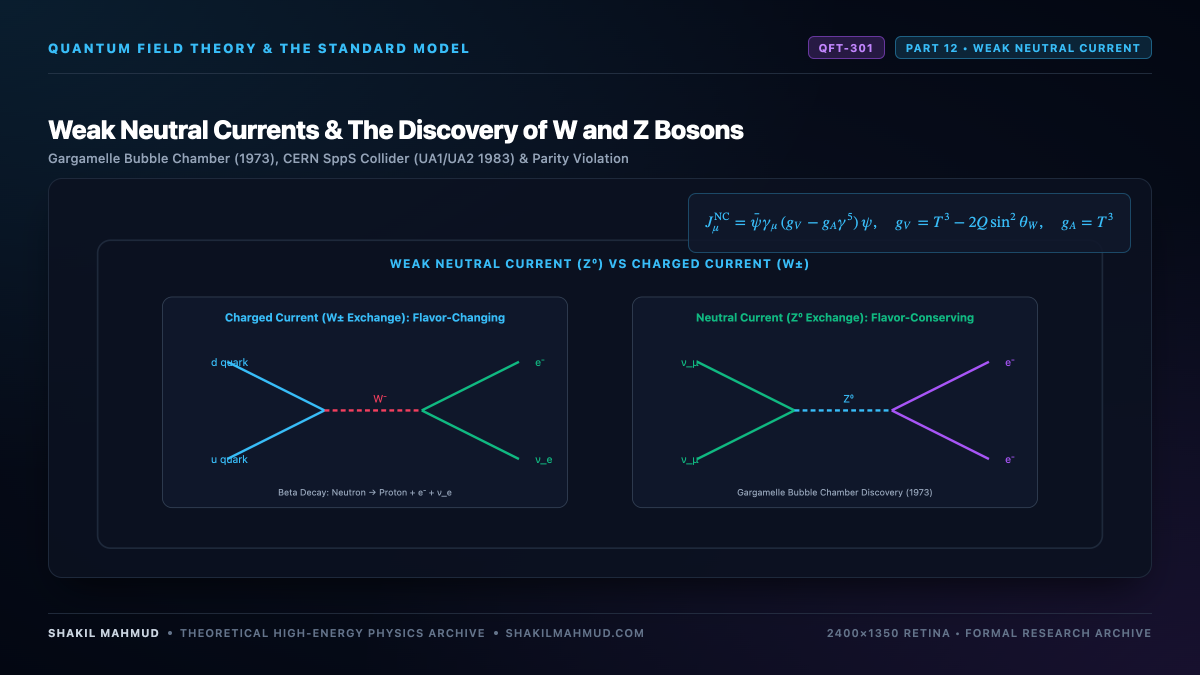
Prior to the late 1960s, every observed weak radioactive decay—such as neutron beta decay ($n to p + e^- + bar{nu}_e$) or muon decay—involved an exchange of electric charge mediated by charged currents ($W^pm$). The electroweak model daringly predicted a completely unknown physical interaction: the Weak Neutral Current mediated by a massive, electrically neutral vector boson ($Z^0$). In 1973, the Gargamelle bubble chamber at CERN detected the first neutrino scattering event without charge exchange, leading directly to the direct discovery of the $W$ and $Z$ bosons in 1983 and cementing the Standard Model.
1. The Structure of Weak Currents
In the electroweak Lagrangian, the coupling of fermions to the gauge bosons is written as:
[
mathcal{L}_{text{int}} = -frac{g}{sqrt{2}} left( J_mu^+ W^{+mu} + J_mu^- W^{-mu} right) – frac{g}{costheta_W} J_mu^{text{NC}} Z^mu – e J_mu^{text{EM}} A^mu
]
The Charged Current (CC) couples exclusively to left-handed chiral fields via the iconic $V – A$ (Vector minus Axial-Vector) Lorentz structure:
[
J_mu^+ = bar{nu}_L gamma_mu e_L + bar{u}_L gamma_mu d_L = frac{1}{2} bar{nu} gamma_mu (1 – gamma^5) e + frac{1}{2} bar{u} gamma_mu (1 – gamma^5) d
]
This explains why the weak interaction maximally violates parity ($P$) and charge conjugation ($C$), as proven by Chien-Shiung Wu in 1957.
2. The Neutral Current (NC) and Chiral Couplings
The Weak Neutral Current couples to both left-handed and right-handed fermions, but with asymmetric coupling strengths parameterized by vector and axial-vector couplings $g_V$ and $g_A$:
[
J_mu^{text{NC}} = sum_f bar{psi}_f gamma_mu left( g_V^f – g_A^f gamma^5 right) psi_f
]
where the coupling coefficients are determined by the weak isospin $T_3^f$ and electric charge $Q_f$:
[
g_V^f = frac{1}{2} T_3^f – Q_f sin^2theta_W, quad g_A^f = frac{1}{2} T_3^f
]
For the electron ($T_3 = -1/2, Q = -1$): $g_V^e = -frac{1}{4} + sin^2theta_W approx -0.027$ and $g_A^e = -1/4$. For the neutrino ($T_3 = +1/2, Q = 0$): $g_V^nu = g_A^nu = +1/4$.
3. The Gargamelle Experiment (1973)
In 1973, physicists firing high-energy muon neutrinos from CERN’s Proton Synchrotron into the Gargamelle heavy-liquid bubble chamber (filled with 12,000 liters of freon $text{CF}_3text{Br}$) discovered two historical events:
- Hadronic Neutral Current: $nu_mu + N to nu_mu + text{hadrons}$ (isolated hadronic showers without any outgoing muon).
- Leptonic Neutral Current: A single pure leptonic elastic scattering event $bar{nu}_mu + e^- to bar{nu}_mu + e^-$, where an electron recoiled forward in freon without any other tracks.
These events proved that neutrinos can interact via momentum exchange without changing their flavor or charge, providing the experimental validation that propelled Salam, Glashow, and Weinberg to the 1979 Nobel Prize.
4. The Discovery of $W^pm$ and $Z^0$ at the CERN SppS Collider (1983)
To produce the physical $W$ and $Z$ bosons directly, Carlo Rubbia transformed the CERN Super Proton Synchrotron (SPS) into a proton-antiproton collider ($Stext{p}bar{text{p}}S$) operating at center-of-mass energy $sqrt{s} = 540 text{ GeV}$, utilizing Simon van der Meer’s stochastic beam cooling technique.
In early 1983, the UA1 and UA2 detector collaborations observed:
- The $W^pm$ Boson: Signaled by high transverse momentum electrons accompanied by large missing transverse energy from the undetected neutrino: $pbar{p} to W^pm + X to e^pm nu + X$, measuring $M_W approx 81 text{ GeV}$.
- The $Z^0$ Boson: Signaled by clean, back-to-back electron-positron or muon-antimuon pairs: $pbar{p} to Z^0 + X to e^+ e^- + X$, measuring $M_Z approx 91 text{ GeV}$.
Rubbia and van der Meer were awarded the Nobel Prize in 1984 with unprecedented speed. The standard electroweak model had achieved experimental confirmation.