How can electromagnetism—an infinite-range force carried by the massless photon—be unified with the weak nuclear force, a subatomic interaction confined to distances smaller than an atomic nucleus? In 1967, Sheldon Glashow, Steven Weinberg, and Abdus Salam demonstrated that electromagnetism and the weak force are two low-energy manifestations of a single, unified gauge group: $SU(2)_L times U(1)_Y$. Broken spontaneously by the Higgs vacuum expectation value, this symmetry separates into the massless electromagnetic $U(1)_{text{EM}}$ and three massive vector bosons.
1. The Electroweak Gauge Group and Chiral Representations
The electroweak theory is governed by the gauge group $G_{text{EW}} = SU(2)_L times U(1)_Y$, where $SU(2)_L$ acts exclusively on left-handed fermions with weak isospin $T$, and $U(1)_Y$ represents weak hypercharge $Y$. Left-handed and right-handed chiral fermions inhabit radically different representations:
- Left-Handed Leptons (Doublets under $SU(2)_L$, $T=1/2$):
[
L_L = begin{pmatrix} nu_e \ e^- end{pmatrix}_L, quad Y = -1
] - Right-Handed Leptons (Singlets under $SU(2)_L$, $T=0$):
[
e_R^-, quad Y = -2 quad (text{No right-handed neutrino in the minimal SM})
] - Left-Handed Quarks (Doublets, $T=1/2$):
[
Q_L = begin{pmatrix} u \ d end{pmatrix}_L, quad Y = +frac{1}{3}
] - Right-Handed Quarks (Singlets, $T=0$):
[
u_R ; (Y = +4/3), quad d_R ; (Y = -2/3)
]
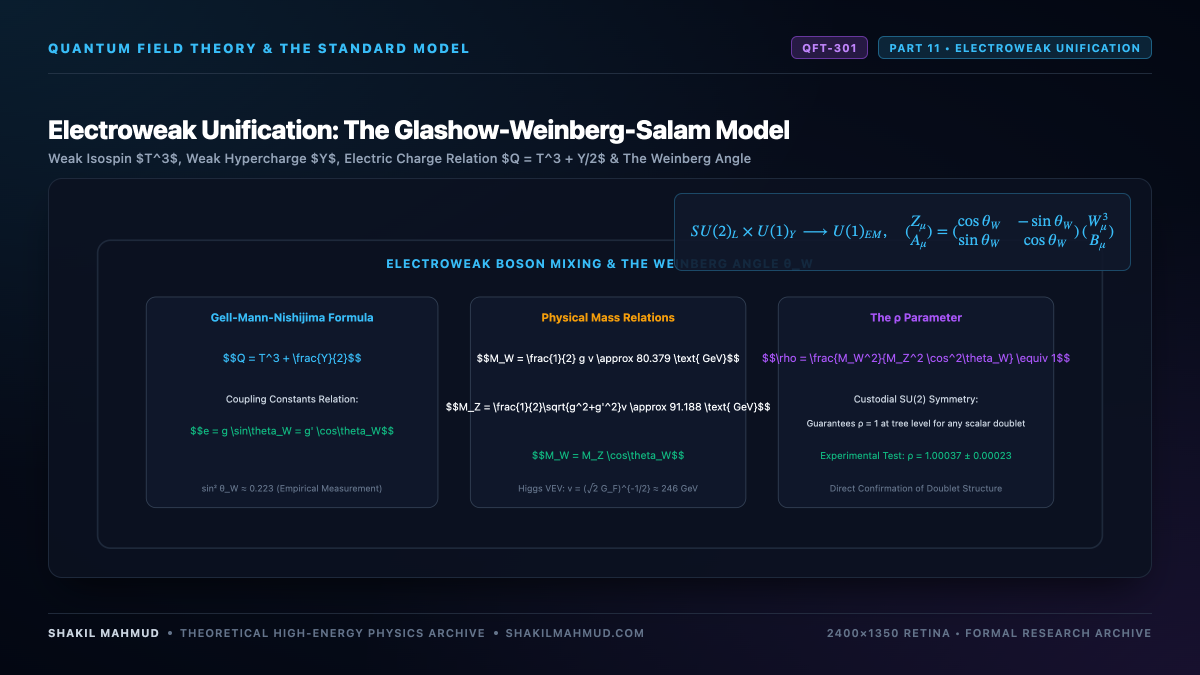
The Gell-Mann-Nishijima formula strictly relates the physical electric charge $Q$ to the third component of weak isospin $T^3$ and hypercharge $Y$:
[
Q = T^3 + frac{Y}{2}
]
2. Spontaneous Symmetry Breaking by the Higgs Doublet
The Higgs field is an $SU(2)_L$ doublet with hypercharge $Y = +1$:
[
Phi = begin{pmatrix} phi^+ \ phi^0 end{pmatrix} = frac{1}{sqrt{2}} begin{pmatrix} phi_1 + iphi_2 \ phi_3 + iphi_4 end{pmatrix}
]
Spontaneous breakdown occurs when $phi^0$ acquires a non-zero vacuum expectation value (VEV) $v$:
[
langle 0 | Phi | 0 rangle = frac{1}{sqrt{2}} begin{pmatrix} 0 \ v end{pmatrix}, quad v approx 246 text{ GeV}
]
Evaluating the generator action on the vacuum reveals that three of the four generators are broken ($T^1, T^2,$ and $T^3 – Y/2$), while the electric charge combination $Q = T^3 + Y/2$ leaves the vacuum invariant:
[
Q langle Phi rangle = left( begin{pmatrix} 1/2 & 0 \ 0 & -1/2 end{pmatrix} + frac{1}{2} begin{pmatrix} 1 & 0 \ 0 & 1 end{pmatrix} right) begin{pmatrix} 0 \ v end{pmatrix} = begin{pmatrix} 1 & 0 \ 0 & 0 end{pmatrix} begin{pmatrix} 0 \ v end{pmatrix} = begin{pmatrix} 0 \ 0 end{pmatrix}
]
Thus, $SU(2)_L times U(1)_Y longrightarrow U(1)_{text{EM}}$: electromagnetism remains strictly unbroken, guaranteeing that the photon is massless.
3. Boson Mixing and the Weinberg Angle $theta_W$
The kinetic term $|D_mu Phi|^2$ couples the vacuum to the three $SU(2)_L$ gauge bosons $W_mu^a$ (coupling $g$) and the $U(1)_Y$ boson $B_mu$ (coupling $g’$):
[
D_mu Phi = left( partial_mu – i g W_mu^a frac{sigma^a}{2} – i frac{g’}{2} B_mu right) Phi
]
Evaluating at the vacuum produces mass terms for the charged bosons:
[
W_mu^pm = frac{1}{sqrt{2}} (W_mu^1 mp i W_mu^2) implies M_W = frac{1}{2} g v approx 80.38 text{ GeV}
]
The neutral bosons $W_mu^3$ and $B_mu$ mix via an orthogonal rotation matrix defined by the Weak Mixing Angle (Weinberg Angle) $theta_W$:
[
begin{pmatrix} Z_mu \ A_mu end{pmatrix} = begin{pmatrix} costheta_W & -sintheta_W \ sintheta_W & costheta_W end{pmatrix} begin{pmatrix} W_mu^3 \ B_mu end{pmatrix}
]
where the mixing angle is defined by $costheta_W equiv frac{g}{sqrt{g^2 + g’^2}}$ and $sintheta_W equiv frac{g’}{sqrt{g^2 + g’^2}}$. The diagonalized physical masses are:
[
M_A = 0 quad (text{Massless Photon } gamma), quad M_Z = frac{1}{2} sqrt{g^2 + g’^2} , v = frac{M_W}{costheta_W} approx 91.19 text{ GeV}
]
The elementary electric charge is unified with the gauge couplings: $e = g sintheta_W = g’ costheta_W$.
4. Precision Tests: The $rho$ Parameter
The tree-level ratio of weak boson masses defines the $rho$ parameter:
[
rho equiv frac{M_W^2}{M_Z^2 cos^2theta_W} equiv 1
]
The identity $rho = 1$ is a profound consequence of the Custodial $SU(2)$ Symmetry of the scalar potential for an $SU(2)$ doublet. High-precision measurements at LEP and the Tevatron confirmed $rho = 1.00037 pm 0.00023$, establishing the Glashow-Weinberg-Salam model as an indisputable pillar of fundamental physics.