Why does the strong force behave completely upside down compared to gravity and electromagnetism? While gravity and electricity weaken with distance ($1/r^2$), the strong nuclear force does the exact opposite: at extremely short distances or ultra-high energies, quarks interact so weakly that they behave as entirely free, unconfined particles; yet as they are pulled apart, the force between them does not decrease, but remains constant, locking them in permanent imprisonment. This dual triumph earned David Gross, Frank Wilczek, and David Politzer the 2004 Nobel Prize: Asymptotic Freedom and Color Confinement.
1. The 1-Loop QCD Beta Function
To compute how the strong coupling constant $g_s$ evolves with energy scale $mu$, we evaluate the 1-loop vertex and self-energy corrections in non-Abelian $SU(N)$ gauge theory with $n_f$ fermion flavors. Two competing physical effects enter:
- Quark Loop Screening: Virtual quark-antiquark pairs polarize the vacuum, screening color charge just as in QED. This contributes a positive term: $+frac{2}{3} n_f T_F = +frac{2}{3} n_f left(frac{1}{2}right) = +frac{1}{3} n_f$.
- Gluon Loop Anti-Screening: Virtual non-Abelian gluon self-interactions carry color charge themselves. Because gluons possess spin 1, their vacuum polarization creates an paramagnetic color medium that concentrates color flux toward the source, causing anti-screening. This contributes a dominant negative term: $-frac{11}{3} C_A = -frac{11}{3} (3) = -11$.
Combining both contributions yields the historic 1-loop Callan-Symanzik beta function:
[
beta(g_s) equiv mu frac{partial g_s}{partial mu} = -frac{g_s^3}{16pi^2} left( frac{11}{3} C_A – frac{4}{3} n_f T_F right) = -frac{g_s^3}{16pi^2} left( 11 – frac{2}{3} n_f right)
]
2. Asymptotic Freedom: $beta < 0$
In our universe, there are 6 quark flavors ($n_f = 6$):
[
11 – frac{2}{3}(6) = 11 – 4 = +7 > 0 implies beta(g_s) < 0
]
Because the coefficient is strictly positive, the beta function is strictly negative! Integrating the renormalization group flow from reference scale $mu_0$ to scale $Q$ yields:
[
alpha_s(Q^2) = frac{alpha_s(mu_0^2)}{1 + frac{alpha_s(mu_0^2)}{12pi} (33 – 2n_f) lnleft( frac{Q^2}{mu_0^2} right)} = frac{12pi}{(33 – 2n_f) lnleft( frac{Q^2}{Lambda_{text{QCD}}^2} right)}
]
As the momentum scale $Q^2 to infty$ (corresponding to distances $r to 0$), the strong coupling constant decreases logarithmically to zero:
[
lim_{Q^2 to infty} alpha_s(Q^2) = 0 quad (textbf{Asymptotic Freedom})
]
Inside a proton probed by deep inelastic electron scattering (SLAC, 1968), quarks behave as free, non-interacting Dirac fermions—Richard Feynman’s “Partons.”
3. Color Confinement and The QCD Flux Tube
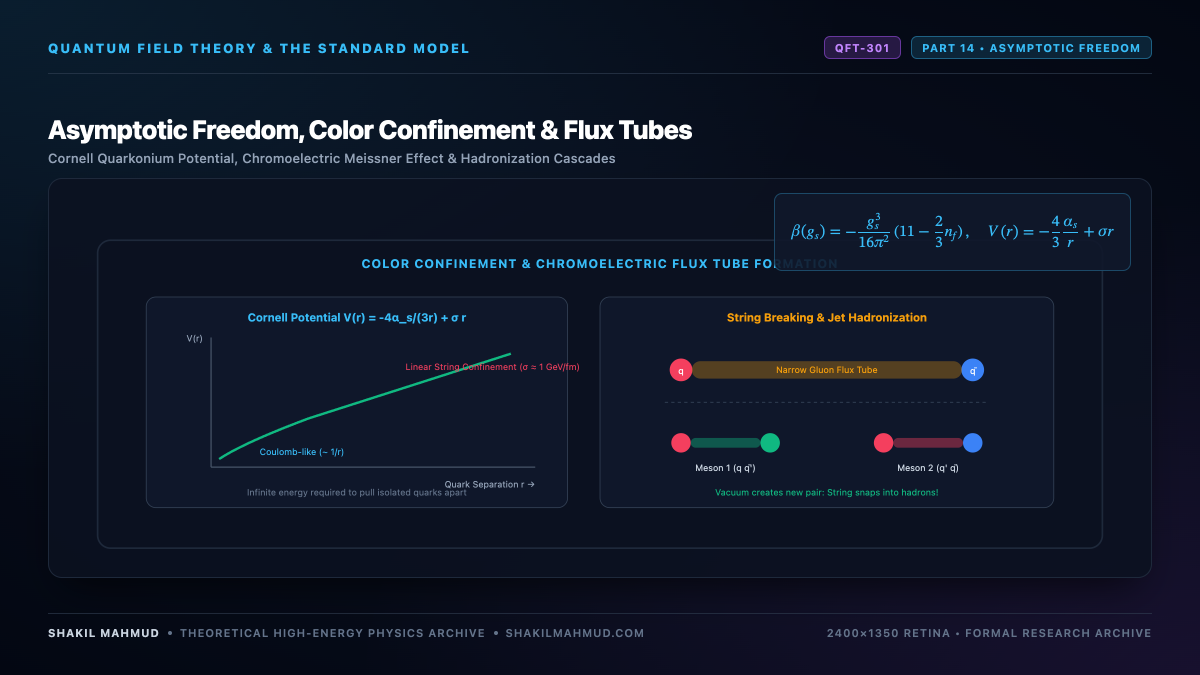
Conversely, as quarks are separated ($r to infty$, $Q^2 to Lambda_{text{QCD}}^2 approx (200 text{ MeV})^2$), the coupling $alpha_s$ grows explosively, rendering perturbation theory invalid. In this non-perturbative infrared regime, the non-Abelian gluon self-interaction repels color magnetic fields, squeezing the chromoelectric field lines into a narrow, one-dimensional cylindrical vortex: a Flux Tube (String).
The interquark potential is described by the Cornell Potential:
[
V(r) = -frac{4}{3} frac{alpha_s}{r} + sigma r
]
where the string tension $sigma approx 1 text{ GeV/fm} approx 14 text{ tons of force}$. As quarks are separated, the energy stored in the flux tube increases linearly: $E(r) = sigma r$.
4. String Breaking and Hadronization
What happens if you try to isolate a single quark by pulling it out of a meson? As the distance reaches $r approx 1 text{ fm}$, the energy stored in the stretched chromoelectric flux tube exceeds $2 m_q c^2$. It becomes energetically favorable for the flux tube to snap, spontaneously creating a new quark-antiquark pair ($qbar{q}$) out of the quantum vacuum:
[
[q dots bar{q}] longrightarrow [q bar{q}’] + [q’ bar{q}]
]
Instead of an isolated free quark, one simply ends up with two newly minted color-singlet mesons! Quarks are perpetually confined inside color-neutral hadrons (baryons and mesons). You can never observe a free quark in isolation, a foundational truth validated across five decades of high-energy physics.