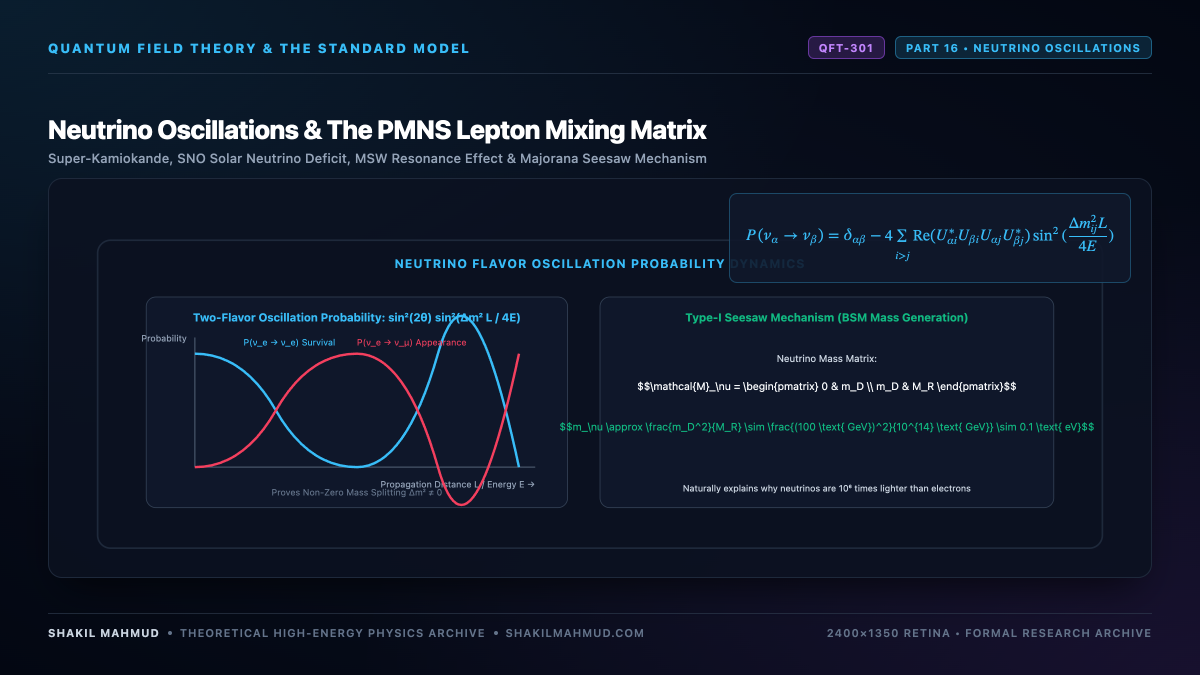
In the minimal 1970s formulation of the Standard Model, neutrinos were assumed to be strictly massless, purely left-handed ghostlike particles moving at the speed of light. However, experiments measuring solar and atmospheric neutrinos observed a baffling deficit of detected particles. In 1998 at Super-Kamiokande and in 2001 at the Sudbury Neutrino Observatory (SNO), physicists proved that neutrinos spontaneously change their flavor identity in flight: an electron neutrino born in the core of the Sun transforms into a muon or tau neutrino before reaching Earth. This phenomenon of Neutrino Oscillations provides the first undeniable experimental proof of physics Beyond the Standard Model.
1. Flavor States vs. Mass Eigenstates
Neutrino oscillation is a quantum mechanical interference phenomenon arising because the neutrino weak flavor eigenstates ($|nu_alpharangle$ with $alpha in {e, mu, tau}$) produced in charged-current weak decays are not states of definite mass. Instead, they are coherent linear superpositions of three distinct mass eigenstates ($|nu_irangle$ with $i in {1, 2, 3}$ having physical masses $m_1, m_2, m_3$):
[
|nu_alpharangle = sum_{i=1}^3 U_{alpha i}^* |nu_irangle
]
where $U$ is the unitary $3 times 3$ Pontecorvo-Maki-Nakagawa-Sakata (PMNS) Matrix:
[
U_{text{PMNS}} = begin{pmatrix} U_{e1} & U_{e2} & U_{e3} \ U_{mu 1} & U_{mu 2} & U_{mu 3} \ U_{tau 1} & U_{tau 2} & U_{tau 3} end{pmatrix}
]
2. Derivation of the Oscillation Probability Formula
Consider a flavor eigenstate $|nu_alpharangle$ produced at $t = 0$. In the ultra-relativistic limit where $p gg m_i$, each mass component propagates with energy $E_i = sqrt{p^2 + m_i^2} approx p + frac{m_i^2}{2E}$. After traveling distance $L approx t$, the state evolves into:
[
|nu(t)rangle = sum_i U_{alpha i}^* e^{-i E_i t} |nu_irangle
]
The transition amplitude to detect flavor $|nu_betarangle$ at distance $L$ is $mathcal{A}(nu_alpha to nu_beta) = langle nu_beta | nu(t) rangle = sum_i U_{alpha i}^* U_{beta i} e^{-i m_i^2 L / (2E)}$. Squaring the amplitude yields the master Oscillation Probability:
[
P(nu_alpha to nu_beta) = |mathcal{A}|^2 = delta_{alphabeta} – 4 sum_{i > j} operatorname{Re}left( U_{alpha i}^* U_{beta i} U_{alpha j} U_{beta j}^* right) sin^2left( frac{Delta m_{ij}^2 L}{4E} right) + 2 sum_{i > j} operatorname{Im}left( U_{alpha i}^* U_{beta i} U_{alpha j} U_{beta j}^* right) sinleft( frac{Delta m_{ij}^2 L}{2E} right)
]
where $Delta m_{ij}^2 equiv m_i^2 – m_j^2$ is the mass-squared splitting. In practical laboratory units:
[
frac{Delta m^2 L}{4E} approx 1.27 left( frac{Delta m^2}{text{eV}^2} right) left( frac{L}{text{km}} right) left( frac{text{GeV}}{E} right)
]
If neutrinos were massless ($m_i = 0$), all $Delta m_{ij}^2 equiv 0$, and the oscillation probability would vanish identically ($P(nu_alpha to nu_beta) = delta_{alphabeta}$). The experimental detection of flavor oscillations proves conclusively that neutrinos have non-zero rest masses.
3. Experimental Validation: Solar & Atmospheric Anomalies
Two distinct mass splittings govern neutrino mixing:
- Atmospheric Neutrinos (Super-Kamiokande, 1998): Takaaki Kajita observed a deficit of upward-going $nu_mu$ produced by cosmic rays on the opposite side of Earth, establishing $nu_mu to nu_tau$ oscillations with $Delta m_{text{atm}}^2 approx 2.5 times 10^{-3} text{ eV}^2$ and near-maximal mixing $theta_{23} approx 45^circ$.
- Solar Neutrinos (SNO, 2001): Arthur McDonald used heavy water ($D_2O$) to measure both the charged-current rate ($nu_e + d to p + p + e^-$) and the neutral-current rate ($nu_x + d to p + n + nu_x$). SNO proved that the total flux of all neutrinos matched solar fusion models perfectly, while $nu_e$ constituted only one-third of the flux, confirming $nu_e to nu_{mu,tau}$ conversion driven by the Mikheyev-Smirnov-Wolfenstein (MSW) matter resonance effect with $Delta m_{text{sol}}^2 approx 7.5 times 10^{-5} text{ eV}^2$.
4. The Seesaw Mechanism: Majorana Neutrinos and BSM Mass
Why are neutrinos at least a million times lighter than the electron ($m_nu < 0.1 text{ eV}$ vs. $m_e approx 511,000 text{ eV}$)? If neutrinos are Majorana fermions (particles identical to their own antiparticles), their mass can arise through the Type-I Seesaw Mechanism.
Introducing ultra-heavy right-handed singlet neutrinos $N_R$ with Majorana mass $M_R sim 10^{14} text{ GeV}$ near the Grand Unification scale, the mass matrix takes the form:
[
mathcal{M}_nu = begin{pmatrix} 0 & m_D \ m_D & M_R end{pmatrix} implies m_nu approx frac{m_D^2}{M_R}
]
Taking typical electroweak Dirac masses $m_D sim v sim 100 text{ GeV}$ naturally generates sub-eV light neutrino masses: $m_nu approx frac{(100 text{ GeV})^2}{10^{14} text{ GeV}} approx 0.1 text{ eV}$. Neutrino mass is our first direct experimental window into Grand Unification physics.