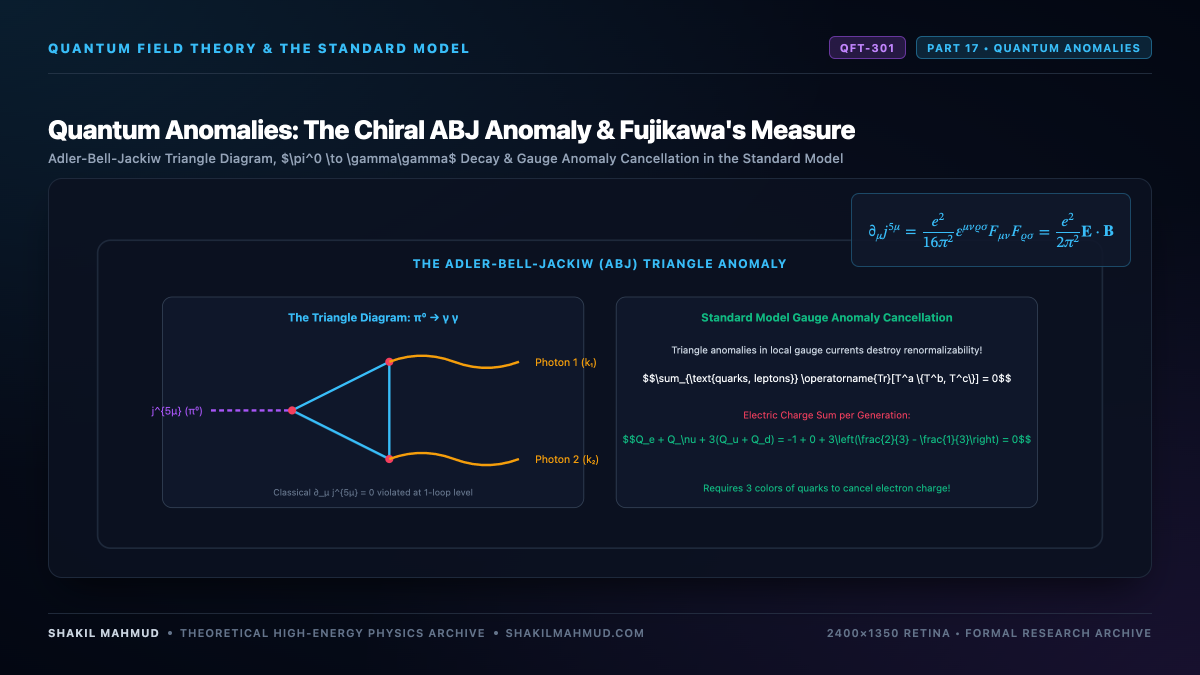
In classical field theory, Noether’s first theorem establishes an ironclad correspondence: every continuous symmetry of the classical action guarantees the existence of an exactly conserved physical current ($partial_mu j^mu = 0$). But in quantum field theory, this classical theorem can fail spectacularly. When a classical symmetry is irrecoverably broken by quantum radiative loop corrections, the theory suffers an Anomaly. While global anomalies explain profound physical phenomena such as the decay of the neutral pion ($pi^0 to gammagamma$), local gauge anomalies are fatal to a quantum theory unless they cancel with miraculous mathematical precision—a requirement that explains why quarks and leptons must coexist in equal numbers in the Standard Model.
1. The Chiral ABJ Triangle Anomaly
Consider massless Dirac fermions coupled to an electromagnetic vector potential $A_mu$. The classical Lagrangian possesses two independent global symmetries:
[
psi to e^{ialpha} psi quad (text{Vector } U(1)_V), quad psi to e^{ibeta gamma^5} psi quad (text{Axial-Vector } U(1)_A)
]
Noether’s theorem guarantees classical conservation of both the vector current $j^mu = bar{psi}gamma^mupsi$ and the axial-vector current $j^{5mu} = bar{psi}gamma^mugamma^5psi$. However, when Stephen Adler, John Bell, and Roman Jackiw computed the 1-loop Triangle Diagram in 1969, they discovered that regularizing the loop integral makes it mathematically impossible to preserve both currents simultaneously.
Enforcing vector current conservation ($partial_mu j^mu = 0$) to protect electromagnetic gauge invariance inevitably breaks axial-vector current conservation, yielding the exact ABJ Anomaly Equation:
[
partial_mu j^{5mu} = frac{e^2}{16pi^2} varepsilon^{munurhosigma} F_{munu} F_{rhosigma} = frac{e^2}{2pi^2} mathbf{E} cdot mathbf{B}
]
Axial charge is not conserved: applying parallel electric and magnetic fields ($mathbf{E} cdot mathbf{B} ne 0$) creates net chiral fermion charge directly out of the vacuum!
2. Fujikawa’s Path Integral Formulation: The Quantum Measure
In 1979, Kazuo Fujikawa provided the ultimate non-perturbative explanation of anomalies. In the path integral formulation:
[
Z = int mathcal{D}psi , mathcal{D}bar{psi} , e^{i S[psi, bar{psi}]}
]
While the classical action $S$ is invariant under chiral transformations $psi to e^{ibeta(x)gamma^5}psi$, the infinite-dimensional functional measure $mathcal{D}psi mathcal{D}bar{psi}$ is not invariant! Under the change of integration variables, the measure transforms with a non-trivial functional Jacobian $J$:
[
mathcal{D}psi mathcal{D}bar{psi} longrightarrow mathcal{D}psi mathcal{D}bar{psi} cdot mathcal{J}[beta], quad ln mathcal{J} = -2i int d^4x , beta(x) operatorname{Tr}(gamma^5)
]
Regulating the trace using a gauge-invariant heat-kernel regulator $e^{-(D^2)/Lambda^2}$ yields precisely the topological Pontryagin density, proving that anomalies originate in the geometric topology of quantum infinite-dimensional Hilbert space.
3. Resolution of the $pi^0 to gammagamma$ Lifetime Paradox
In the 1960s, naive soft-pion current algebra predicted that the neutral pion decay rate into two photons ($pi^0 to 2gamma$) should be virtually zero, in catastrophic disagreement with the measured lifetime $tau approx 8.4 times 10^{-17} text{ s}$. The ABJ anomaly resolves this paradox completely.
Because the $pi^0$ is the pseudo-Goldstone boson of broken axial isospin, the anomaly directly couples the pion field to two electromagnetic photons:
[
mathcal{L}_{pigammagamma} = frac{alpha N_c}{12pi f_pi} pi^0 varepsilon^{munurhosigma} F_{munu} F_{rhosigma}
]
Evaluating the decay width yields $Gamma(pi^0 to gammagamma) = left(frac{N_c}{3}right)^2 frac{alpha^2 m_pi^3}{64pi^3 f_pi^2} approx 7.73 text{ eV}$, matching experiment to 1% precision if and only if the number of quark colors is $N_c = 3$. The pion decay rate was historical experimental proof of quark colors.
4. The Miracle of Gauge Anomaly Cancellation
While global anomalies represent physical processes, an anomaly in a local gauge symmetry destroys the Ward identities, generating longitudinal unphysical states, breaking renormalizability, and rendering the theory mathematically inconsistent. In the electroweak theory, triangle diagrams with three gauge currents ($mathcal{A}^{abc} propto operatorname{Tr}[T^a {T^b, T^c}]$) must cancel completely when summing over all chiral fermions in a generation:
[
sum_{text{fermions}} Y_f^3 = 0, quad sum_{text{fermions}} T_{3f}^2 Y_f = 0
]
Evaluating the charge sum for a single generation:
[
sum Q_f = Q_e + Q_{nu} + N_c (Q_u + Q_d) = -1 + 0 + 3 left( +frac{2}{3} – frac{1}{3} right) = -1 + 1 equiv 0
]
The Grand Cancellation Miracle: The lepton anomaly is canceled by the quark anomaly if and only if quarks come in exactly three colors ($N_c = 3$) and quarks have fractional charges of $+2/3$ and $-1/3$ matching the integer charge of the electron! Quarks and leptons are not arbitrary, separate building blocks; they are mathematically bound together by the anomaly cancellation of the Standard Model.