In the middle decades of the nineteenth century, biological science possessed an exquisite theory of organismal change without possessing the slightest comprehension of its governing engine. Charles Darwin had published On the Origin of Species in 1859, proposing that the magnificent diversity of living forms arose through natural selection acting upon continuous phenotypic variations. Yet Darwin’s monumental synthesis was haunted by a lethal conceptual flaw: the prevailing nineteenth-century orthodoxy of blending inheritance. Under the blending hypothesis, the hereditary material was envisioned as continuous fluids—like drops of black and white paint—that mixed irreversibly within the offspring. If a novel, advantageous hereditary variation appeared in an individual, sexual reproduction with normal individuals would dilute it by half in each successive generation, causing favorable adaptations to vanish into the statistical mean long before natural selection could preserve them.
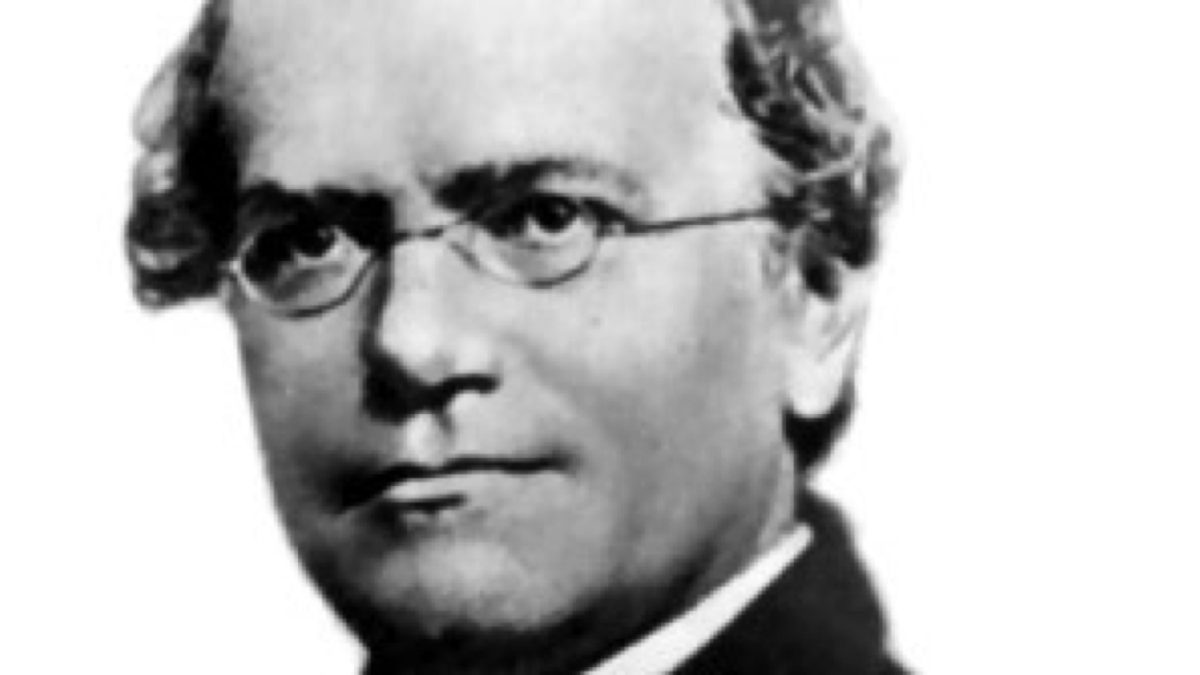
The mathematical resolution of this paradox took shape not in the grand university lecture halls of London, Paris, or Berlin, but within a quiet, rectangular monastery garden measuring just thirty-five meters in length at the Augustinian Abbey of St. Thomas in Brünn (modern-day Brno, Czech Republic). There, an ordained friar named Gregor Johann Mendel (1822–1884), trained in physics and combinatorial mathematics under Christian Doppler and Andreas von Ettingshausen at the University of Vienna, initiated an eight-year experimental odyssey that would fundamentally overturn the continuum model of life.
The Experimental Logic of Pisum sativum
Between 1856 and 1863, Mendel cultivated, crossed, and meticulously categorized more than 28,000 individual pea plants (Pisum sativum). His experimental triumph was rooted in methodological choices that distinguished him from every contemporary plant hybridizer:
- Bimodal, Discontinuous Traits: Rather than attempting to track nebulous, continuous traits such as plant weight or leaf broadness, Mendel isolated seven sharply defined, mutually exclusive dichotomies: round vs. wrinkled seeds, yellow vs. green cotyledons, purple vs. white flowers, inflated vs. constricted pods, green vs. yellow unripe pods, axial vs. terminal flowers, and tall vs. dwarf stems.
- True-Breeding Parental Lineages: Mendel spent two years verifying that his parental stocks bred true across multiple generations before initiating hybridization.
- Quantitative Combinatorics: Rather than observing a few progeny impressionistically, Mendel counted thousands of offspring across successive filial generations ($F_1$, $F_2$, $F_3$), subjecting biological variation to the rigorous calculus of probability theory.
When Mendel cross-pollinated true-breeding round-seeded plants with true-breeding wrinkled-seeded plants, the resulting first filial ($F_1$) generation did not yield intermediate, moderately dimpled seeds. Instead, every single $F_1$ plant produced perfectly round seeds. The wrinkled trait had vanished entirely. In the vocabulary Mendel coined, the round character was dominant (herrschend), and the wrinkled character was recessive (rezessiv).
The Law of Factorial Segregation
The decisive intellectual revelation occurred when Mendel allowed the $F_1$ plants to self-fertilize, producing the second filial ($F_2$) generation. If inheritance operated via blending fluids, the recessive wrinkled trait was permanently destroyed. But in the $F_2$ generation, wrinkled seeds reappeared in pristine form, without a trace of dilution or structural alteration. Across 7,324 seeds scored in this trial, Mendel counted 5,474 round seeds and 1,850 wrinkled seeds—an exact mathematical ratio of 2.96 to 1, or effectively $3:1$.
“The behavior of each pair of differing traits in a hybrid association is independent of the other differences in the two original parental stocks. The developmental law discovered for one pair of traits applies to all.”
— Gregor Mendel, Versuche über Pflanzen-Hybriden (1866)
To explain this invariant statistical ratio, Mendel proposed what is now formalized as the First Law of Genetics: The Law of Segregation. Each hereditary trait is governed by a pair of discrete, particulate internal determinants—which Mendel termed Elemente (now recognized as alleles). In the formation of gametes (pollen and ovules), these paired factors segregate so that each germ cell carries only one factor. If $R$ represents the dominant round factor and $r$ the recessive wrinkled factor:
- Parental cross: $RR times rr rightarrow$ all $F_1$ progeny are heterozygous $Rr$ (phenotypically round).
- $F_1$ self-fertilization: $Rr times Rr rightarrow$ gametes produce combinations $RR + 2Rr + rr$.
- Genotypic ratio: $1,RR : 2,Rr : 1,rr$ (yielding the observed $3:1$ dominant-to-recessive phenotypic ratio).
Independent Assortment and the Delayed Dawn
Extending his crosses to two traits simultaneously (dihybrid crosses, such as yellow-round seeds crossed with green-wrinkled seeds), Mendel discovered the Second Law: The Law of Independent Assortment. In the $F_2$ generation, traits recombined into four distinct phenotypes conforming to a $(3:1) times (3:1) = 9:3:3:1$ combinatorial distribution ($9$ yellow-round, $3$ green-round, $3$ yellow-wrinkled, $1$ green-wrinkled). The factor governing seed color assorted completely independently of the factor governing seed shape.
When Mendel presented his paper Versuche über Pflanzen-Hybriden (“Experiments on Plant Hybridization”) to the Brünn Natural History Society in the spring of 1865, his audience of botanists and naturalists applauded politely but failed entirely to comprehend its revolutionary import. Accustomed to descriptive taxonomy, they could not decipher Mendel’s probabilistic formalism. The paper was published in the society’s proceedings in 1866, sent to major libraries across Europe, and fell into thirty-four years of total obscurity. When Mendel died in 1864 from Bright’s disease, his papers were burned by the monastery’s succeeding abbot. Yet Mendel had harbored no doubts about the reality of his discoveries, famously telling his fellow monks: “Meine Zeit wird schon kommen”—”My time will yet come.”