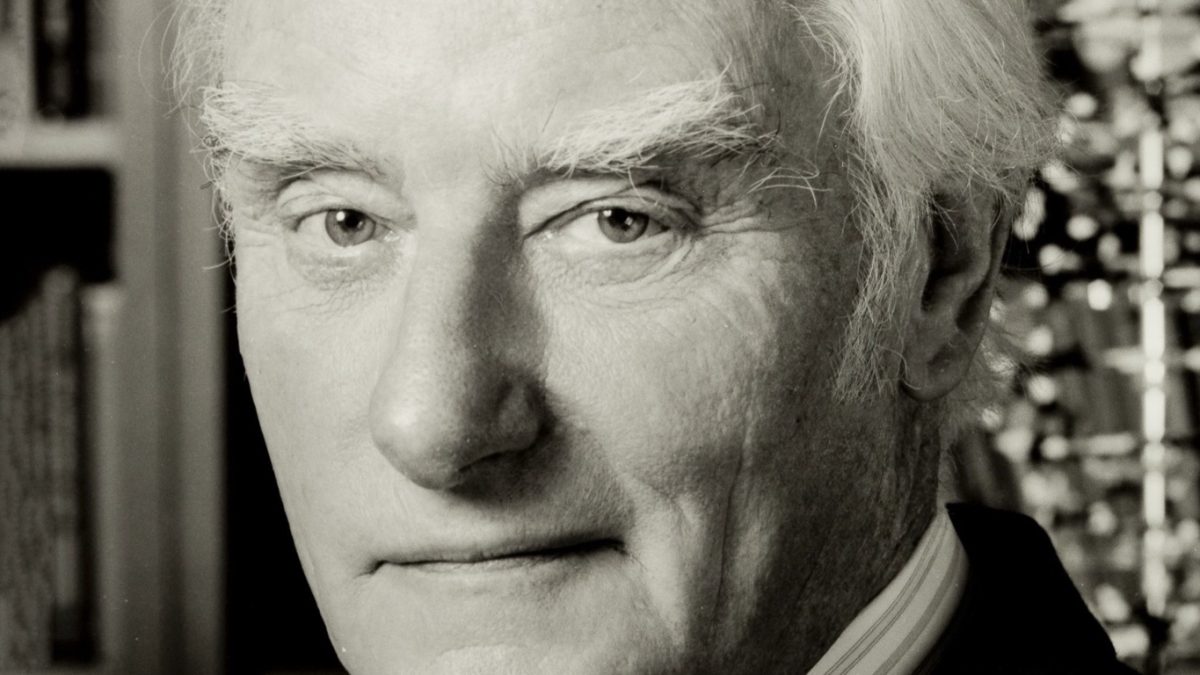
The discovery of the double helix in 1953 answered the structural question of DNA replication, but it immediately unleashed a profound biophysical enigma: How does a passive one-dimensional sequence of four nucleotides inside the nucleus dictate the assembly of complex, three-dimensional enzymes and proteins in the cytoplasm? DNA was a passive tape; proteins were the active metabolic machinery of the cell. Between these two molecular kingdoms lay a vast conceptual gulf that required theoretical illumination. That illumination was provided almost single-handedly by the theoretical genius of Francis Crick (1916–2004).
The Sequence Hypothesis (1958)
In a legendary lecture delivered to the Society for Experimental Biology in September 1957 (published in 1958 under the title On Protein Synthesis), Crick formulated two interconnected principles that would become the axiomatic foundations of molecular biology.
The first was the Sequence Hypothesis. Rejecting the vague contemporary notions that protein folding was induced by cytoplasmic templates or that amino acids were sorted by catalytic enzymes, Crick made a bold, reductionist declaration:
“The Sequence Hypothesis assumes that the specificity of a piece of nucleic acid is expressed solely by the sequence of its bases, and that this sequence is a (simple) code for the amino acid sequence of a particular protein.”
— Francis Crick, On Protein Synthesis (1958)
Furthermore, Crick posited that the linear sequence of amino acids in a polypeptide chain contains all the thermodynamic information necessary to guide its spontaneous folding into its unique three-dimensional native structure—an insight later validated experimentally by Christian Anfinsen’s ribonuclease refolding experiments.
The Formulation of the Central Dogma
The second principle was Crick’s most famous and frequently misunderstood conceptual construct: The Central Dogma. Many popular textbooks erroneously describe the Central Dogma as a simple biochemical flow chart: $text{DNA} rightarrow text{RNA} rightarrow text{Protein}$. But Crick’s formulation was fundamentally about information theory and sequence transfer:
“The Central Dogma of Molecular Biology deals with the detailed residue-by-residue transfer of sequential information. It states that such information cannot be transferred back from protein to either protein or nucleic acid.”
— Francis Crick, Nature (1970)
Crick systematically categorized all nine conceivable directional transfers of sequence information into three classes:
- General Transfers (Permitted and Routine):
- $text{DNA} rightarrow text{DNA}$ (Replication via DNA Polymerase)
- $text{DNA} rightarrow text{RNA}$ (Transcription via RNA Polymerase)
- $text{RNA} rightarrow text{Protein}$ (Translation via Ribosomes)
- Special Transfers (Permitted in Exceptional Circumstances):
- $text{RNA} rightarrow text{RNA}$ (RNA viral replication via RNA-dependent RNA polymerase)
- $text{RNA} rightarrow text{DNA}$ (Reverse transcription via Reverse Transcriptase, discovered by Temin & Baltimore in 1970)
- $text{DNA} rightarrow text{Protein}$ (Demonstrated in cell-free systems under extreme in vitro conditions)
- Forbidden Transfers (Never Observed, Mathematically Impossible):
- $text{Protein} rightarrow text{Protein}$
- $text{Protein} rightarrow text{RNA}$
- $text{Protein} rightarrow text{DNA}$
Because protein translation involves degenerate, non-overlapping triplet codons and complex stereochemical interactions where the nucleic acid template is physically dissociated from the peptide bond synthesis, the cell possesses zero biochemical machinery capable of reverse-translating an amino acid sequence back into a specific polynucleotide sequence. This irreversible one-way street buried the Lamarckian dream of inheriting acquired somatic modifications once and for all.
The Adaptor Hypothesis: Predicting Transfer RNA
Crick’s sharpest theoretical triumph occurred when addressing the mechanism of translation. Renowned cosmologist and polymath George Gamow had proposed that amino acids directly nestled into the physical grooves of the DNA double helix like keys in a lock. Crick immediately recognized this was chemically absurd: many amino acids (such as leucine, isoleucine, and valine) possess greasy, non-polar hydrophobic side chains that have zero chemical affinity for hydrophilic, charged nucleic acid bases.
In an unpublished paper circulated within the “RNA Tie Club” in 1955, Crick proposed the radical Adaptor Hypothesis: nature must have evolved small, specific “adaptor” nucleic acid molecules. Each adaptor would carry a specific amino acid esterified at one terminus, while possessing a specific trinucleotide base sequence at the other terminus capable of forming Watson-Crick hydrogen bonds with the messenger RNA template.
At the time, not a shred of physical evidence existed for such molecules. Yet within three years, Mahlon Hoagland and Paul Zamecnik at Harvard isolated “soluble RNA” (sRNA)—a small, stable, 75-nucleotide ribonucleic acid that charged with radioactive amino acids and bound to ribosomes. The adaptor was real: it was transfer RNA (tRNA). Pure theoretical deduction had anticipated the molecular hardware of life.