Three hundred and twenty million years ago, the continents were swathed in an endless, suffocatingly dense emerald canopy: the great coal swamp forests of the Carboniferous Period. Towering forty-metre lycopsid scale trees sucked gigatons of carbon from the atmosphere, driving atmospheric oxygen to an astonishing 35%—an all-time planetary high. Under this hyperoxic sky, giant predatory griffinflies with the wingspan of hawks darted between trees, while two-metre millipedes crashed through the undergrowth. Yet for all their terrestrial dominance, vertebrates remained tethered to water by a reproductive ball-and-chain: the delicate, jelly-coated amphibian egg. The breaking of this chain through the invention of the cleidoic amniotic egg would permanently divorce vertebrates from the water and spark the deep evolutionary duel between synapsids and diapsids.
1. The Giant Carboniferous Ecosystem: Hyperoxia & Tracheal Diffusion
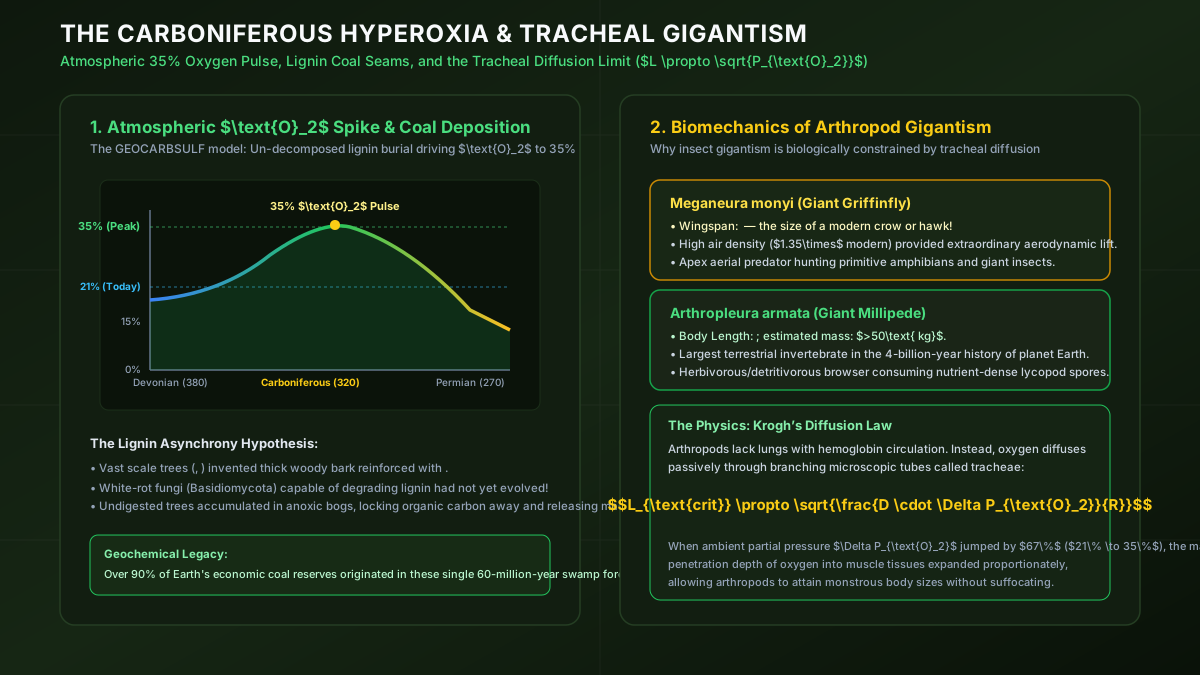
The Carboniferous Period ($359\text{–}299\text{ Ma}$) witnessed the most extreme atmospheric perturbation in Phanerozoic history. Vast swamp forests dominated by giant clubmosses (Lepidodendron, Sigillaria) and horsetails (Calamites) evolved thick trunks reinforced by lignin—a recalcitrant, cross-linked aromatic polymer. At this point in evolutionary history, white-rot fungi (Basidiomycota) equipped with lignin peroxidase enzymes had not yet evolved to digest this woody tissue. As trees died, they fell into stagnant, acidic, oxygen-starved peat bogs, escaping decomposition and burying immense reservoirs of organic carbon as coal seams.
Because photosynthesis releases molecular oxygen ($6\text{CO}_2 + 6\text{H}_2\text{O} \to \text{C}_6\text{H}_{12}\text{O}_6 + 6\text{O}_2$) and decomposition was blocked, atmospheric oxygen surged from a Devonian baseline of $21\%$ to an extraordinary peak of $35\%$, elevating total atmospheric surface pressure by more than $35\%$.
This atmospheric hyperoxia had a profound biophysical consequence for terrestrial arthropods. Unlike vertebrates, which circulate oxygen using a closed vascular system with hemoglobin, insects and myriapods rely on tracheal respiration—an invaginated network of branching micro-tubes that delivers oxygen directly to cells via passive gaseous diffusion.
Under August Krogh’s classical diffusion model, the maximum penetration depth ($L_{\text{crit}}$) of oxygen through a tissue cylinder of radius $R$ is governed by: $$L_{\text{crit}} \propto \sqrt{\frac{D \cdot \Delta P_{\text{O}_2}}{R}}$$ Where $D$ is the gas diffusion coefficient and $\Delta P_{\text{O}_2}$ is the ambient partial pressure of oxygen. In modern air ($\text{O}_2 = 21\%$), diffusion becomes lethally inefficient beyond a body diameter of a few centimeters.
With oxygen boosted to $35\%$, the partial pressure increased by $67\%$, allowing oxygen to diffuse deeper into muscle tissues without suffocation. Arthropods grew to monstrous, nightmare proportions:
- Meganeura monyi: A predatory griffinfly with a wingspan of $75\text{ cm}$ ($2.5\text{ feet}$) and large compound eyes, capable of powered aerial hunting in dense air that provided $35\%$ greater aerodynamic lift.
- Arthropleura armata: A heavily armored millipede reaching $2.6\text{ metres}$ ($8.5\text{ feet}$) in length and weighing over $50\text{ kg}$—the largest terrestrial invertebrate in Earth history.
2. The Cleidoic Amniotic Breakthrough: Packaging the Pond
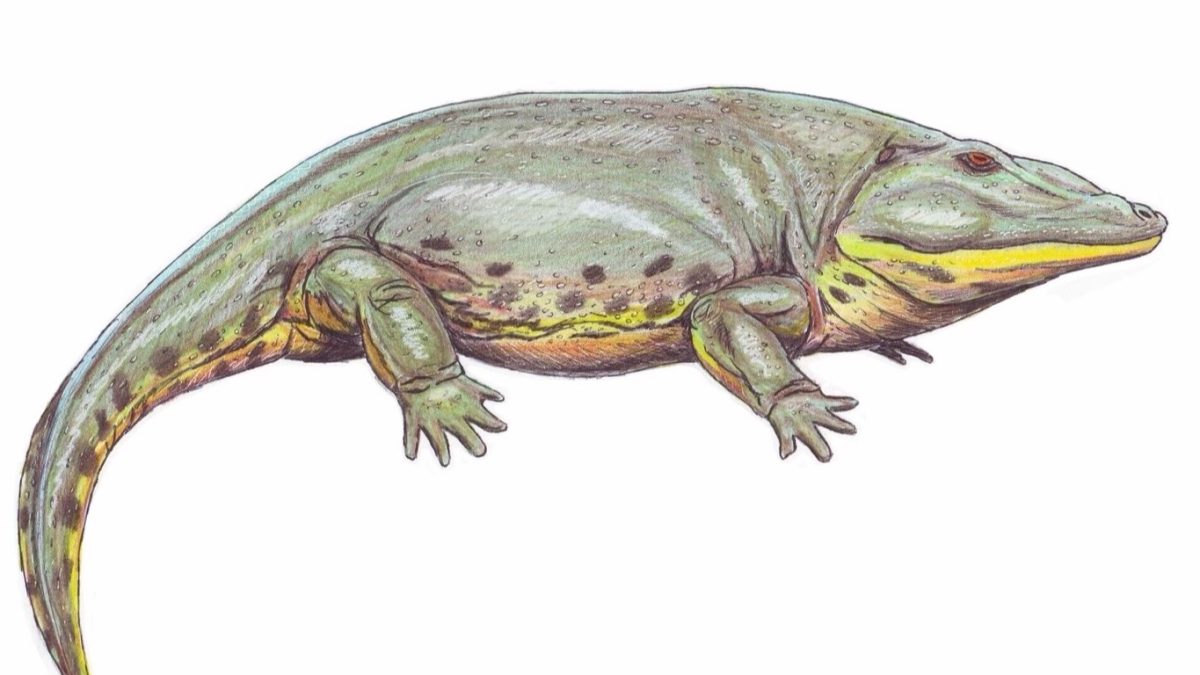
While arthropods and giant labyrinthodont temnospondyl amphibians dominated the wetlands, vertebrates faced an inescapable ecological barrier. The eggs of amphibians (anamniotes) are naked, gelatinous globes permeable to water. If laid on dry land, the sun rapidly evaporates their moisture, killing the embryo. Furthermore, the developing amphibian embryo excretes soluble, highly toxic ammonia ($\text{NH}_3$), which requires continuous immersion in surrounding water to dilute and wash away.
Consequently, amphibians were chained to the water’s edge. They could hunt on land, but they were forced to return to wetlands to reproduce, and their offspring had to endure a perilous free-swimming larval (tadpole) phase.
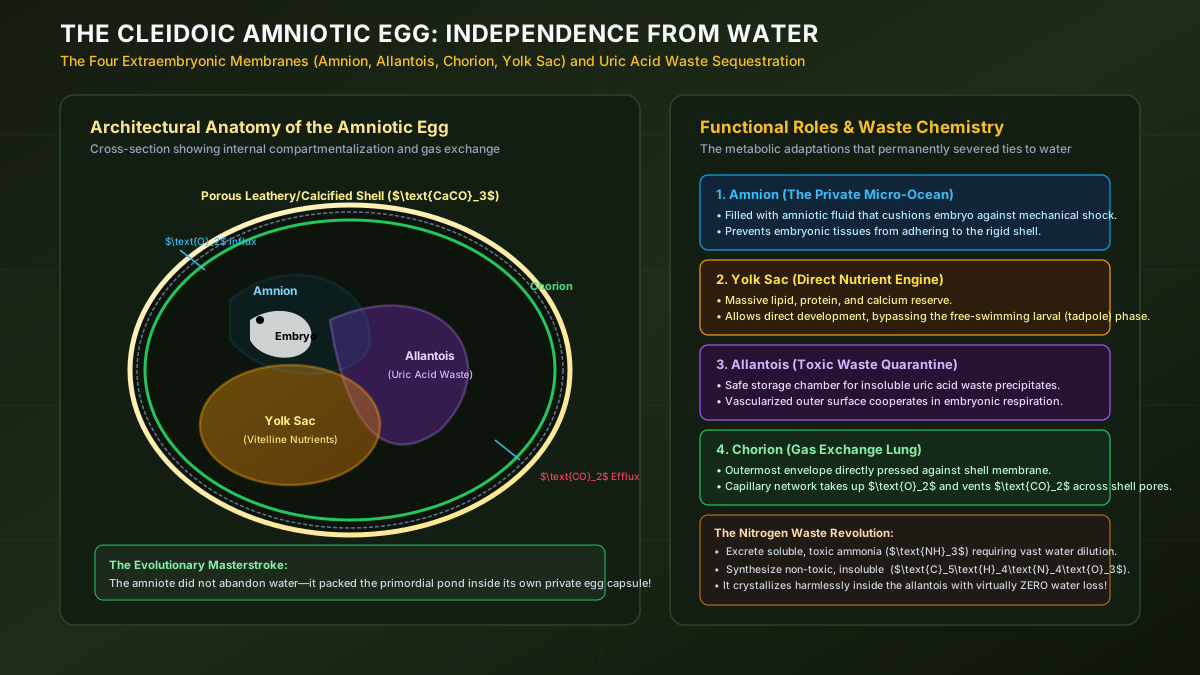
In the Late Carboniferous ($\approx 315\text{ Ma}$), stem tetrapods achieved one of the greatest adaptive breakthroughs in evolutionary history: the cleidoic (closed) amniotic egg. Instead of escaping the water, the amniote did something vastly more ingenious: it packaged the ancient primordial pond inside a waterproof capsule through four specialized extraembryonic membranes:
- The Amnion: A thin, transparent fluid-filled membrane directly enclosing the embryo. The amniotic fluid maintains a saline, buoyant micro-environment that cushions the developing tissues against gravity and physical shock, keeping the embryo suspended in an internal sea.
- The Yolk Sac: An extensively vascularized diverticulum containing energy-dense lipids, proteins, and minerals. Unlike small amphibian eggs that rely on larval grazing, the massive yolk provides full sustenance until the embryo hatches as a fully formed, miniature terrestrial adult.
- The Allantois: A vascularized sac growing from the hindgut. It serves as an isolated containment vault for metabolic waste, and its outer vascular network participates in gas exchange.
- The Chorion: The outermost protective envelope encompassing the entire embryonic apparatus. Placed in direct contact with the inner surface of the shell, its dense capillary beds absorb oxygen and exhaust carbon dioxide through microscopic pores in the shell.
The Biochemical Revolution: Uric Acid vs. Ammonia
The amniotic egg could not have functioned without a complete overhaul of nitrogen metabolism. Ammonia excretion would have poisoned the embryo within days inside a sealed shell. Amniotes evolved the biochemical machinery to convert nitrogen waste into Uric Acid ($\text{C}_5\text{H}_4\text{N}_4\text{O}_3$).
Uric acid is practically non-toxic and insoluble in water. It precipitates out of solution as harmless white crystals, sequestered safely inside the allantois until hatching with virtually zero water loss. With this biochemical triumph and a porous, calcium carbonate ($\text{CaCO}_3$) shell, amniotes severed all reproductive ties to the water. They were free to march inland, colonize high plateaus, and conquer deserts.
3. The Grand Amniote Split: Synapsids vs. Diapsids
Almost immediately upon inventing the amniotic egg, the basal amniotes bifurcated into two rival evolutionary empires. This monumental division is recorded not in the limbs or scales, but in the architectural engineering of the skull roof behind the eye sockets: temporal fenestration.
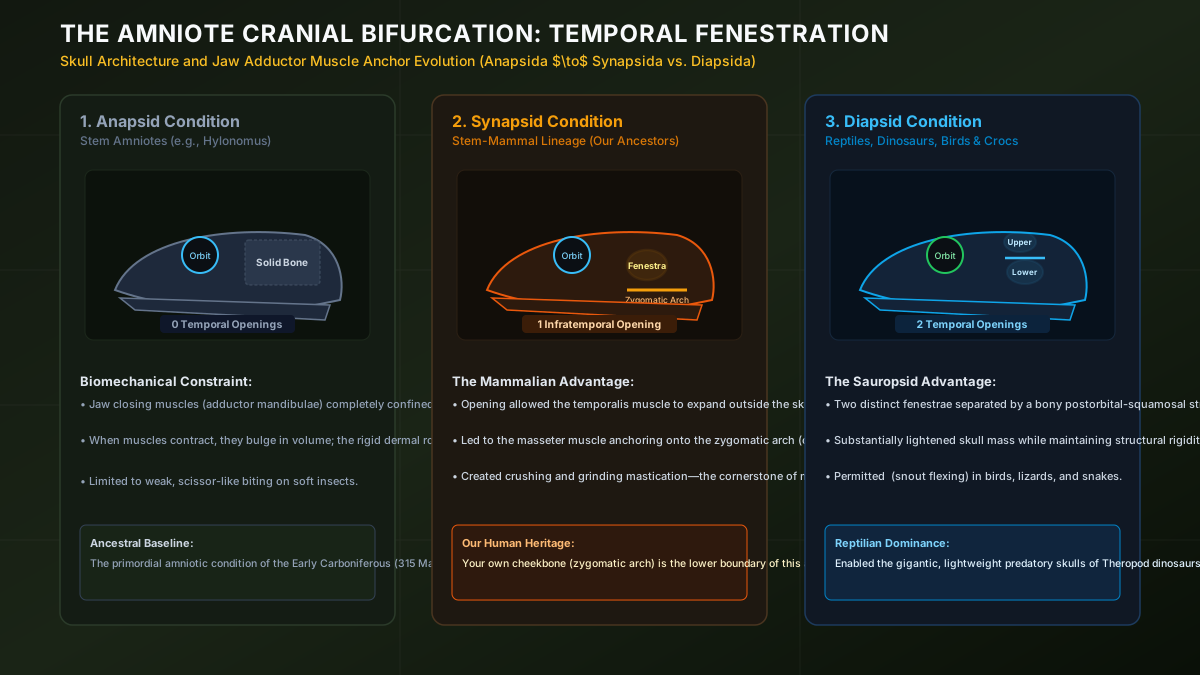
1. The Anapsid Condition (Solid Roof)
Represented by the earliest known amniote, Hylonomus lyelli (found fossilized inside hollow lycopod tree stumps in Nova Scotia, $315\text{ Ma}$). Anapsids possessed a completely solid dermal skull roof behind the orbit, inherited directly from primitive amphibians. The jaw-closing adductor muscles were boxed inside this rigid bone cylinder; when muscles contract, they must bulge in volume, meaning anapsid bite force was fundamentally constrained by the internal volume of the braincase.
2. The Synapsid Lineage: Our Ancestral Clan
In the Late Carboniferous, one branch of amniotes opened a single lower temporal fenestra on each side of the skull, bounded by the postorbital, squamosal, and jugal bones. This was Class Synapsida—the stem-mammal dynasty.
This single opening was a biomechanical triumph. It allowed the temporalis muscle to expand outward and anchor directly onto the dorsal edges of the braincase, while the lower bony margin evolved into the zygomatic arch (cheekbone), providing an anchor for the newly evolved masseter muscle. For the first time, vertebrates could execute complex grinding, shearing, and crushing chewing motions—the evolutionary prerequisite for mammalian endothermy and metabolic power.
3. The Diapsid Lineage: The Sauropsid Empire
The second great branch, Class Diapsida (represented by basal forms like Petrolacosaurus), evolved two temporal openings: an upper (supratemporal) and lower (infratemporal) fenestra separated by a horizontal postorbital-squamosal bone strut.
This dual-window design drastically lightened the skull while preserving tensile strength, providing multiple complex attachment angles for jaw muscles. In later Mesozoic radiations, this architecture enabled cranial kinesis—the ability to flex and tilt skull bones independently—which fueled the terrifying predatory bite of theropod dinosaurs and the acrobatic beak dexterity of modern birds.
As the Carboniferous drew to a close, a global cooling trend began drying up the equatorial coal swamps. The amphibians, shackled to their drying pools, began a catastrophic decline. The future of Earth now belonged entirely to the amniotes—and in the arid, challenging Permian world that lay ahead, it was our synapsid ancestors who struck first.