Three hundred thousand years ago, the African continent became the nursery of our own species: Homo sapiens. Yet contrary to the simplistic storybook myth of a single isolated “Garden of Eden”, our anatomical and genetic origin was a pan-African mosaic—a continent-wide web of semi-isolated populations periodically connecting across fluctuating green Sahara corridors. Furthermore, for the vast majority of our existence, we were not alone. Fifty thousand years ago, our planet was a multi-species Tolkien-esque world inhabited simultaneously by at least five distinct hominins: Homo sapiens, cold-adapted Neanderthals in Eurasia, enigmatic Denisovans in Siberia and Tibet, diminutive island “Hobbits” (Homo floresiensis) in Indonesia, and Homo luzonensis in the Philippines. Through ancient DNA sequencing, we now know that our ancestors did not simply replace these archaic cousins—they loved them, interbred with them, and absorbed their adaptive genes. As the last surviving hominin standing, humanity sparked a Symbolic Revolution that transformed biological evolution into runaway cultural evolution, culminating in a species that now deciphers the four-billion-year epic of its own cosmic origins.
1. The Late Pleistocene Archaic Mosaic: A Multi-Species World
For decades, paleoanthropologists debated two polarized models: the strict Recent African Origin model (proposing modern humans arose suddenly in a single East African valley ~150 ka) versus the classical Multiregional Evolution model. In 2017, a team led by Jean-Jacques Hublin stunned the scientific world by redating the fossil site of Jebel Irhoud in Morocco. Thermoluminescence dating of heated flints established that anatomically early Homo sapiens lived in northwestern Africa $315,000\text{ years ago}$—pushing the dawn of our species back by over $100,000\text{ years}$!

The Pan-African Evolution Model
Synthesizing fossil discoveries from Jebel Irhoud ($315\text{ ka}$, Morocco), Omo Kibish ($233\text{ ka}$, Ethiopia), Florisbad ($260\text{ ka}$, South Africa), and Herto ($160\text{ ka}$, Ethiopia), Eleanor Scerri and colleagues formulated the Pan-African Multiregional Evolution Model. Early Homo sapiens populations were geographically structured across the vast African landmass. During wet “Green Sahara” pluvial episodes, rivers and lakes connected North, East, and Southern Africa, allowing migrating bands to exchange genes and lithic innovations. During arid phases, populations retreated into isolated environmental refugia, developing unique morphological traits. Our species did not evolve from a single tribe; it emerged from the dynamic, continent-wide coalescence of a shifting ecological metapopulation.
The Five Hominin Species of the Late Pleistocene
As recently as $60,000\text{ years ago}$, an alien visitor arriving on planet Earth would have encountered a vibrant diversity of human species:
- Homo sapiens: Characterized by a globular neurocranium, a flat face retracted beneath the frontal lobes, an average brain capacity of $\sim 1,350\text{ cm}^3$, and a distinct, protruding bony mental trigon (the true chin).
- Homo neanderthalensis: Flourishing across Europe and Western Asia. Possessing a larger cranial capacity ($1,450\text{–}1,600\text{ cm}^3$) housed in a long, low skull with an occipital bun, sweeping browridges, and no chin. Cold-adapted with broad, barrel-shaped chests and thick, stocky limbs conforming to Allen’s and Bergmann’s ecogeographical rules.
- Denisovans: Identified from a fingertip bone and massive molars in Denisova Cave, Siberia, and a jawbone from the Baishiya Karst Cave in Tibet. Genetically a sister lineage to Neanderthals, adapted to high-altitude cold environments.
- Homo floresiensis (“The Hobbit”): Discovered in Liang Bua cave on the Indonesian island of Flores. Standing only $1.06\text{ m}$ ($3\text{ ft }6\text{ in}$) tall with an australopithecine-sized brain of $\sim 420\text{ cm}^3$, this species evolved extreme insular dwarfism to survive on an isolated island alongside pygmy Stegodon elephants until $\sim 60,000\text{ years ago}$.
- Homo luzonensis: Discovered in Callao Cave, Luzon, Philippines ($50\text{–}67\text{ ka}$), exhibiting a unique mosaic of primitive, curved australopithecine-like phalanges and derived small molars.
2. Paleogenomics: Ancient DNA and the ABBA-BABA Proof
For more than a century, anthropologists debated whether migrating modern humans violently exterminated archaic populations or peacefully interbred with them. The answer came from the revolutionary science of Paleogenomics, spearheaded by Swedish geneticist Svante Pääbo at the Max Planck Institute for Evolutionary Anthropology (honored with the 2022 Nobel Prize in Physiology or Medicine).

The D-Statistic: The Mathematical Proof of Admixture
In 2010, Pääbo’s consortium published the first draft sequence of the Neanderthal genome extracted from 40,000-year-old bones from Vindija Cave, Croatia. To test for gene flow, population geneticist Richard Green developed the $D$-Statistic (the ABBA-BABA Test):
Consider four genome sequences aligned at orthologous nucleotide sites: an African modern human ($H_1$), a non-African modern human ($H_2$), a Neanderthal ($A$), and a chimpanzee outgroup ($O$). Let ‘A’ denote the ancestral allele (shared with the chimpanzee) and ‘B’ denote the derived mutation:
- An ABBA site occurs when the African carries the ancestral allele (A), while both the non-African and the Neanderthal share the derived mutation (B): $[A, B, B, A]$.
- A BABA site occurs when the non-African carries the ancestral allele (A), while the African and the Neanderthal share the derived mutation (B): $[B, A, B, A]$.
Under a null hypothesis of strict species divergence without gene flow, stochastic Incomplete Lineage Sorting (ILS) predicts that the number of ABBA sites must equal the number of BABA sites: $N(\text{ABBA}) \approx N(\text{BABA})$, yielding a $D$-statistic of zero:
\[ D = \frac{N(\text{ABBA}) – N(\text{BABA})}{N(\text{ABBA}) + N(\text{BABA})} = 0 \]When Pääbo’s team ran the calculation across billions of base pairs, the result was staggering: in every non-African human on Earth (French, Han Chinese, Papuan), $N(\text{ABBA})$ significantly exceeded $N(\text{BABA})$, generating a highly positive $D$-statistic with a statistical significance exceeding $Z > 5.0$! This proved mathematically that Neanderthals interbred with modern humans. The primary admixture event occurred between $55,000\text{ and }60,000\text{ years ago}$ in the Near East or Levant, just as our ancestors first expanded out of Africa.
The Living Archaic Heritage: Adaptive Introgression
We are not pure-blooded; we are walking mosaics of archaic genomes:
- Neanderthal Legacy ($1.5\text{–}2.5\%$): Present in all non-African human genomes. Archaic alleles conferred essential immune adaptations to survive Eurasian pathogens: TLR1, TLR6, and TLR10 (Toll-like receptors), as well as keratin genes (BNC2) that toughened skin against cold climates. However, archaic alleles also carry legacy vulnerabilities, including an archaic haplotype on Chromosome 3 linked to increased risk of respiratory failure from COVID-19.
- Denisovan Legacy ($4\text{–}6\%$): Extensively preserved in Indigenous Australians, Papuans, and Melanesians. In 2014, Rasmus Nielsen discovered that modern high-altitude Tibetans inherited a miraculous Denisovan genetic gift: an archaic variant of the EPAS1 transcription factor. While standard human alleles cause the blood to thicken dangerously with excess red blood cells at elevations $>4,000\text{ meters}$, the Denisovan EPAS1 variant prevents chronic mountain sickness, enabling Tibetans to thrive in the low-oxygen heights of the Himalayas.
3. The Upper Paleolithic Symbolic Revolution
By 45,000 years ago, as Neanderthals and Denisovans retreated toward extinction, modern humans ignited a cognitive and cultural explosion across Eurasia and Africa: The Upper Paleolithic Symbolic Revolution.
The Materialization of the Human Mind
What sets modern humans apart from every other creature that has ever lived is our capacity for Symbolic Thought—the ability to assign arbitrary, shared conceptual meaning to an external material object:
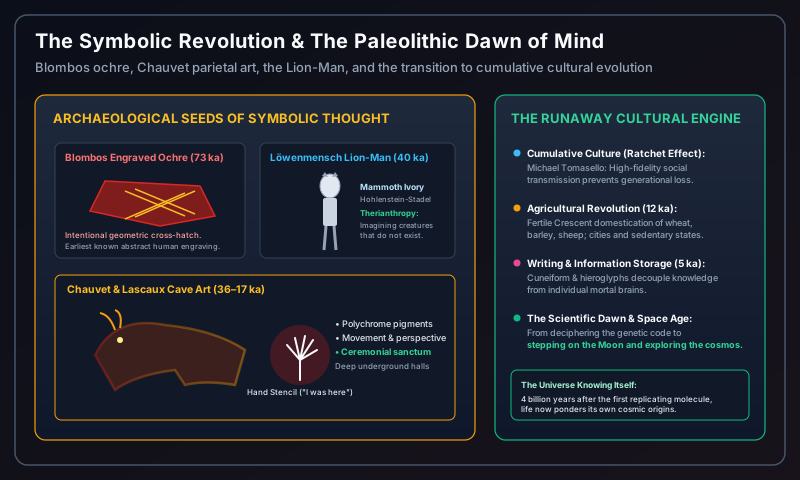
- Abstract Geometry (Blombos Cave, South Africa, $73\text{ ka}$): Christopher Henshilwood excavated chunks of red ochre engraved with meticulous, deliberate cross-hatched diamond patterns, alongside perforated marine tick-shell beads (Nassarius kraussianus) worn as personal identity jewelry.
- Therianthropy & Myth (The Löwenmensch, Germany, $40\text{ ka}$): Carved from mammoth ivory found in Hohlenstein-Stadel cave, the “Lion-Man” depicts an upright human body topped with the head of a cave lion. This sculpture represents a momentous cognitive threshold: the capacity to conceptualize, visualize, and sculpt an imaginary entity that does not exist in the physical world—the birth of religious imagination, mythology, and art.
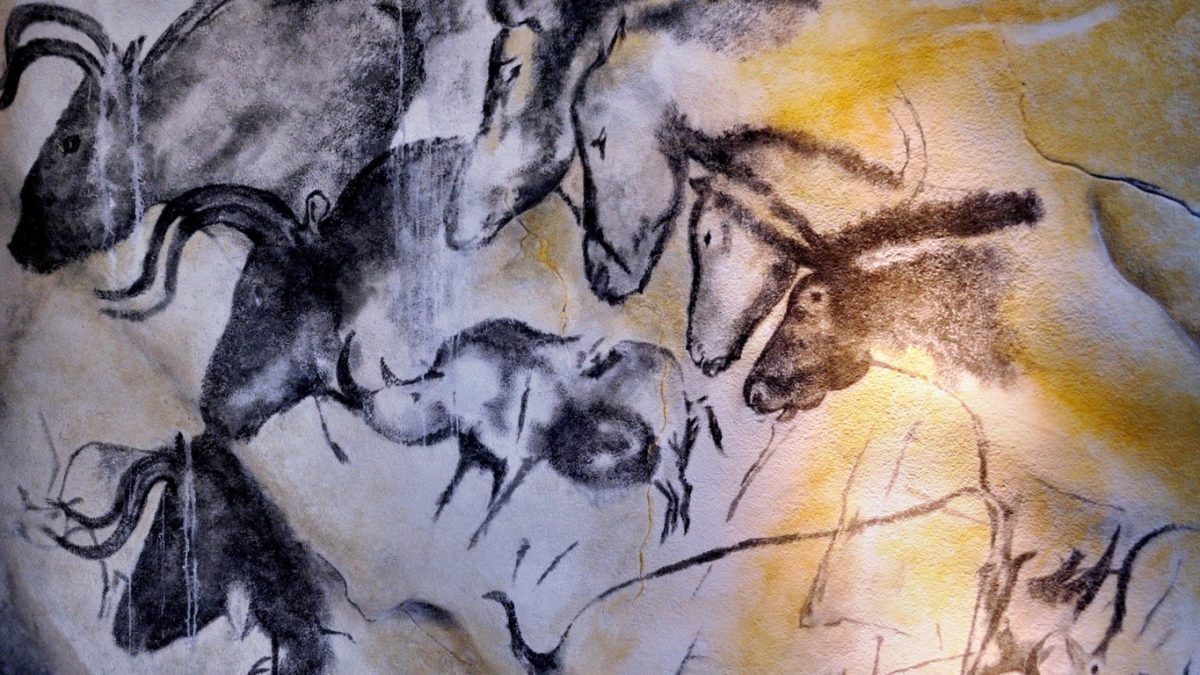
- Parietal Cave Sanctuaries (Chauvet & Lascaux, France, $36\text{–}17\text{ ka}$): Deep within pitch-black subterranean limestone chambers, Upper Paleolithic artists used charcoal, red hematite, and yellow goethite to render dynamic, shaded herds of running horses, fighting woolly rhinos, and charging steppe bison. Alongside these animal masterpieces are haunting negative hand stencils: an artist placed their open hand against the rock and blew a cloud of liquid pigment through a hollow bone pipe, leaving a permanent personal signature across deep time: “I am here. I was here.”
- Music and Harmonics (Hohle Fels, Germany, $40\text{ ka}$): The discovery of delicate flutes carved from the radius bones of griffon vultures with meticulously spaced finger holes proves that complex musical harmony and melodic expression are as old as our species.
4. The Cumulative Cultural Horizon: The Grand Epilogue
With the symbolic revolution, the primary driver of human adaptation shifted forever. For 3.8 billion years, life adapted to its environment through the slow, blind, generational filtering of biological natural selection. But in Homo sapiens, a new evolutionary engine emerged: Cumulative Cultural Evolution (The Ratchet Effect).
As cognitive psychologist Michael Tomasello demonstrated, human culture possesses a unique “ratchet”: once a useful innovation is invented (a bone sewing needle, a bow and arrow, a herbal medicine), high-fidelity social learning, language, and shared intentionality prevent it from slipping backward. The next generation does not reinvent the wheel; it starts where the previous generation left off.
From Savannas to the Stars
In a geological heartbeat of twelve thousand years—a mere fraction of one percent of our evolutionary history—the cultural ratchet accelerated with staggering exponential speed:
- The Agricultural Revolution ($12\text{–}10\text{ ka}$): In the Fertile Crescent, Yangtze River, and Mesoamerica, humans domesticated wheat, rice, corn, and livestock. Nomadic hunting bands settled into permanent villages, sparking the emergence of cities, architecture, and division of labor.
- External Information Storage ($5\text{ ka}$): In ancient Sumer and Egypt, the invention of cuneiform and hieroglyphic writing decoupled human knowledge from individual mortal brains. Ideas could now be transmitted across thousands of miles and thousands of years without loss of fidelity.
- The Scientific Revolution & Modernity ($500\text{ yr — Present}$): The institutionalization of the empirical scientific method unlocked the fundamental laws of thermodynamics, electromagnetism, and quantum mechanics. We built telescopes that gaze back to the cosmic dawn, mapped the three-billion-base-pair human genome, and stepped foot on the lunar surface.
The 4-Billion-Year Epic: The Universe Knowing Itself
Four billion years ago, in the scalding, pitch-black hydrothermal crevices of an Archean ocean, simple alkaline fluids bubbled through catalytic iron-sulfur chambers, giving birth to the first fragile, replicating molecular chains. Through four billion years of planetary catastrophe—the Great Oxygenation Event, Snowball Earth glaciations, the Cambrian explosion, the conquest of land, the Permian Great Dying, the meteoritic vaporization of the dinosaurs, and the arid crucible of the African rift—that continuous unbroken chain of replicating DNA never snapped.
Today, that epic journey resides inside you. The water flowing in your veins carries the salinity of the primordial ocean. The mitochondria powering your cells are the living descendants of alphaproteobacteria engulfed two billion years ago. The calcium phosphate minerals in your bones were forged by Ordovician jawless fish. The middle ear bones vibrating to the sounds of this world are the transformed jaw joints of Permian synapsids. And the brain contemplating these words is the direct beneficiary of the nocturnal mammalian neocortex, the primate visual canopy, and the Oldowan stone-knapper’s spark.
As Carl Sagan once poetically observed: “We are a way for the cosmos to know itself.” Four billion years after the spark of abiogenesis, the epic of evolution has produced a conscious, compassionate, inquisitive species capable of looking back across the abyss of deep time, marveling at the odyssey that brought us here, and taking conscious stewardship of our living planetary home.