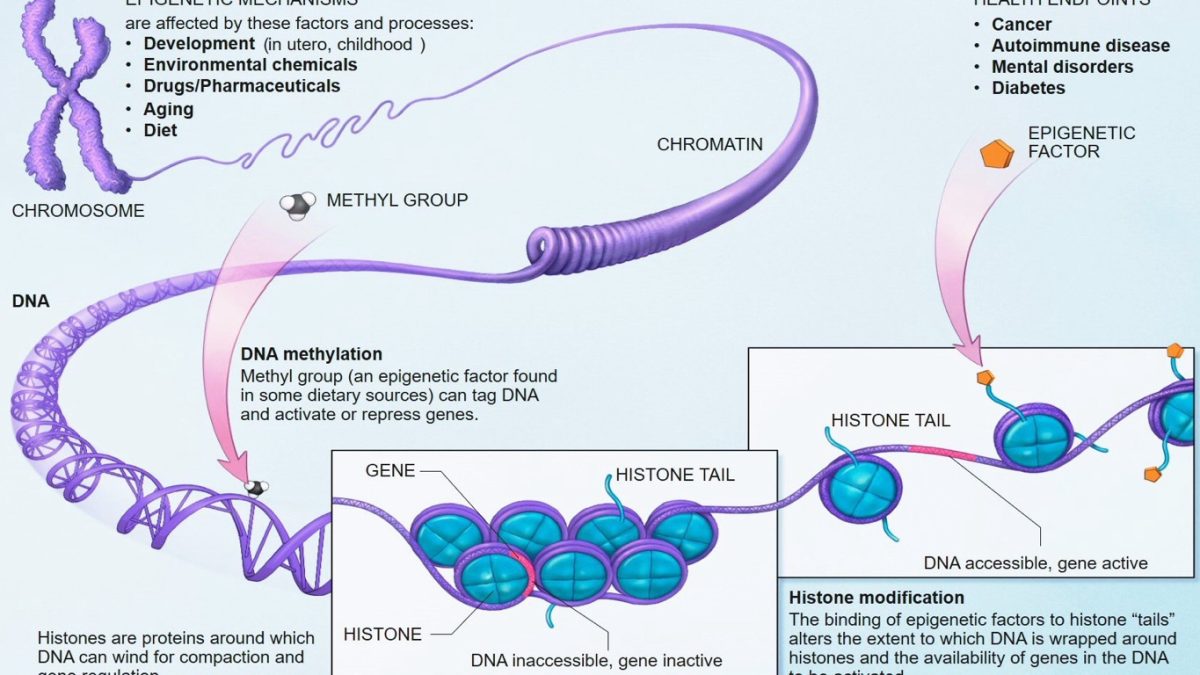
With the completion of the Human Genome Project, genetic determinism achieved its historical zenith. The popular press hailed the sequence as the complete blueprint of humanity, predicting that all disease, behavior, and physiological fate were hard-coded in our ATGC sequence. Yet a profound biological paradox immediately dismantled this simplistic genetic fatalism. Consider identical monozygotic twins: they begin life with 100% identical DNA sequences derived from the same fertilized zygote. Yet as they age, one twin may develop schizophrenia, rheumatoid arthritis, or cancer, while the other remains robustly healthy. Or consider the human body itself: a rod cell in your eye, a motor neuron in your spinal cord, and a hepatocyte in your liver all share the exact same 3.1 billion base pairs—yet their morphology, proteome, and cellular functions are radically distinct. The answer to this mystery did not lie in the hardware of the genome, but in its dynamic software: the kingdom of Epigenetics.
Waddington’s Epigenetic Landscape
The conceptual framework of epigenetics was envisioned decades before its molecular machinery was understood. In 1942, British developmental biologist and polymath Conrad Hal Waddington (1905–1975) coined the term epigenetics (a portmanteau of epigenesis and genetics) to describe the complex developmental processes that bridge the genotype to the phenotype.
Waddington illustrated this concept with his famous visual metaphor: the Epigenetic Landscape. A pluripotent embryonic stem cell is depicted as a marble resting at the apex of a tilted, undulating surface carved with branching valleys, ravines, and hills. As the marble rolls downhill under gravity, it encounters successive fork points. Taking one valley leads to a neural lineage; taking another leads to muscle, bone, or blood. Once a marble rolls deep into a specific valley, the steep topography locks it into an irreversible terminal differentiation state.
For decades, Waddington’s landscape was treated as a poetic abstraction. Today, we know the physical valleys and ridges of that landscape are constructed from concrete biochemical modifications: the epigenome.
The Molecular Marks: DNA Methylation and the Histone Code
Eukaryotic genomic DNA does not float naked within the nucleoplasm. Instead, roughly two meters of linear DNA is tightly compressed into the microscopic nucleus by wrapping around octamers of basic packaging proteins called histones (two copies each of H2A, H2B, H3, and H4) to form repeating subunits called nucleosomes. The epigenome operates through two primary layers of covalent modification:
1. DNA Cytosine Methylation
Specialized enzymes known as DNA Methyltransferases (DNMTs) transfer a methyl group ($-text{CH}_3$) from S-adenosylmethionine to the fifth carbon of cytosine rings, creating 5-methylcytosine ($5text{mC}$). In mammalian genomes, this modification occurs predominantly on cytosines located directly adjacent to guanines, in regions known as CpG dinucleotides. Clusters of CpGs located in gene promoters—termed CpG islands—are typically unmethylated in active genes. When an environmental signal or developmental program methylates a CpG island, methyl-CpG-binding proteins (MBDs) are recruited, physically blocking transcription factors and silencing gene expression. Crucially, during DNA replication, maintenance methyltransferases (such as DNMT1) recognize hemimethylated DNA and methylate the newly synthesized daughter strand, ensuring that epigenetic silence is faithfully inherited across mitotic cell divisions.
2. The Histone Code Hypothesis
Formulated by C. David Allis and Thomas Jenuwein in 2000, the Histone Code Hypothesis states that post-translational covalent modifications on the protruding N-terminal flexible tails of histones act as a combinatorial biological language controlling chromatin accessibility:
- Histone Acetylation: Histone acetyltransferases (HATs) attach acetyl groups ($-text{COCH}_3$) to positively charged lysine residues (e.g., H3K9ac, H3K27ac). Acetylation neutralizes the positive charge of the lysine, weakening its electrostatic attraction to the negatively charged DNA backbone. The chromatin relaxes into an open, accessible state—euchromatin—allowing RNA polymerase to bind and transcribe. Conversely, Histone Deacetylases (HDACs) strip off acetyl groups, condensing chromatin into transcriptionally inert heterochromatin.
- Histone Methylation: Histone methyltransferases add one, two, or three methyl groups to specific lysines or arginines. Unlike acetylation, the effect of methylation depends strictly on the exact residue: trimethylation of Lysine 4 on Histone 3 (H3K4me3) is a hallmark of active promoters, whereas trimethylation of Lysine 27 on Histone 3 (H3K27me3), catalyzed by the Polycomb Repressive Complex 2 (PRC2), enforces profound transcriptional silencing.
Epigenetic Plasticity and Environmental Memory
Unlike the rigid, permanent letters of the DNA sequence, epigenetic marks are plastic: they respond dynamically to the organism’s environment, nutrition, stress, and lifestyle. In the famous agouti mouse experiments conducted by Randy Jirtle and Robert Waterland at Duke University, pregnant female agouti mice (which normally give birth to yellow, obese, diabetic offspring prone to cancer) were fed diets rich in methyl donors (folic acid, vitamin B12, choline). The supplemental methyl groups methylated the promoter of the agouti gene in the developing embryos, silencing the mutant locus and causing the offspring to be born lean, brown, and healthy—without altering a single nucleotide of their DNA!
The ultimate demonstration of epigenetic reversibility occurred in 2006, when Japanese stem cell pioneer Shinya Yamanaka proved that the steep valleys of Waddington’s landscape could be scaled in reverse. By introducing merely four transcription factors (Oct4, Sox2, Klf4, and c-Myc—the “Yamanaka factors”) into adult, terminally differentiated skin fibroblasts, Yamanaka wiped clean their epigenetic histone and methylation signatures, rolling the marble back up to the summit of the mountain to create induced Pluripotent Stem Cells (iPSCs). The genome is not a destiny; it is an instrument, played by the epigenetic symphony of life.