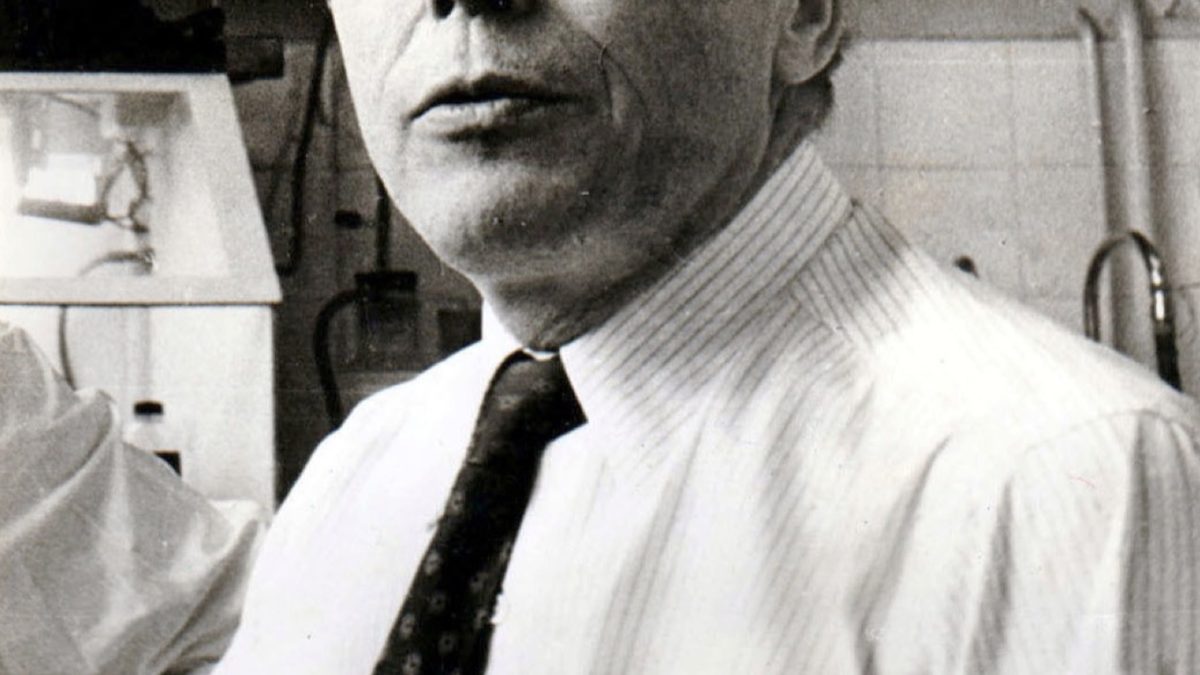
By the dawn of the 1960s, molecular genetics had illuminated the structural template of DNA and deciphered the linear genetic code. Yet a fundamental mystery of organismal life remained entirely unexplained: Regulation. A living cell does not synthesize every enzyme encoded in its genome simultaneously; to do so would result in rapid metabolic exhaustion and death. More pointedly, in multicellular organisms, a retinal rod cell, an epidermal keratinocyte, and a pancreatic beta cell all possess the exact same complete genomic library—yet each cell type expresses completely divergent repertoires of proteins. How do genes turn on and off in response to cellular cues? The answer emerged from the Pasteur Institute in Paris through the intellectual partnership of François Jacob (1920–2013) and Jacques Monod (1910–1976).
The Diauxie Phenomenon and Lactose Metabolism
Monod’s journey began during the Nazi occupation of Paris in World War II, studying the growth kinetics of the bacterium Escherichia coli. When Monod cultured E. coli in medium containing two sugars—glucose and lactose—he observed an intriguing growth curve termed diauxie:
- The bacteria initially grew exponentially, consuming all available glucose.
- Once glucose was exhausted, growth abruptly stopped for roughly an hour (the lag phase).
- Growth then resumed at a slightly slower rate as the bacteria metabolized lactose.
Monod realized that while the enzymes for glucose breakdown were constitutive (constantly synthesized), the enzymes required to metabolize lactose—chief among them $beta$-galactosidase, which cleaves the disaccharide lactose into glucose and galactose—were strictly inducible. In the absence of lactose, a cell contained fewer than five molecules of $beta$-galactosidase. But within minutes of adding lactose, enzyme synthesis accelerated more than a thousand-fold, eventually accounting for up to 6–7% of the total soluble protein in the bacterium. How did the presence of a humble sugar flick the switch of protein production?
The PaJaMo Experiment and the Operon Model
In 1958, Monod teamed up with François Jacob and Arthur Pardee to execute the famed PaJaMo experiment. Utilizing bacterial conjugation (bacterial mating), they transferred genes governing lactose utilization from a male donor bacterium into a mutant female recipient that lacked the ability to synthesize $beta$-galactosidase.
The results revealed a startling regulatory architecture. Inducibility was not mediated by an enzyme activator, but by a negative repressor:
- The normal wild-type state was active, constant repression.
- A specific regulatory gene, termed $lacI$, encoded a specialized protein: the Lac repressor.
- The Lac repressor bound physically to a specific DNA sequence situated directly adjacent to the structural genes, which Jacob and Monod christened the Operator ($O$).
- When the repressor was bound to the operator, it physically obstructed RNA polymerase from transcribing the structural genes: $lacZ$ ($beta$-galactosidase), $lacY$ (lactose permease, a membrane transporter), and $lacA$ (transacetylase).
Jacob and Monod unified this physical cluster of coordinated genes under a revolutionary concept: the Operon.
“The operon is a functional unit of coordinated gene expression, consisting of structural genes transcribed together into a single polycistronic messenger RNA under the control of a common operator and promoter.”
— François Jacob & Jacques Monod, Journal of Molecular Biology (1961)
Allostery: The Molecular Computing Switch
The final conceptual triumph of the Jacob-Monod model was the mechanism of induction. When lactose enters the cell, a minute fraction is converted into allolactose. Allolactose acts as the physiological inducer. It does not attack the DNA or interact with the promoter; instead, it binds directly to a specific pocket on the Lac repressor protein.
This binding triggers what Monod termed an allosteric transition. The repressor protein changes its three-dimensional conformation, causing its DNA-binding domains to pinch inwards, dramatically reducing its affinity for the operator sequence by a factor of 10,000. The repressor falls off the operator DNA like a dropped key. RNA polymerase is immediately liberated to glide down the template, churning out a single, long polycistronic mRNA encoding all three enzymes in stoichiometric harmony.
When lactose is depleted, allolactose dissociates from the repressor; the repressor snaps back into its high-affinity conformation, reattaches to the operator in less than a second, and shuts down transcription immediately. The genome was revealed not as a static blueprint, but as a living, dynamic cybernetic circuit governed by feedback inhibition and logical Boolean gates ($IF dots THEN$). Monod famously quipped: “What is true for E. coli is true for the elephant.” While eukaryotic gene regulation involves chromatin remodeling and complex enhancers, the fundamental logic of allosteric transcriptional control remains the universal governor of cellular life.