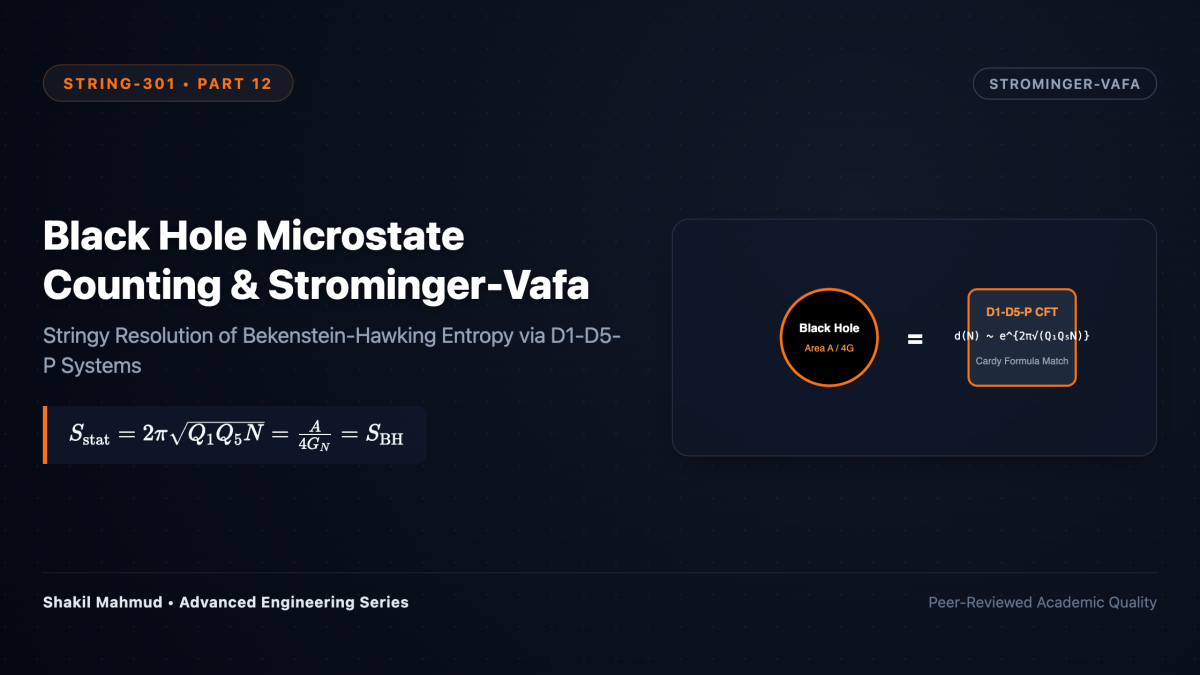
In 1973, Jacob Bekenstein and Stephen Hawking shocked theoretical physics by discovering that black holes are thermodynamic systems possessing a physical temperature (T_H = rac{hbar c^3}{8pi G M k_B}) and a colossal entropy proportional to the area (A) of their event horizon: (S_{ ext{BH}} = rac{k_B c^3 A}{4 G hbar}). For over two decades, the statistical-mechanical origin of this entropy remained a deep mystery: what microscopic quantum microstates does this area count? In 1996, Andrew Strominger and Cumrun Vafa achieved a triumphant breakthrough in string theory by computing the exact microstate degeneracy of a 5D extremal black hole using D-brane bound states and reproducing the Bekenstein-Hawking formula from first principles.
1. The 5D Extremal Black Hole in Low-Energy Supergravity
Consider Type IIB superstring theory compactified on the 5-dimensional torus (T^5 = T^4 imes S^1) (or (K3 imes S^1)). In 5-dimensional low-energy effective supergravity, one can construct an extremal, spherically symmetric, supersymmetric (BPS) charged black hole carrying three charges:
- (Q_1): Electric charge associated with the Ramond-Ramond 2-form (C_2).
- (Q_5): Magnetic charge associated with (C_2) (or electric charge under (C_6)).
- (P = N): Quantized momentum along the circle (S^1).
The spacetime metric in 5 dimensions takes the form:
[
ds^2 = -(f_1 f_5 f_p)^{-2/3} dt^2 + (f_1 f_5 f_p)^{1/3} (dr^2 + r^2 dOmega_3^2)
]
where the harmonic functions are:
[
f_1(r) = 1 + rac{r_1^2}{r^2}, quad f_5(r) = 1 + rac{r_5^2}{r^2}, quad f_p(r) = 1 + rac{r_p^2}{r^2}
]
The event horizon is located at (r = 0), which is a 3-sphere (S^3). The area of this event horizon is:
[
A_H = lim_{r o 0} 2pi^2 r^3 sqrt{f_1 f_5 f_p} = 2pi^2 r_1 r_5 r_p
]
Relating the horizon radii (r_1, r_5, r_p) to the integer quantized charges (Q_1, Q_5, N) and Newton’s constant (G_5 = rac{pi G_{10}}{4 V_5}), the macroscopic Bekenstein-Hawking entropy is:
[
S_{ ext{BH}} = rac{A_H}{4 G_5} = 2pi sqrt{Q_1 Q_5 N}
]
2. The Microscopic D-Brane Configuration
Strominger and Vafa recognized that at weak string coupling ((g_s N ll 1)), the strong gravitational collapse into a black hole disappears, and the system can be described purely in flat spacetime as a supersymmetric bound state of Dirichlet branes:
| Object | Number / Charge | Spatial Orientation along (T^4 imes S^1) |
|---|---|---|
| D5-Branes | (Q_5) | Wraps (x^5, x^6, x^7, x^8) ((T^4)) and (x^9) ((S^1)) |
| D1-Branes | (Q_1) | Wraps (x^9) ((S^1)) inside the D5-branes |
| Momentum Modes (P) | (N) | Carries left-moving gravitational wave momentum along (x^9) ((S^1)) |
This D1-D5-P bound state preserves (1/8) of the original 32 supercharges ((mathcal{N}=4) in 5D, 4 conserved real supersymmetries), ensuring it is an extremal BPS state. Because BPS states belong to shortened supersymmetry representations, their degeneracy is topologically protected by the index theorem and cannot change as the coupling constant (g_s) is varied from weak coupling ((g_s o 0)) to strong coupling ((g_s N gg 1), where the black hole forms).
3. Effective 2D Superconformal Field Theory and Cardy’s Formula
At low energies, the dynamics of open strings moving on the D1-D5 intersection are described by a 2-dimensional ((4,4)) superconformal field theory (SCFT) living on the worldsheet (mathbb{R} imes S^1). The target space of this sigma model is the symmetric orbifold:
[
mathcal{M} = ext{Sym}^{Q_1 Q_5}(T^4) quiv rac{(T^4)^{Q_1 Q_5}}{S(Q_1 Q_5)}
]
Each copy of (T^4) contributes 4 bosonic and 4 fermionic degrees of freedom. Therefore, the central charge of this effective SCFT is:
[
c = c_{ ext{boson}} + c_{ ext{fermion}} = 4 left(1 + rac{1}{2}
ight) imes Q_1 Q_5 = 6 Q_1 Q_5
]
The momentum (P = N / R) along (S^1) corresponds precisely to placing the SCFT at Virasoro excitation level:
[
L_0 = N
]
In modular-invariant 2D conformal field theory, the asymptotic degeneracy of states (
ho(L_0)) at high excitation level (L_0 gg c) is given rigorously by Cardy’s Formula:
[
d(N) approx xpleft( 2pi sqrt{rac{c cdot L_0}{6}}
ight)
]
Substituting the microscopic central charge (c = 6 Q_1 Q_5) and eigenvalue (L_0 = N):
[
d(Q_1, Q_5, N) approx xpleft( 2pi sqrt{rac{(6 Q_1 Q_5) cdot N}{6}}
ight) = xpleft( 2pi sqrt{Q_1 Q_5 N}
ight)
]
4. The Statistical Entropy Matches Bekenstein-Hawking Exactly
Taking Boltzmann’s statistical entropy (S_{ ext{micro}} = ln d(Q_1, Q_5, N)):
[
S_{ ext{micro}} = ln left[ xpleft( 2pi sqrt{Q_1 Q_5 N}
ight)
ight] = 2pi sqrt{Q_1 Q_5 N} quiv S_{ ext{BH}}
]
The statistical microstate counting in flat-space quantum field theory matches the macroscopic Bekenstein-Hawking area law of general relativity to the exact prefactor (1/4)!
5. Resolving the Information Paradox and Near-Extremal Radiation
Strominger and Vafa’s triumph has profound implications for the black hole information paradox:
- Unitary Microstates: The black hole is demonstrated to be a conventional thermodynamic ensemble of unitary quantum mechanical states, not a singularity that annihilates quantum information.
- Near-Extremal Hawking Radiation: Perturbing the system slightly above extremality by introducing right-moving momentum modes ((bar{L}_0 = bar{N})) yields microscopic thermal emission rates. The D-brane annihilation cross-section matches Hawking’s semi-classical graybody factors (sigma(omega)) across all energy regimes, proving that Hawking radiation is a unitary quantum process.