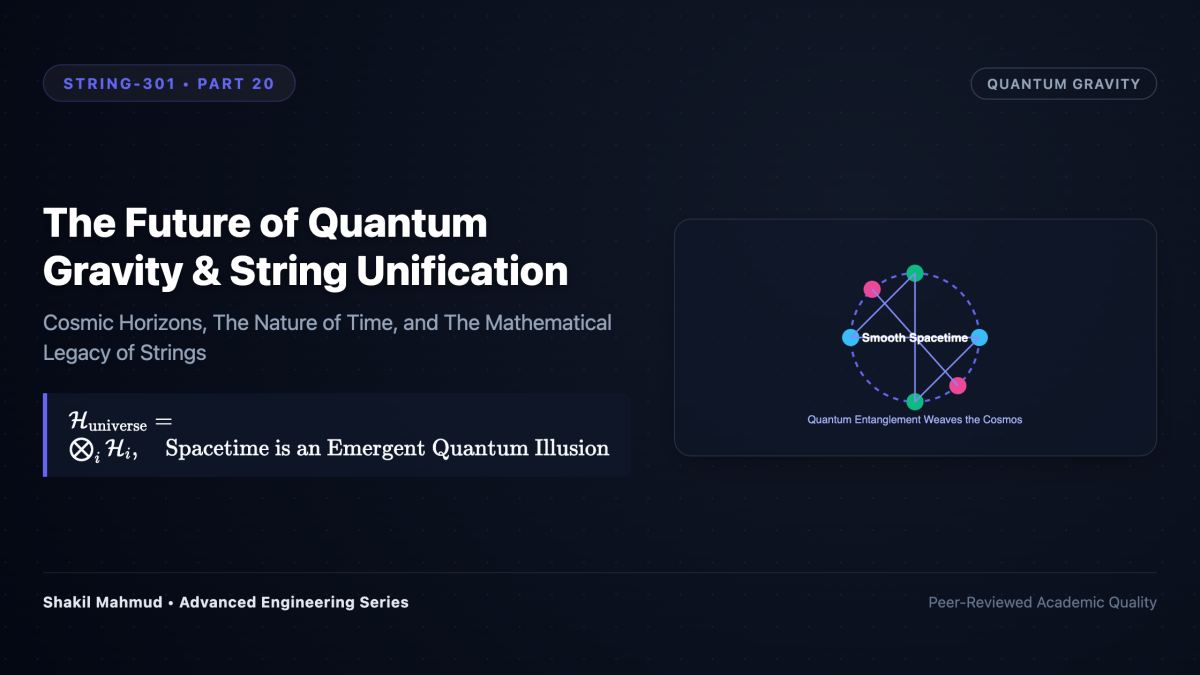
Over fifty years since Gabriele Veneziano wrote down an obscure dual resonance formula in 1968, String Theory has evolved from a hadronic scattering model into the most profound, mathematically sophisticated, and comprehensive framework for the complete unification of theoretical physics. It has dissolved the divide between point particles and geometry, unified five divergent superstring formalisms into 11-dimensional M-theory, established that gravity emerges holographically from quantum entanglement, and reshaped pure mathematics. In this final capstone, we synthesize the grand landscape of Modern String Theory, evaluate its open frontiers, and contemplate the ultimate nature of emergent spacetime and time itself.
1. The Grand Non-Perturbative Duality Web: Synthesis of M-Theory
The defining triumph of the Second Superstring Revolution was the realization that the five distinct 10-dimensional superstring theories are not independent universes, but perturbative expansions of a single unique underlying theory—M-Theory—around different asymptotic limits of moduli space:
| Theory | Spacetime D | Duality Partner | Transformation Mechanism |
|---|---|---|---|
| Type IIA | 10D | 11D M-Theory | Strong coupling: (R_{11} = g_s ll_s o infty); D0-branes form KK modes |
| Type IIA | 10D | Type IIB | T-Duality on circle (S^1): (R leftrightarrow alpha’/R), odd/even D-branes map |
| Type IIB | 10D | Type IIB | (SL(2, mathbb{Z})) S-Duality: (g_s leftrightarrow 1/g_s), F-strings swap with D1-strings |
| Type I | 10D | Heterotic (SO(32)) | S-Duality: Strong coupling of Type I is weak coupling of Heterotic (SO(32)) |
| Heterotic (E_8 imes E_8) | 10D | 11D M-Theory on (S^1/mathbb{Z}_2) | Horava-Witten compactification: (E_8) gauge sectors reside on 10D orbifold boundaries |
Every point in this interconnected moduli space is physically continuous. Physics is fundamentally unique; what changes is only the language used to describe it at different energy scales.
2. Holography and Quantum Error Correcting Codes
The discovery of AdS/CFT revealed that spacetime geometry is an emergent macroscopic approximation. In 2015, Almheiri, Dong, and Harlow made a stunning discovery connecting holography to quantum computation: AdS/CFT is a Quantum Error-Correcting Code (QECC):
- The bulk interior degrees of freedom are the logical qubits, while the boundary CFT degrees of freedom are the physical qubits.
- Information located deep in the bulk is redundantly encoded across entangled boundary subregions. If a portion of the boundary is erased or lost, the bulk operator can still be reconstructed perfectly from the remaining subregions through entanglement wedge reconstruction!
- Spacetime smooths out and protects quantum information against local environmental decoherence. Geometry is the error-correcting architecture of quantum mechanics.
3. The Grand Unresolved Frontiers
Despite its mathematical majesty, string theory confronts profound open challenges that define the frontline of modern research:
- The Cosmological Constant and de Sitter Spacetime: While AdS/CFT is rigorously understood for negative cosmological constants ((Lambda 0)). Formulating a microscopically exact theory of quantum gravity in expanding de Sitter space (dS/CFT) remains one of theoretical physics’ greatest open puzzles due to the absence of a spatial boundary and the presence of dynamic observer horizons.
- The Nature of Emergent Time: Holography demonstrates that spatial dimensions emerge from boundary entanglement, but what about time? If space is emergent, time and causality must also be emergent features of a more fundamental, timeless quantum information state.
- Direct Experimental Verification: Because the characteristic string length (ll_s sim 10^{-35}) meters is far beyond direct particle accelerator probes, experimental tests rely on cosmological relics (primordial gravitational waves, cosmic superstring loops, CMB non-Gaussianities) and precision tabletop tests of the Equivalence Principle and fifth forces.
4. The Paradigm Shift of the 21st Century
Classical physics assumed that continuous spacetime was the fundamental stage, with matter moving upon it. String theory has completely inverted this paradigm:
Continuous spacetime, gravity, and locality are not fundamental. They are macroscopic thermodynamic illusions emerging from the quantum entanglement, quantum informational complexity, and algebraic dualities of microscopic degrees of freedom.
As string theory enters its second half-century, it stands not merely as a candidate for unifying the four fundamental forces, but as the conceptual crucible forging the new physics of the quantum century.