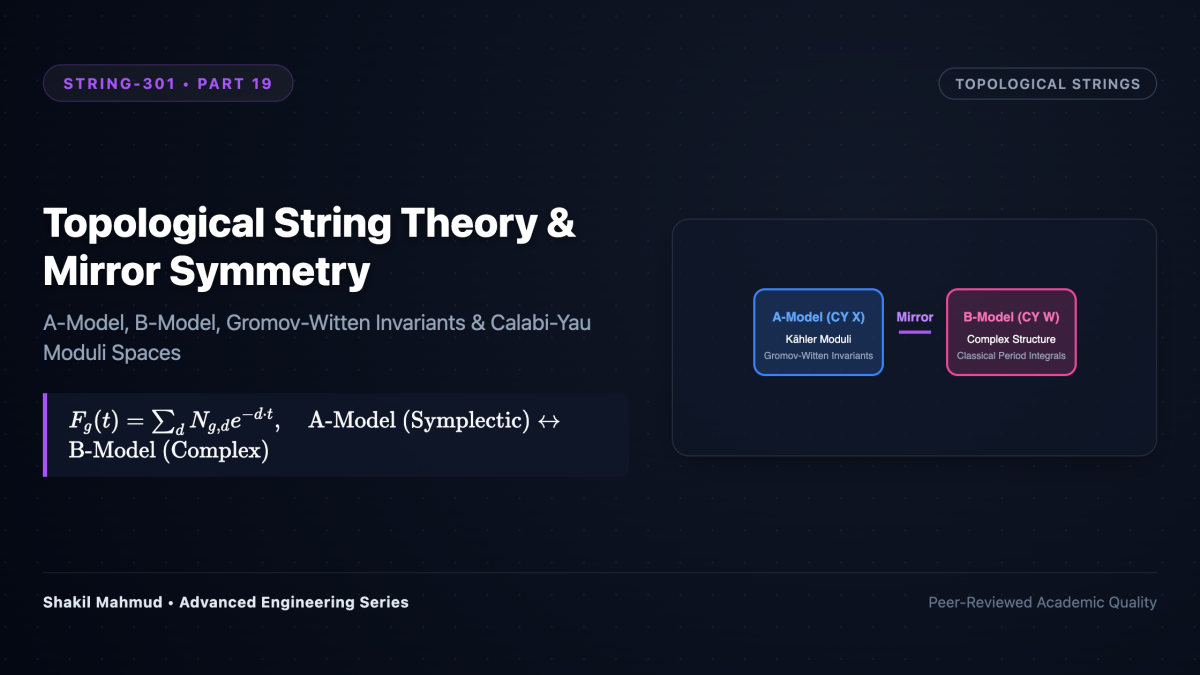
Topological String Theory represents one of the most fruitful symbioses between modern theoretical physics and pure algebraic geometry. By performing a topological twist on the two-dimensional ((2,2)) superconformal worldsheet theory, physical spacetime fluctuations freeze, isolating pure topological invariants. The resulting theories—the A-Model (governed by symplectic geometry and instantons) and the B-Model (governed by complex structure deformation and classical variation of Hodge structures)—are linked by Mirror Symmetry, solving enumerative algebraic geometry problems that defied mathematicians for centuries.
1. The Topological Twist of ((2,2)) Superconformal Field Theory
Consider a 2D sigma model with ((2,2)) supersymmetry mapping a worldsheet (Sigma) into a Calabi-Yau three-fold (X). The global symmetry algebra contains (U(1)_V) (vector) and (U(1)_A) (axial) (R)-symmetries. Coupling the Lorentz spin connection (omega) to the (R)-symmetry currents yields two distinct topological twists:
- The A-Twist (A-Model): The Lorentz spin generator (J) is shifted by the vector (R)-charge: (J’ = J + J_V). Under this twist, the scalar BRST supercharge is (Q_A = G_+^V + bar{G}_-^V) satisfying (Q_A^2 = 0). The physical observables depend solely on the Kähler (symplectic) structure of (X), completely independent of its complex structure.
- The B-Twist (B-Model): The Lorentz spin generator is shifted by the axial (R)-charge: (J’ = J + J_A). The scalar BRST operator is (Q_B = bar{G}_+^A + bar{G}_-^A). The physical observables depend solely on the complex structure of (X), completely invariant under changes in its volume or Kähler metric.
2. The A-Model and Gromov-Witten Invariants
In the A-model, worldsheet instantons—holomorphic maps (phi: Sigma_g o X) wrapping 2-cycles (beta in H_2(X, mathbb{Z}))—contribute to the topological free energy at genus (g):
[
mathcal{F}_g^A(t) = sum_{beta in H_2(X, mathbb{Z})} N_{g, beta} , e^{-int_beta omega_{mathbb{C}}} = sum_beta N_{g, beta} q^beta
]
where (N_{g, beta}) are the Gromov-Witten Invariants: rational numbers that count the virtual number of holomorphic curves of genus (g) and degree (beta) passing through specified cycles in (X). In classical mathematics, computing these numbers for higher degrees was an insurmountable challenge.
3. Mirror Symmetry: Candelas, de la Ossa, Green, and Parkes
Mirror symmetry asserts that every Calabi-Yau manifold (X) possesses a mirror partner (Y) such that their Hodge numbers are transposed:
[
h^{1,1}(X) = h^{2,1}(Y), qquad h^{2,1}(X) = h^{1,1}(Y)
]
and the A-model on (X) is exactly equivalent to the B-model on (Y):
[
mathcal{F}_g^A(X; t) = mathcal{F}_g^B(Y; z)
]
In 1991, Philip Candelas and collaborators used this equivalence to compute the number of rational curves (genus (g=0)) of arbitrary degree (d) on the quintic three-fold in (mathbb{P}^4). In the B-model on mirror quintic (Y), there are no quantum instanton corrections at all! The free energy is determined entirely by classical periods of the holomorphic 3-form (Omega(z)) satisfying the Picard-Fuchs differential equation:
[
left[ heta^4 – 5z (5 heta+1)(5 heta+2)(5 heta+3)(5 heta+4)
ight] Pi(z) = 0 quad left( heta quiv z rac{d}{dz}
ight)
]
Solving this ordinary differential equation yielded the exact number of rational curves for all degrees simultaneously:
| Degree (d) | Number of Degree-(d) Rational Curves (n_d) on Quintic Three-Fold |
|---|---|
| (d = 1) (Lines) | 2,875 (Known since Schubert, 1879) |
| (d = 2) (Conics) | 609,250 (Known since Katz, 1986) |
| (d = 3) (Cubics) | 317,206,375 (String Theory corrected math errors in 1991) |
| (d = 4) (Quartics) | 242,467,530,000 |
| (d = 5) (Quintics) | 704,288,164,978,454,687,500 |
4. Homological Mirror Symmetry and the BCOV Holomorphic Anomaly
In 1994, Maxim Kontsevich elevated mirror symmetry to a profound category-theoretic conjecture: Homological Mirror Symmetry (HMS), establishing an equivalence between the derived Fukaya category of Lagrangian submanifolds in (X) (A-branes) and the bounded derived category of coherent sheaves on (Y) (B-branes):
[
D^b ext{Fuk}(X) cong D^b ext{Coh}(Y)
]
At higher genus ((g ge 1)), Bershadsky, Cecotti, Ooguri, and Vafa (BCOV) discovered that the topological string amplitudes satisfy a non-trivial differential equation known as the Holomorphic Anomaly Equation:
[
bar{partial}_{bar{i}} mathcal{F}_g = rac{1}{2} bar{C}_{bar{i}}^{jk} left( D_j D_k mathcal{F}_{g-1} + sum_{r=1}^{g-1} D_j mathcal{F}_r D_k mathcal{F}_{g-r}
ight)
]
The failure of (mathcal{F}_g) to be purely holomorphic arises from the boundary of moduli space where Riemann surfaces pinch and degenerate. This recursive differential equation allows the systematic computation of quantum invariants to arbitrary genus.