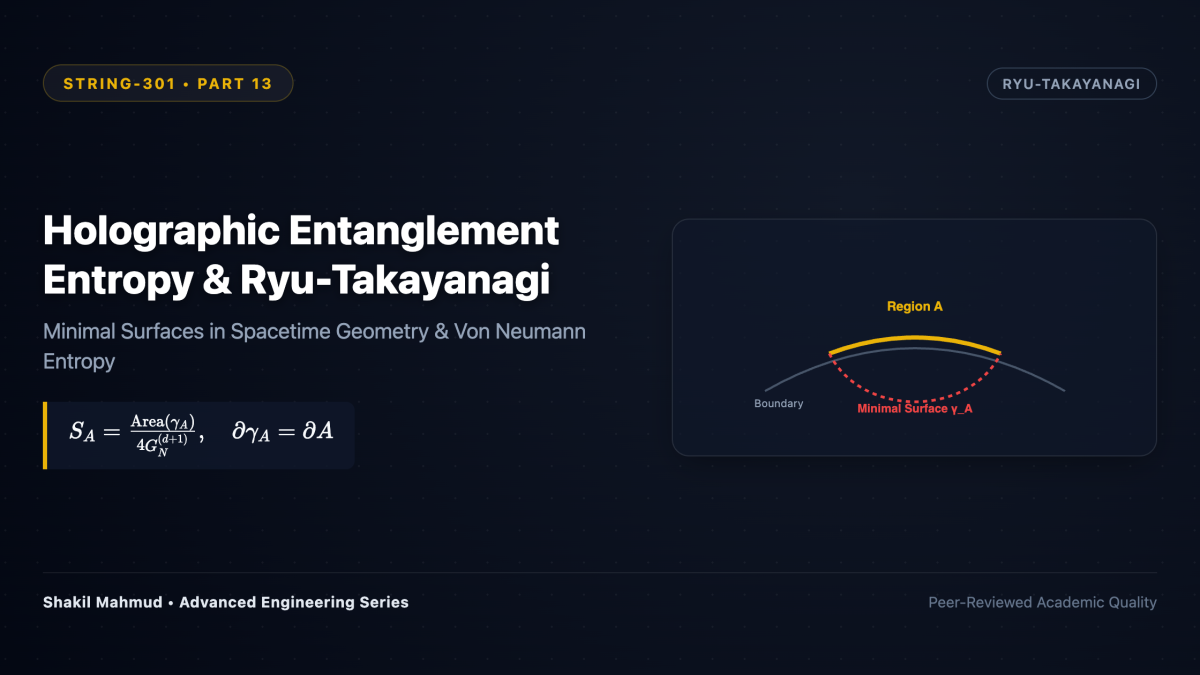
One of the most profound breakthroughs of 21st-century theoretical physics is the realization that spacetime geometry is woven directly from quantum entanglement. In 2006, Shinsei Ryu and Tadashi Takayanagi formulated a breathtakingly simple geometric proposal that computes the von Neumann entanglement entropy of a boundary subregion using the area of a minimal surface in the gravitational bulk. This part explores the Ryu-Takayanagi (RT) Formula, its derivation via the gravitational replica trick, subadditivity inequalities, and quantum extremal surfaces.
1. Entanglement Entropy in Quantum Field Theory
Consider a quantum field theory in a pure global state (|Psi
angle) with density matrix (
ho = |Psi
angle langlePsi|). Dividing a spatial Cauchy surface into a subsystem (A) and its spatial complement (B = A^c), the Hilbert space factorizes as (mathcal{H} = mathcal{H}_A otimes mathcal{H}_B). The state of subsystem (A) is described by the reduced density matrix obtained by tracing over the unobserved degrees of freedom in (B):
[
ho_A = ext{Tr}_B(
ho)
]
The measure of quantum entanglement between (A) and (B) is the von Neumann Entanglement Entropy:
[
S_A = – ext{Tr}_A(
ho_A ln
ho_A)
]
In continuum quantum field theory, (S_A) suffers from an ultraviolet area-law divergence (S_A propto ext{Area}(partial A) / psilon^{d-2}), making its direct analytic calculation notoriously difficult except in conformal field theories in (1+1) dimensions.
2. The Ryu-Takayanagi Formula
Ryu and Takayanagi conjectured that in static, asymptotically AdS spacetimes, the entanglement entropy of boundary region (A) is given by the area of a codimension-2 bulk minimal surface (gamma_A) anchored to the boundary (partial A):
[
S_A = rac{ ext{Area}(gamma_A)}{4 G_N^{(d+1)}}
]
where (gamma_A) satisfies three precise geometric requirements:
- Boundary Homology: The bulk surface (gamma_A) shares the exact same boundary as region (A): (partialgamma_A = partial A).
- Homology Constraint: There exists a spatial bulk hypersurface (r_A) such that (partial r_A = gamma_A cup A).
- Area Minimization: Among all homologous surfaces, (gamma_A) minimizes the Riemannian area functional:
[
delta left( int_{gamma_A} d^{d-1}sigma sqrt{det(g_{alphabeta})}
ight) = 0
]
In time-dependent spacetimes, Hubeny, Rangamani, and Takayanagi (HRT) generalized this to extremal surfaces with vanishing mean curvature vector.
3. Gravitational Replica Trick: Lewkowycz-Maldacena Derivation
In 2013, Aitor Lewkowycz and Juan Maldacena proved the RT formula rigorously by generalizing the field-theory replica trick to the gravitational path integral. In CFT, the von Neumann entropy is the limit of the Rényi entropies:
[
S_A = lim_{n o 1} S_n(A) = -lim_{n o 1} rac{partial}{partial n} ln ext{Tr}(
ho_A^n)
]
Computing ( ext{Tr}(
ho_A^n)) requires evaluating the Euclidean path integral on an (n)-sheeted branched cover manifold (mathcal{M}_n), branched along the boundary region (A). Under AdS/CFT, this path integral equals the bulk gravitational action on an asymptotically AdS manifold (mathcal{B}_n) whose boundary is (mathcal{M}_n):
[
ext{Tr}(
ho_A^n) approx e^{-I_{ ext{grav}}[mathcal{B}_n]}
]
Assuming replica symmetry (mathbb{Z}_n), the quotient space (hat{mathcal{B}}_n = mathcal{B}_n / mathbb{Z}_n) is a smooth manifold everywhere except on the fixed-point set of the (mathbb{Z}_n) isometry, where it possesses a conical singularity with deficit angle (Delta heta = 2pi(1 – 1/n)). Evaluating the Einstein-Hilbert action on this conical space isolates the codimension-2 singularity:
[
I_{ ext{grav}}[hat{mathcal{B}}_n] = I_{ ext{regular}} + left(1 – rac{1}{n}
ight) rac{ ext{Area}(gamma_A)}{4 G_N}
]
Differentiating with respect to (n) and taking (n o 1) recovers the RT formula exactly.
4. Entanglement Inequalities and Strong Subadditivity
Quantum mechanics demands that entanglement entropy satisfy fundamental information-theoretic inequalities. The RT formula proves these geometrically:
- Subadditivity: For any disjoint boundary regions (A) and (B):
[
S(A cup B) le S(A) + S(B)
]
Geometrically, the union of surfaces (gamma_A cup gamma_B) is homologous to (A cup B). Since the true minimal surface (gamma_{A cup B}) minimizes area, its area cannot exceed ( ext{Area}(gamma_A) + ext{Area}(gamma_B)). - Strong Subadditivity (SSA): For any three regions (A, B, C):
[
S(A cup B cup C) + S(B) le S(A cup B) + S(B cup C)
]
While proving SSA algebraically in quantum field theory is notoriously challenging (Lieb-Ruskai theorem), in bulk geometry it is an elementary consequence of rearranging minimal surface intersections.
5. Quantum Extremal Surfaces and Island Formula
Faulkner, Lewkowycz, and Maldacena (FLM) included bulk quantum field corrections, followed by Engelhardt and Wall’s formulation of Quantum Extremal Surfaces (QES):
[
S(A) = min_{gamma_A} ext{ext} left[ rac{ ext{Area}(gamma_A)}{4 G_N} + S_{ ext{bulk}}(Sigma_A)
ight]
]
This quantum-corrected generalized entropy provided the long-sought breakthrough in 2019 (Penington; Almheiri et al.) calculating the unitary Page Curve of evaporating black holes, proving that quantum information escapes black holes through non-trivial bulk entanglement islands.