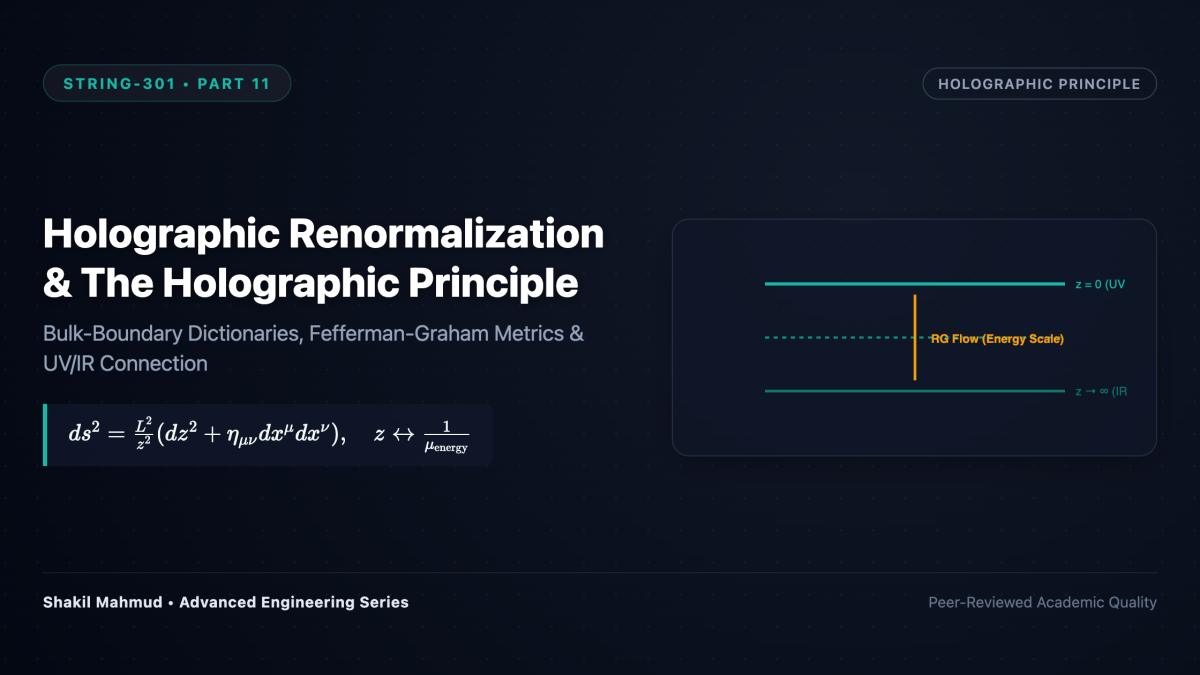
The Holographic Principle—originally conceived by Gerard ‘t Hooft and Leonard Susskind from black hole thermodynamics—posits that the information content of a spatial volume is bounded by its boundary area in Planck units. In the AdS/CFT correspondence, this principle finds its rigorous mathematical realization. However, mapping bulk classical gravity actions to field-theory correlation functions produces infinite bulk volume divergences. The resolution is Holographic Renormalization: an asymptotic geometric counterterm algorithm developed using the Fefferman-Graham expansion, perfectly mirroring the ultraviolet divergences of quantum field theory.
1. The Fefferman-Graham Metric and Asymptotically AdS Spacetimes
In differential geometry, any asymptotically Anti-de Sitter (AAdS) spacetime of dimension (d+1) can be represented in a neighborhood of the conformal boundary in Fefferman-Graham coordinates:
[
ds^2 = rac{L^2}{z^2} left( dz^2 + g_{mu
u}(x, z) dx^mu dx^
u
ight)
]
where (z > 0) is the radial coordinate, with the conformal boundary situated at (z = 0). As (z o 0), the metric tensor (g_{mu
u}(x, z)) admits a Taylor-like expansion in powers of (z^2):
[
g_{mu
u}(x, z) = g_{(0)mu
u}(x) + z^2 g_{(2)mu
u}(x) + z^4 g_{(4)mu
u}(x) + dots + z^d left( g_{(d)mu
u}(x) + h_{(d)mu
u}(x) ln(z^2)
ight) + mathcal{O}(z^{d+1})
]
Solving the bulk vacuum Einstein equations with negative cosmological constant (Lambda = -d(d-1)/(2L^2)):
[
R_{MN} – rac{1}{2} R G_{MN} + Lambda G_{MN} = 0
]
determines the lower-order coefficients (g_{(2)}, g_{(4)}, dots) purely algebraically in terms of the boundary metric (g_{(0)mu
u}) and its curvature tensors:
[
g_{(2)mu
u} = -rac{1}{d-2} left( R_{mu
u}[g_{(0)}] – rac{1}{2(d-1)} R[g_{(0)}] g_{(0)mu
u}
ight)
]
2. The Problem of Bulk Infrared Divergences
When computing the on-shell supergravity action (S_{ ext{on-shell}}) evaluated on classical solutions, the integral over the radial coordinate diverges as (z o 0) due to the infinite volume of AdS near the boundary:
[
S_{ ext{grav}} = -rac{1}{16pi G_{d+1}} int_{mathcal{M}} d^{d+1}x sqrt{-G} (R – 2Lambda) – rac{1}{8pi G_{d+1}} int_{partialmathcal{M}} d^d x sqrt{-gamma} K
]
where (K) is the trace of the extrinsic curvature of the boundary hypersurface ({z = psilon}). Under the holographic UV/IR connection, this infinite bulk volume divergence (bulk IR) corresponds precisely to the infinite ultraviolet divergence (boundary UV) of the dual boundary CFT.
3. Counterterm Subtraction and the Renormalized Holographic Action
Following de Haro, Solodukhin, and Skenderis (2001), holographic renormalization systematically regularizes and renormalizes the action by introducing an ultraviolet cutoff (z = psilon) and subtracting local boundary counterterms:
[
S_{ ext{ren}} = lim_{psilon o 0} left[ S_{ ext{bulk}}[psilon] + S_{ ext{GH}}[psilon] + S_{ ext{ct}}[psilon]
ight]
]
For (d = 4), the counterterm action (S_{ ext{ct}}) is explicitly composed of intrinsic curvature invariants of the induced metric (gamma_{mu
u} = rac{L^2}{psilon^2} g_{mu
u}(x, psilon)):
[
S_{ ext{ct}} = rac{1}{8pi G_5} int_{z=psilon} d^4x sqrt{-gamma} left( rac{3}{L} + rac{L}{4} mathcal{R} – rac{L^3}{32} left( mathcal{R}_{mu
u}mathcal{R}^{mu
u} – rac{1}{3}mathcal{R}^2
ight) ln psilon
ight)
]
4. The Holographic Stress-Energy Tensor and Conformal Anomaly
Functional differentiation of the renormalized action with respect to the boundary metric (g_{(0)}^{mu
u}) yields the expectation value of the quantum stress-energy tensor in the CFT:
[
langle T_{mu
u}
angle_{ ext{CFT}} = rac{2}{sqrt{-g_{(0)}}} rac{delta S_{ ext{ren}}}{delta g_{(0)}^{mu
u}} = rac{d L^{d-1}}{16pi G_{d+1}} left( g_{(d)mu
u} – X_{mu
u}[g_{(0)}]
ight)
]
Taking the trace reveals the Holographic Conformal (Trace) Anomaly:
[
langle T^mu_mu
angle = rac{L^3}{16pi G_5} left( rac{1}{8} left( mathcal{R}_{mu
u}mathcal{R}^{mu
u} – rac{1}{3}mathcal{R}^2
ight)
ight) = rac{c}{16pi^2} C_{mu
u
hosigma} C^{mu
u
hosigma} – rac{a}{16pi^2} E_4
]
Matching the central charges in (mathcal{N}=4) SYM: (c = a = rac{N^2}{4}). The exact reproduction of quantum anomalies from purely classical differential geometry stands as one of holography’s most triumphant confirmations.
5. The UV/IR Connection and Degrees of Freedom
The UV/IR connection explains why a ((d+1))-dimensional gravitational theory can be encoded in a (d)-dimensional non-gravitational boundary theory without losing information:
- In quantum gravity, high-energy collisions do not probe arbitrarily small distances; instead, they create black holes whose horizon area grows with energy ((R_s propto E)). The UV regime of gravity is inherently an IR regime of geometry.
- A boundary region of spatial size (delta x) interacts with bulk modes situated at radial depth (z sim delta x). High energy (UV, small (delta x)) is localized near the boundary ((z o 0)), while low energy (IR, large (delta x)) penetrates deep into the interior ((z o infty)).
- The holographic entropy bound confirms that the maximum entropy in a bulk volume of radius (R) satisfies (S le A / (4 G_N)), matching the maximum number of degrees of freedom in the boundary theory (S_{ ext{CFT}} sim N^2 V_3 T^3).