Perturbative string theory defines physical scattering amplitudes by summing two-dimensional Riemann surfaces over topological genus expansions: (S = sum_g g_s^{2g-2} mathcal{A}_g). While mathematically elegant, this definition is inherently tied to a fixed classical background metric, lacking manifest Background Independence, and fails to capture non-perturbative phenomena such as vacuum transitions and D-brane decay. String Field Theory (SFT) overcomes these limitations by promoting the entire string configuration into a dynamical quantum field (Psi[X(sigma)]), achieving an off-shell, non-perturbative formulation governed by infinite-dimensional gauge symmetries.
1. Witten’s Cubic Open String Field Theory Action
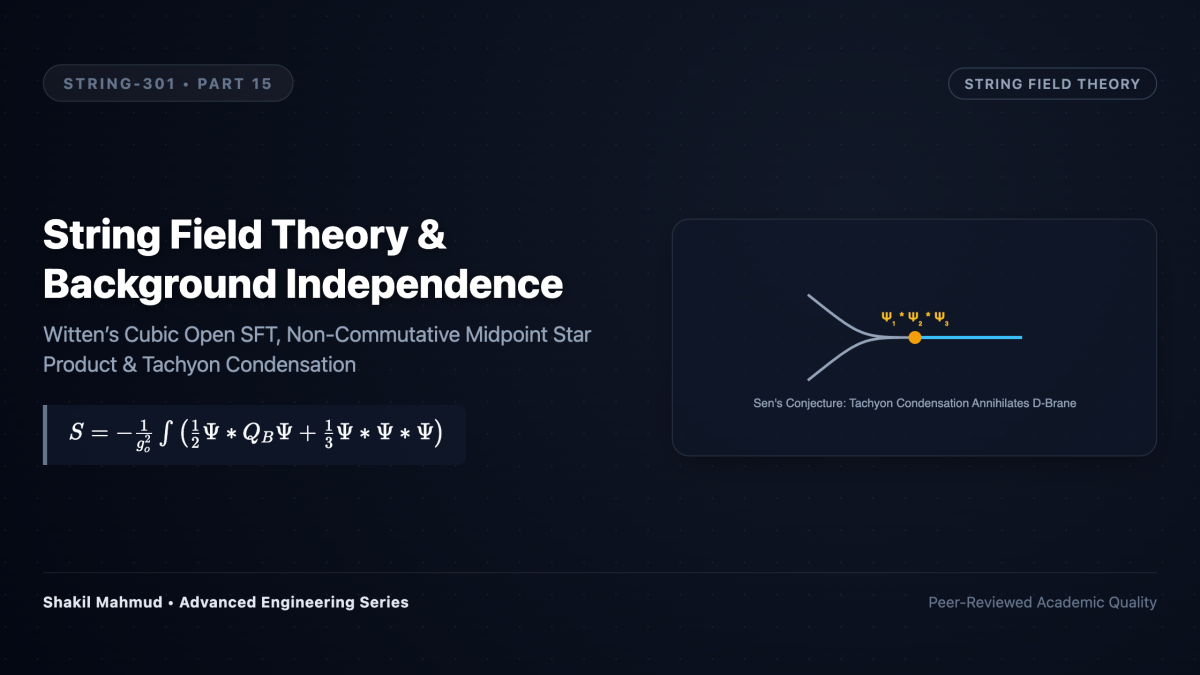
In 1986, Edward Witten formulated cubic open bosonic string field theory by drawing a profound geometric analogy to non-abelian Chern-Simons gauge theory. The string field (Psi) is a state in the first-quantized open string Hilbert space of ghost number 1:
[
|Psi
angle = left( phi(x) + A_mu(x) alpha_{-1}^mu + T(x) c_1 + dots
ight) |0
angle
]
where (T(x)) is the scalar tachyon, (A_mu(x)) is the Yang-Mills gauge vector, and dots represent an infinite tower of massive string excitations. Witten’s classical action is:
[
S[Psi] = -rac{1}{g_o^2} left( rac{1}{2} int Psi * Q_B Psi + rac{1}{3} int Psi * Psi * Psi
ight)
]
The three fundamental mathematical structures in this action are:
- The BRST Operator (Q_B): A nilpotent, anticommuting differential operator ((Q_B^2 = 0)) of ghost number 1 acting as the exterior derivative: (d o Q_B).
- The Star Product ((*)): A non-commutative, associative gluing operation (Psi_1 * Psi_2) that joins the right half of the string (sigma in [pi/2, pi]) of (Psi_1) to the left half (sigma in [0, pi/2]) of (Psi_2) via delta-function overlaps.
- The Integration Map ((int)): A trace operation that glues the left and right halves of a single open string together, satisfying cyclic invariance: (int A * B = (-1)^{|A||B|} int B * A).
2. Gauge Invariance and the Equation of Motion
The cubic action is invariant under the non-abelian gauge transformation parameterized by an arbitrary ghost number 0 string field (Lambda):
[
delta Psi = Q_B Lambda + Psi * Lambda – Lambda * Psi
]
Varying the action yields the stunningly compact non-linear equation of motion for the string field:
[
Q_B Psi + Psi * Psi = 0
]
This single algebraic equation encapsulates the full infinite set of coupled non-linear equations of motion for every particle in the infinite string spectrum—from massless Maxwell/Yang-Mills bosons to infinitely high-spin Regge states.
3. Sen’s Conjectures on Tachyon Condensation
The bosonic string (and non-BPS D-brane systems in superstrings) features an open string tachyon with negative mass squared (M^2 = -1/alpha’). In standard perturbative physics, this indicates an unstable false vacuum. In 1999, Ashoke Sen proposed three revolutionary conjectures governing the rolling of the tachyon:
- Tachyon Potential Depth: The energy difference between the unstable perturbative vacuum ((Psi = 0)) and the true minimum ((Psi = Psi_0)) of the tachyon potential exactly equals the total tension and mass of the D-brane:
[
Delta V = V(0) – V(Psi_0) = T_{ ext{D}}
]
where (T_{ ext{D}p} = rac{1}{(2pi)^p g_s ll_s^{p+1}}). - Absence of Open Strings (The Tachyon Vacuum): At the true stable minimum (Psi_0), the D-brane completely disintegrates and dissolves into closed string radiation. Consequently, there are no physical open string excitations around the tachyon vacuum: the BRST cohomology of the operator (mathcal{Q} = Q_B + [Psi_0, cdot]_*) is strictly trivial:
[
H^*(mathcal{Q}) = 0
] - Lower-Dimensional D-Branes as Solitons: Stable lower-dimensional D((p-2k))-branes emerge as topological solitons (lumps or vortex solutions) of the tachyon field on higher-dimensional non-BPS D(p)-branes.
Using level-truncation approximations in Witten’s SFT, Kostelecky, Samuel, and Sen verified that the depth of the numerical tachyon potential matches the D-brane tension to over (99.91%) accuracy, providing irrefutable non-perturbative proof of string field theory.
4. Closed String Field Theory and Background Independence
Formulating Closed String Field Theory is substantially more intricate because closed strings interact through Riemann surfaces of arbitrary moduli. Developed by Zwiebach (1993), closed SFT requires a non-polynomial action governed by an (L_infty) (strongly homotopy Lie) algebra:
[
S[Phi] = rac{1}{2} langle Phi, Q_B Phi
angle + sum_{n=3}^{infty} rac{1}{n!} { Phi^n }
]
A truly background-independent formulation of closed SFT would allow the metric of spacetime itself to be nothing more than a specific classical expectation value of the string field (Phi_0), demonstrating that spacetime geometry is not a fundamental prerequisite, but a dynamically chosen vacuum configuration of string fields.