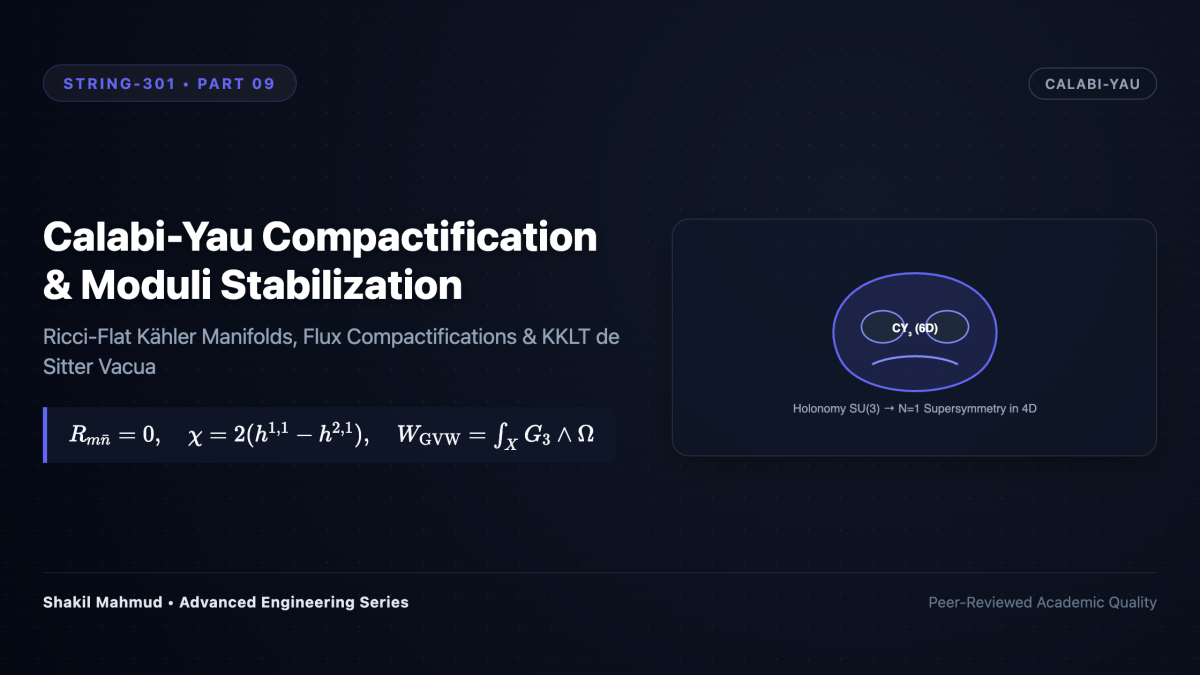
Superstring theory achieves quantum consistency and anomaly cancellation strictly in 10 spacetime dimensions. To describe our observable four-dimensional universe, six spatial dimensions must be compactified onto an internal compact space (X_6). The geometry and topology of this internal manifold dictate every fundamental law of 4D physics: gauge groups, chiral fermion representations, Yukawa couplings, and cosmological parameters. This part explores Calabi-Yau Compactification, (SU(3)) holonomy, Hodge diamond topology, and the breakthrough KKLT Moduli Stabilization Mechanism that yields metastable de Sitter vacua matching dark energy observations.
1. Preserving (mathcal{N}=1) Supersymmetry and (SU(3)) Holonomy
To produce a realistic four-dimensional effective field theory with low-energy supersymmetry ((mathcal{N}=1)), the 10-dimensional spacetime is factorized into the direct product:
[
mathcal{M}_{10} = mathcal{M}_{1,3} imes X_6
]
where (mathcal{M}_{1,3}) is 4D Minkowski spacetime and (X_6) is a compact 6-dimensional Riemannian manifold. Supersymmetry invariance requires the vanishing of the gravitino variation under supersymmetry transformation parameters (psilon):
[
delta psi_M =
abla_M psilon + rac{1}{4cdot 24} (Gamma_M{}^{NPQR} – 8delta_M^N Gamma^{PQR}) H_{NPQR} psilon = 0
]
In the absence of background fluxes ((H=0)), the condition reduces to the existence of a globally covariantly constant, non-vanishing spinor on (X_6):
[
abla_m ta = 0 quad (m = 1, dots, 6)
]
For a Riemannian manifold of dimension 6, the generic holonomy group is (SO(6) cong SU(4)). The existence of a single covariantly constant spinor decomposes the 4-spinor representation under a subgroup: (mathbf{4} o mathbf{3} oplus mathbf{1}). This requires the restricted holonomy group of (X_6) to be strictly contained within (SU(3)):
[
ext{Hol}(g) subseteq SU(3)
]
2. Calabi-Yau Manifolds: Kähler Geometry and Yau’s Theorem
A compact Riemannian manifold (X) with (SU(3)) holonomy is defined as a Calabi-Yau three-fold ((CY_3)). Mathematically, it satisfies three equivalent foundational criteria:
- Kähler Metric: The manifold admits a complex structure (J) and a compatible metric (g) such that the fundamental 2-form (omega_{mbar{n}} = i g_{mbar{n}}) is closed: (domega = 0).
- Ricci-Flatness: In 1978, Shing-Tung Yau proved the Calabi Conjecture: any compact Kähler manifold with vanishing first Chern class ((c_1(X) = 0)) admits a unique Ricci-flat Kähler metric in each Kähler class:
[
R_{mbar{n}} = partial_m partial_{bar{n}} ln det(g) = 0
] - Holomorphic Volume Form: There exists a unique, globally defined, nowhere-vanishing holomorphic ((3,0))-form (Omega):
[abla_m Omega_{npq} = 0, quad dOmega = 0
]
3. Hodge Diamond and Moduli of Calabi-Yau Manifolds
The topological characteristics of a Calabi-Yau manifold are encoded in its Hodge numbers (h^{p,q} = dim H^{p,q}(X_6, mathbb{C})), arranged in the symmetric Hodge diamond:
| Hodge Diamond of a Calabi-Yau Three-Fold | ||||||
|---|---|---|---|---|---|---|
| (h^{0,0} = 1) | ||||||
| (h^{1,0} = 0) | (h^{0,1} = 0) | |||||
| (h^{2,0} = 0) | (h^{1,1}) | (h^{0,2} = 0) | ||||
| (h^{3,0} = 1) | (h^{2,1}) | (h^{1,2} = h^{2,1}) | (h^{0,3} = 1) | |||
| (h^{3,1} = 0) | (h^{2,2} = h^{1,1}) | (h^{1,3} = 0) | ||||
| (h^{3,2} = 0) | (h^{2,3} = 0) | |||||
| (h^{3,3} = 1) | ||||||
The Euler characteristic (chi(X_6)) is given by:
[
chi(X_6) = 2(h^{1,1} – h^{2,1})
]
In 4D (mathcal{N}=1) effective field theory, fluctuations in the Calabi-Yau geometry appear as massless scalar fields known as Moduli:
- Kähler Moduli ((h^{1,1})): Deformations of the sizes and volumes of internal 2-cycles and 4-cycles, parameterized by the complexified Kähler form (T_i = b_i + i t_i = int_{Sigma_i} (B_2 + i omega)).
- Complex Structure Moduli ((h^{2,1})): Deformations of the shapes and angles of the manifold that preserve the complex structure, parameterized by harmonic ((2,1))-forms (int_{A_a} Omega = z^a).
4. The Moduli Problem and Flux Compactification
Unstabilized moduli are disastrous for phenomenology: massless scalars mediate long-range fifth forces violating the Equivalence Principle, and their expectation values determine gauge couplings ((g_{YM}^{-2} propto ext{Vol}(X_6))). Thus, moduli must acquire non-zero potential energy and masses.
Turning on non-trivial background Ramond-Ramond ((F_3)) and Neveu-Schwarz ((H_3)) flux integers over 3-cycles generates the celebrated Gukov-Vafa-Witten (GVW) Superpotential:
[
W_{ ext{flux}} = int_{X_6} Omega wedge (F_3 – au H_3)
]
where ( au = C_0 + i e^{-phi}) is the axio-dilaton. The (F)-term supersymmetry conditions:
[
D_a W = partial_a W + W partial_a K = 0
]
generate non-zero masses for all complex structure moduli (z^a) and the axio-dilaton ( au). However, the Kähler moduli (T) do not appear in (W_{ ext{flux}}) due to the no-scale structure of Type IIB string theory, remaining completely unconstrained at tree-level.
5. The KKLT Mechanism: Achieving Stable de Sitter Vacua
In 2003, Shamit Kachru, Renata Kallosh, Andrei Linde, and Sandip Trivedi (KKLT) resolved the stabilization of Kähler moduli and demonstrated how positive cosmological constants (de Sitter vacua) can arise in string theory through a three-stage mechanism:
- Tree-Level Flux Stabilization: Fluxes fix ( au) and (z^a), yielding a constant effective superpotential value (W_0 = langle W_{ ext{flux}}
angle). - Non-Perturbative Kähler Moduli Stabilization: Non-perturbative effects (such as Euclidean D3-brane instantons wrapping a 4-cycle, or gaugino condensation in a pure Yang-Mills (SU(N)) gauge theory on a stack of wrapped D7-branes) introduce an exponential dependence in the superpotential:
[
W(T) = W_0 + A e^{-a T}
]
where (a = 2pi / N). Combined with the Kähler potential (K = -3ln(T + bar{T})), the (F)-term scalar potential:
[
V_F = e^K left( K^{Tbar{T}} |D_T W|^2 – 3 |W|^2
ight)
]
develops an isolated, supersymmetric, negative minimum: an Anti-de Sitter (AdS) Vacuum at:
[
D_T W = partial_T W + W partial_T K = 0 implies -a A e^{-a T} = rac{3 (W_0 + A e^{-a T})}{2 ext{Re}(T)}
] - Uplift to Positive Cosmological Constant: Introducing an anti-D3-brane ((overline{ ext{D3}})) placed at the tip of a highly warped throat (such as the Klebanov-Strassler deformed conifold) contributes a positive, supersymmetry-breaking energy density:
[
delta V_{ ext{uplift}} = rac{D}{( ext{Re}(T))^2} = rac{2 T_3 e^{4A_0}}{( ext{Re}(T))^2}
]
where (e^{A_0} ll 1) is the warp factor that exponentially suppresses the uplift energy. This elevates the negative AdS vacuum into a metastable de Sitter (dS) vacuum with (V > 0), perfectly accommodating dark energy and cosmic acceleration.