Cosmic inflation provides our most successful paradigm for solving the horizon and flatness problems while generating the primordial density perturbations seeded in the Cosmic Microwave Background (CMB). However, standard field-theoretic models of inflation suffer from the notorious “eta-problem”—where high-scale quantum gravity corrections spoil the delicate flatness of the inflaton potential. In string cosmology, inflation is realized dynamically through the physical motion of Dirichlet branes propagating through warped extra dimensions. This part examines D-Brane Inflation, the KKLMMT model, Dirac-Born-Infeld (DBI) relativistic field dynamics, and cosmic superstring relics.
1. The Eta-Problem in Quantum Gravity
Slow-roll inflation requires the slow-roll parameters to be much smaller than unity:
[
psilon = rac{M_{ ext{Pl}}^2}{2} left( rac{V’}{V}
ight)^2 ll 1, qquad ta = M_{ ext{Pl}}^2 rac{V”}{V} ll 1
]
In quantum gravity, Planck-suppressed dimension-6 operators (Deltamathcal{L} = rac{mathcal{O}_4 phi^2}{M_{ ext{Pl}}^2}) generically induce a mass correction (Delta m^2 sim V / M_{ ext{Pl}}^2), giving:
[
Delta ta = M_{ ext{Pl}}^2 rac{Delta V”}{V} sim 1
]
This lifts the mass of the inflaton to the Hubble scale ((m sim H)), terminating slow-roll inflation prematurely after only a couple of e-folds instead of the required (N_e ge 60). Solving the eta-problem requires embedding the inflaton within a fully controlled quantum gravity framework.
2. Brane Inflation and the KKLMMT Model
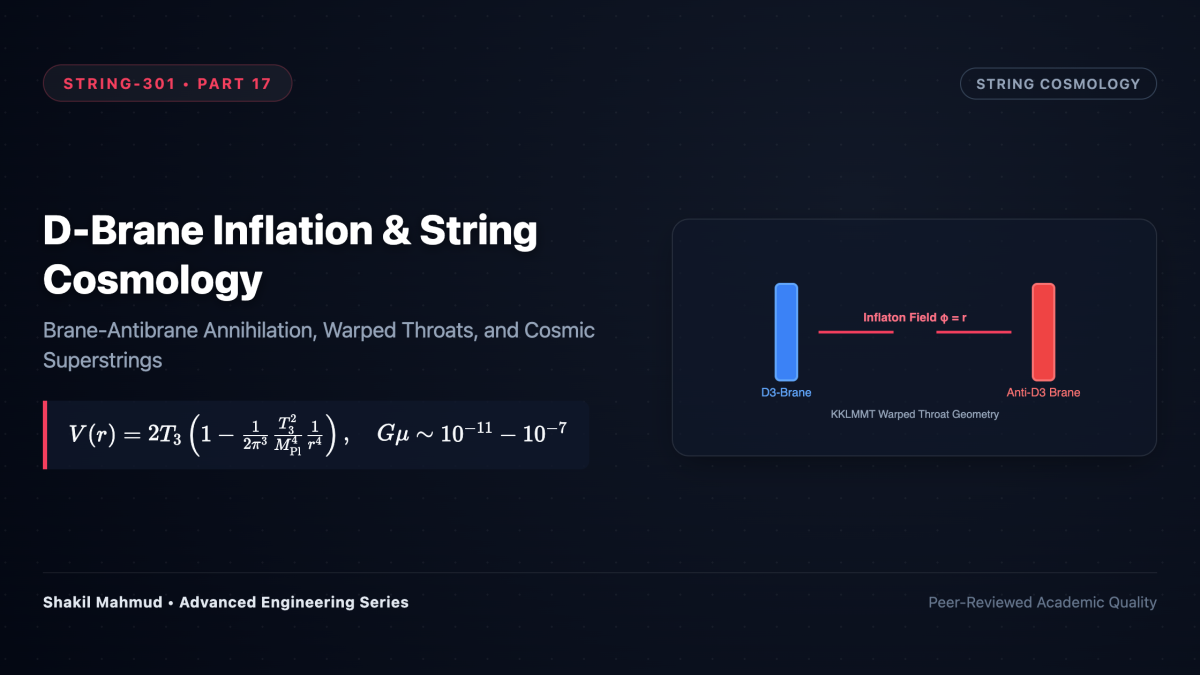
In 1998, Gia Dvali and Henry Tye proposed that the inflaton field (phi) is the physical spatial separation (r) between a D3-brane and an anti-D3-brane ((overline{ ext{D3}})) moving through the compactified internal dimensions. In 2003, Kachru, Kallosh, Linde, Maldacena, McAllister, and Trivedi (KKLMMT) developed a fully stabilized realization within warped flux compactifications.
The anti-D3-brane is drawn down to the tip of a strongly warped Klebanov-Strassler deformed conifold (throat), where its tension is exponentially red-shifted: (T_3^{ ext{eff}} = h_0^4 T_3 ll M_{ ext{Pl}}^4). A mobile D3-brane falls slowly down the throat toward the anti-D3-brane under their mutual gravitational and Ramond-Ramond attraction:
[
V(r) = 2 T_3 h^4(r) left( 1 – rac{1}{2pi^3} rac{T_3}{M_{ ext{Pl}}^4} rac{1}{r^4}
ight)
]
The canonical inflaton field is related to radial distance by (phi = sqrt{T_3} , r). The warp factor (h(r) propto r/L) dynamically balances the conformal curvature corrections, keeping (ta ll 1) over sufficient e-folds to sustain inflation.
3. Dirac-Born-Infeld (DBI) Inflation
When the D3-brane accelerates rapidly down the warped throat, its motion is governed not by the standard slow-roll kinetic term, but by the fully non-linear Dirac-Born-Infeld (DBI) Action:
[
S_{ ext{DBI}} = -int d^4x sqrt{-g} left[ rac{1}{f(phi)} left( sqrt{1 – f(phi)dot{phi}^2} – 1
ight) + V(phi)
ight]
]
where (f(phi) = rac{lambda}{phi^4}) is the warp geometry function. The local speed of sound for scalar perturbations is:
[
c_s = sqrt{1 – f(phi)dot{phi}^2} le 1
]
As the brane approaches the local speed of light in the throat ((dot{phi}^2 o 1/f(phi))), the relativistic Lorentz factor (gamma = 1/c_s gg 1) diverges. Relativistic inertia restricts the brane’s speed, allowing prolonged inflation even in potentials that are far too steep for conventional slow-roll inflation! This predicts distinct observational signatures in the primordial bispectrum: large equilateral non-Gaussianity (f_{ ext{NL}}^{ ext{equil}} propto -1/c_s^2).
4. Brane Annihilation and Cosmic Superstring Relics
Inflation terminates when the D3-brane collides with the anti-D3-brane at the throat tip. The open strings stretched between them become tachyonic, condensing via Sen’s mechanism. The branes annihilate completely, releasing their tension into reheat radiation that populates the Hot Big Bang.
Via the Kibble-Zurek mechanism, this annihilation process leaves behind lower-dimensional topological defects: 1-dimensional D1-branes (D-strings) and fundamental strings (F-strings), bound into ((p, q))-cosmic superstring networks. Stretched to macroscopic cosmic lengths by cosmic expansion, these strings emit distinct gravitational wave bursts detectable by pulsar timing arrays (NANOGrav) and space-based interferometers (LISA).