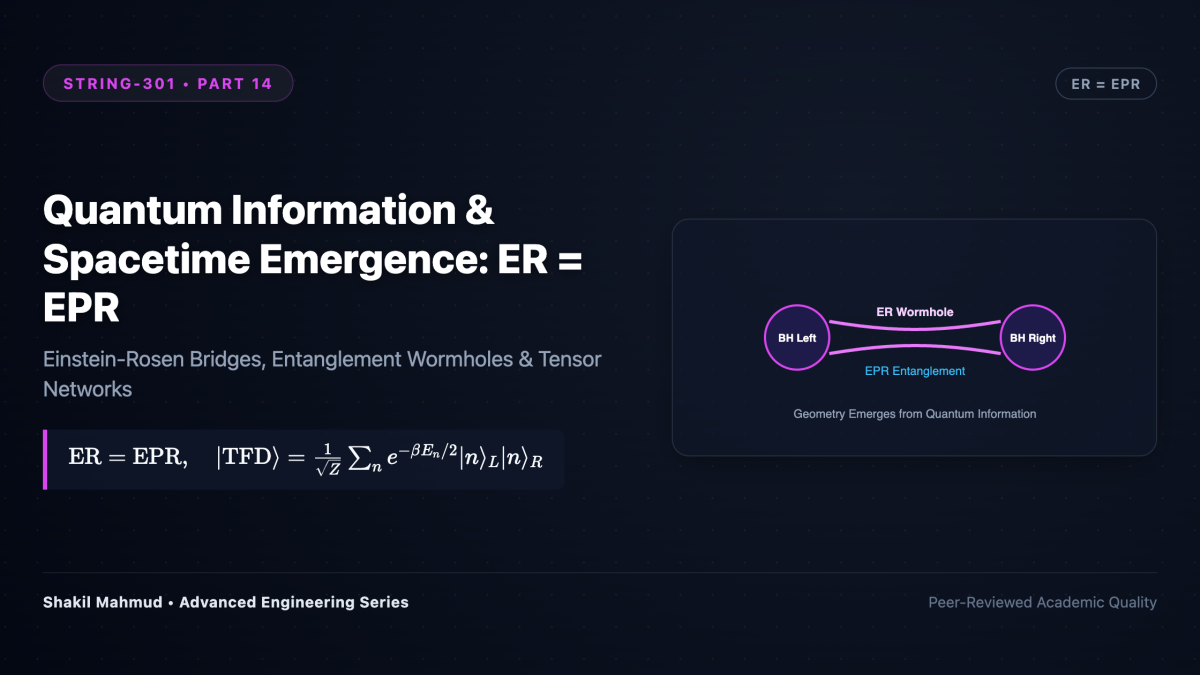
In 1935, Albert Einstein co-authored two foundational papers that initially seemed unrelated: one with Boris Podolsky and Nathan Rosen pointing out quantum entanglement (EPR), and another with Rosen describing non-traversable wormholes or bridges in general relativity (ER). In 2013, Juan Maldacena and Leonard Susskind made the radical proposal that these two phenomena are physically identical: ER = EPR. Geometric connectivity in spacetime is literally the manifest physical expression of quantum entanglement, laying the blueprint for how smooth spacetime emerges from discrete quantum informational tensor networks.
1. The Thermofield Double State and Eternal Black Holes
The clearest mathematical demonstration of ER = EPR is the holographic description of the maximally extended eternal AdS-Schwarzschild black hole. In classical general relativity, the Penrose conformal diagram of an eternal black hole features two asymptotically AdS asymptotic boundaries (Left (L) and Right (R)) connected in the interior by an Einstein-Rosen (ER) bridge (wormhole).
Under AdS/CFT, the quantum state on the boundary consists of two uncoupled, non-interacting copies of the conformal field theory (( ext{CFT}_L) and ( ext{CFT}_R)) prepared in a specially entangled state known as the Thermofield Double (TFD) State:
[
| ext{TFD}
angle = rac{1}{sqrt{Z(beta)}} sum_{n} e^{-beta E_n / 2} |n
angle_L otimes |n^*
angle_R
]
where (beta = 1/T_H) is the inverse Hawking temperature, and (|n^*
angle = Theta |n
angle) is the time-reversed energy eigenstate. Tracing out either CFT yields an exact thermal density matrix:
[
ho_R = ext{Tr}_L | ext{TFD}
angle langle ext{TFD}| = rac{1}{Z(beta)} sum_{n} e^{-beta E_n} |n
angle_R langle n|_R = rac{e^{-beta H_R}}{Z(beta)}
]
Even though there is zero physical interaction between CFT(_L) and CFT(_R) ((H = H_L + H_R)), their massive quantum entanglement (EPR) generates a smooth, connected classical spatial geometry between them: the Einstein-Rosen bridge (ER).
2. Disentangling Spacetime: Van Raamsdonk’s Thought Experiment
In 2010, Mark Van Raamsdonk posed a pivotal thought experiment: what happens to bulk geometry if we systematically reduce the entanglement between CFT(_L) and CFT(_R)?
- According to Ryu-Takayanagi, the cross-sectional area (A) of the ER bridge connecting (L) and (R) is directly proportional to their mutual entanglement entropy:
[
A = 4 G_N S(L:R)
] - As the quantum entanglement is dialled toward zero ((S o 0)), the neck of the wormhole pinches down, the area contracts, and the ER bridge snaps. Spacetime geometrically pinches off into two completely disconnected spacetimes.
Therefore, quantum entanglement is the essential adhesive that binds points of spacetime together. Without entanglement, classical spacetime ceases to exist.
3. Tensor Networks and MERA: Spacetime as a Quantum Circuit
The boundary-to-bulk mapping finds a concrete computational analog in Tensor Networks, specifically the Multi-scale Entanglement Renormalization Ansatz (MERA) developed by Guifré Vidal:
- Disentanglers and Isometries: A MERA network organizes quantum states hierarchically by applying local unitary gates (disentanglers) to remove short-range entanglement, followed by coarse-graining isometries.
- Hyperbolic Geometry: Brian Swingle observed in 2012 that the graph structure of a MERA tensor network is a discrete discretization of hyperbolic space: spatial slices of Anti-de Sitter spacetime!
- Geodesics as Minimal Cuts: The minimum number of bonds cut to isolate a subsystem in a tensor network upper-bounds the entanglement entropy:
[
S_A le ( ext{Number of cut bonds}) imes ln(chi)
]
which is the exact discrete equivalent of the Ryu-Takayanagi formula ( ext{Area}(gamma_A) / 4G_N).
4. Traversable Wormholes and Quantum Teleportation
In classical general relativity, Einstein-Rosen bridges are strictly non-traversable: any signal or observer attempting to jump through falls into the black hole singularity before reaching the other side, because the average null energy condition (NEC) (int T_{kk} dlambda ge 0) prevents the throat from staying open.
In 2016, Ping Gao, Daniel Jafferis, and Aron Wall (GJW) made an extraordinary discovery: by coupling the two boundary CFTs through a simple double-trace interaction:
[
delta H(t) = -g mathcal{O}_L(t) mathcal{O}_R(t) quad (g > 0)
]
a pulse of negative energy is injected into the bulk gravitational spacetime. This violates the classical Null Energy Condition, producing a negative gravitational time-delay (a time advance). The wormhole throat opens momentarily, allowing an observer to enter from the Left and safely emerge on the Right!
Under the AdS/CFT dictionary, this physical journey through a traversable wormhole is mathematically identical to Quantum Teleportation of quantum information between the two entangled boundary CFTs.