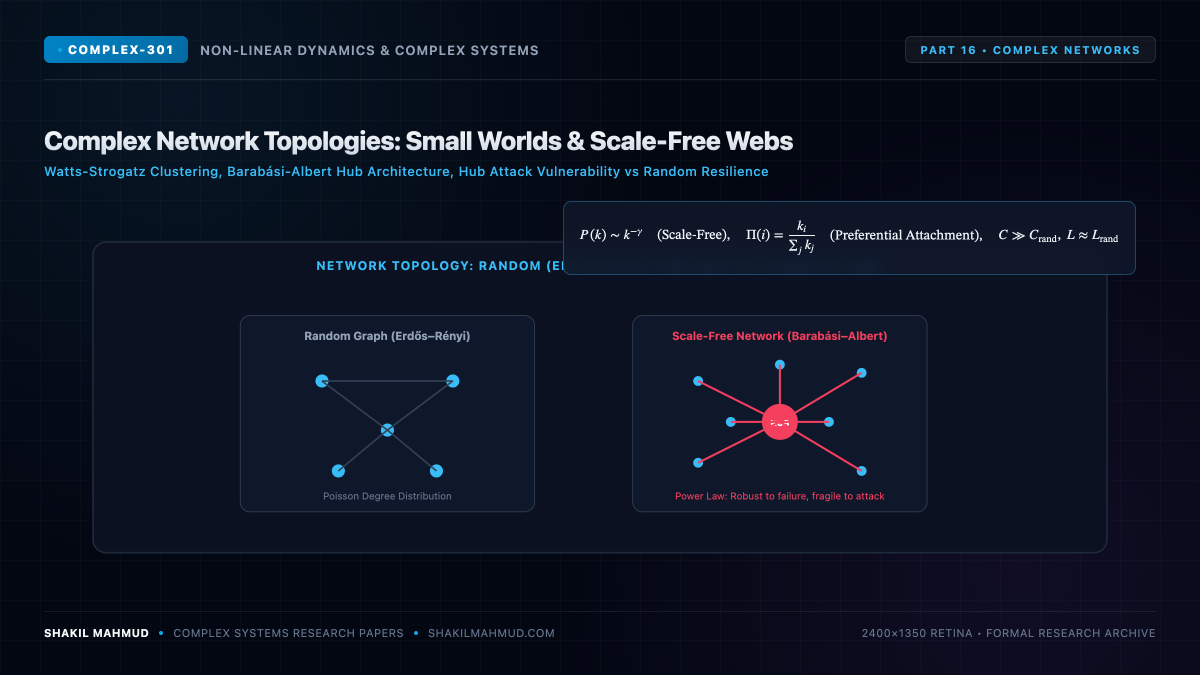
From the metabolic pathways inside a bacterium and the synaptic connectome of the human brain to the World Wide Web and global air transportation lattices, real-world complex systems are fundamentally structured as interacting networks. Classical graph theory pioneered by Paul Erdős and Alfréd Rényi assumed random connectivity. However, the turn of the 21st century revealed two universal topological architectures that govern nearly all real-world complex networks: the Small-World Property and Scale-Free Degree Distributions.
1. Erdős-Rényi Random Graphs vs. Empirical Networks
In an Erdős-Rényi graph $G(N, p)$, each of the possible $binom{N}{2}$ edges is occupied independently with probability $p$. The degree distribution $P(k)$—the probability that a randomly chosen node has exactly $k$ links—follows a Poisson distribution in the limit $N to infty$ with average degree $langle k rangle = p(N-1)$:
[
P(k) = frac{langle k rangle^k e^{-langle k rangle}}{k!}
]
Because the Poisson distribution decays faster than exponentially, nodes with degree significantly higher than $langle k rangle$ are virtually non-existent. However, empirical measurements of the Internet, social networks, and protein interaction maps revealed fat tails and heavy clustering completely incompatible with random graphs.
2. The Watts-Strogatz Small-World Model
In 1998, Duncan Watts and Steven Strogatz introduced a model interpolating between a completely ordered regular ring lattice and a completely random graph. Starting with a ring of $N$ nodes where each node is connected to its $2k$ nearest neighbors, each edge is rewired with probability $p in [0, 1]$ to a randomly chosen target node.
Two fundamental statistical metrics characterize the transition:
- Characteristic Path Length $L(p)$: The average shortest-path distance between all node pairs.
- Clustering Coefficient $C(p)$: The probability that two neighbors of a given node are themselves connected.
Watts and Strogatz discovered a broad intermediate regime ($0.001 < p < 0.1$) where the rewiring of a tiny fraction of edges creates global shortcuts, causing $L(p)$ to drop dramatically to logarithmic scaling $L sim ln N$ while the clustering coefficient $C(p)$ remains nearly as high as the ordered lattice ($C(p) approx 3/4$). This defines the Small-World Effect: high local clique cohesion coupled with astonishingly short global communication distances (popularized as “six degrees of separation”).
3. The Barabási-Albert Scale-Free Model
In 1999, Albert-László Barabási and Réka Albert demonstrated that real networks are dynamic and non-uniform. They identified two universal organizing mechanisms:
- Continuous Growth: Starting from a small core of $m_0$ nodes, at each discrete time step a new node with $m le m_0$ links is added to the network.
- Preferential Attachment (“The Rich Get Richer”): The probability $Pi(i)$ that the new node connects to existing node $i$ is proportional to node $i$’s current degree $k_i$:
[
Pi(i) = frac{k_i}{sum_j k_j}
]
Using the continuum mean-field approximation $frac{partial k_i}{partial t} = m Pi(i) = frac{m k_i}{2 m t} = frac{k_i}{2t}$, integration yields power-law growth $k_i(t) = m (t / t_i)^{1/2}$. Transforming into the stationary degree distribution yields a scale-free power law:
[
P(k) = 2 m^2 k^{-gamma}, quad text{with } gamma = 3
]
4. Topological Robustness vs. Fragility: The Achilles’ Heel
Scale-free networks possess a profound topological duality discovered by Réka Albert, Hawoong Jeong, and Barabási:
- Error Tolerance: Under random failure of nodes, scale-free networks with $gamma le 3$ are virtually indestructible. Even if 80% of nodes are removed at random, the giant connected component remains intact because the overwhelming majority of nodes have very low degree ($k sim m$).
- Vulnerability to Targeted Attacks: Conversely, if an adversary strategically removes the tiny fraction of high-degree “hubs” (the top 1-2%), the network shatters abruptly into isolated, disconnected clusters. This topological Achilles’ heel governs the spread of viral epidemics, immunization campaigns, internet routing resilience, and targeted cancer therapeutics.