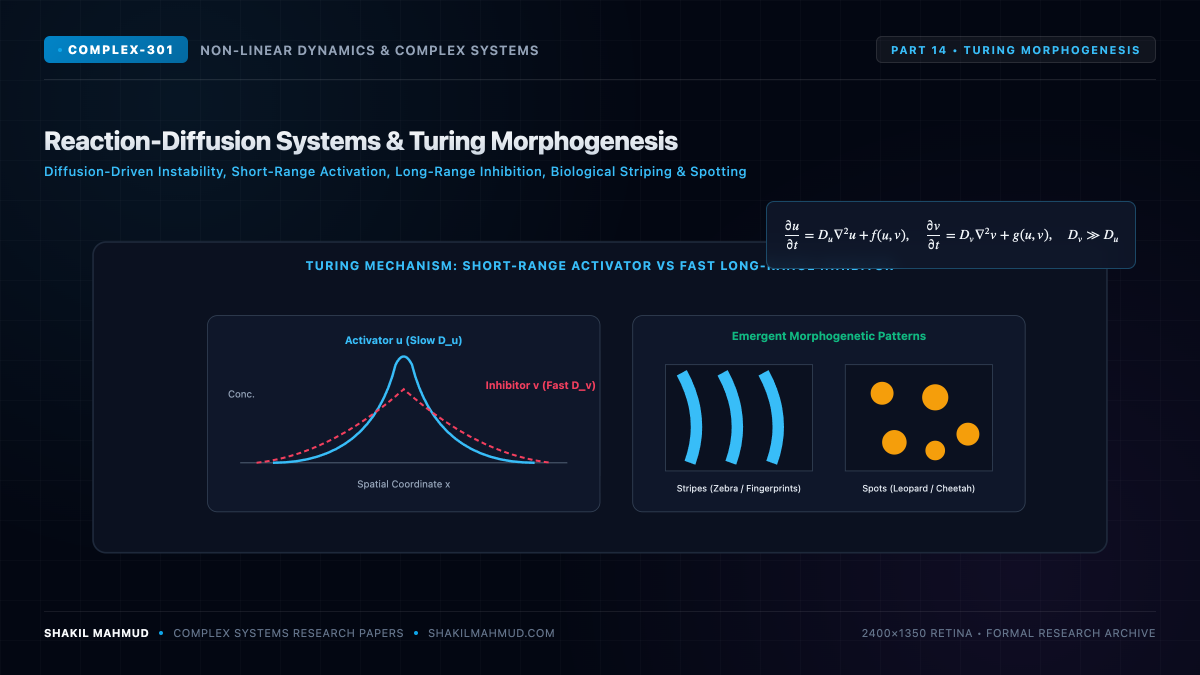
How does an initially uniform, spherical blastula break spatial symmetry to sculpt the intricate stripes of a zebra, the spots of a leopard, or the segmented digits of a vertebrate limb? In his seminal 1952 paper, “The Chemical Basis of Morphogenesis,” computational pioneer Alan Turing proved a profound mathematical paradox: while diffusion is universally recognized as a homogenizing, entropy-maximizing physical process, the combination of non-linear chemical reactions with differential diffusion rates can spontaneously destabilize a spatially uniform steady state, generating macroscopic, self-organizing spatial patterns.
1. The Reaction-Diffusion Mathematical Framework
Consider two chemically reacting and diffusing morphogen species: an activator $u(mathbf{r}, t)$ and an inhibitor $v(mathbf{r}, t)$ inhabiting a spatial domain $Omega subset mathbb{R}^d$. Their spatiotemporal evolution is governed by coupled non-linear parabolic partial differential equations:
[
begin{aligned}
frac{partial u}{partial t} &= f(u, v) + D_u nabla^2 u \
frac{partial v}{partial t} &= g(u, v) + D_v nabla^2 v
end{aligned}
]
where $f(u, v)$ and $g(u, v)$ represent non-linear reaction kinetics (such as the Gierer-Meinhardt or FitzHugh-Nagumo models), $nabla^2 = sum_{i=1}^d frac{partial^2}{partial x_i^2}$ denotes the spatial Laplacian operator, and $D_u, D_v > 0$ represent the molecular diffusion coefficients of the activator and inhibitor, respectively.
2. Conditions for Diffusion-Driven Turing Instability
Suppose the system possesses a spatially homogeneous steady state $(u_0, v_0)$ satisfying $f(u_0, v_0) = 0$ and $g(u_0, v_0) = 0$. For a Turing instability to occur, two seemingly contradictory conditions must be met simultaneously:
- Stability in the Absence of Diffusion ($D_u = D_v = 0$): The local reaction kinetics must be asymptotically stable. Evaluating the Jacobian matrix $J_0$ at $(u_0, v_0)$:
[
J_0 = begin{pmatrix} f_u & f_v \ g_u & g_v end{pmatrix}
]
stability requires that the trace be strictly negative and the determinant strictly positive:
[
operatorname{Tr}(J_0) = f_u + g_v 0
] - Instability in the Presence of Differential Diffusion ($D_u ne D_v$): Linearizing around $(u_0, v_0)$ with spatial perturbation modes $sim e^{lambda t + i mathbf{k} cdot mathbf{r}}$, the linearized dispersion relation yields eigenvalues $lambda(k^2)$ governed by $det(lambda I – J_k) = 0$, where $J_k = J_0 – k^2 D$. The modified determinant becomes:
[
h(k^2) = D_u D_v (k^2)^2 – (D_v f_u + D_u g_v) k^2 + det(J_0)
]
For an instability to arise ($operatorname{Re}(lambda) > 0$), $h(k^2)$ must become negative for some finite wavenumber $k^2 > 0$. Minimizing $h(k^2)$ with respect to $k^2$ yields the critical condition:
[
D_v f_u + D_u g_v > 2 sqrt{D_u D_v det(J_0)} > 0
]
Since $operatorname{Tr}(J_0) = f_u + g_v 0$ is for $f_u$ and $g_v$ to have opposite signs. Specifically, the activator must exhibit local auto-catalysis ($f_u > 0$), the inhibitor must exhibit negative self-regulation ($g_v < 0$), and the inhibitor must diffuse significantly faster than the activator:
[
d = frac{D_v}{D_u} gg 1 quad (text{Short-Range Activation, Long-Range Inhibition})
]
3. Wavenumber Selection and Pattern Morphology
When the diffusion ratio $d$ exceeds the critical bifurcation threshold $d_c$, an unstable band of spatial wavenumbers $[k_-, k_+]$ emerges with positive growth rates $lambda(k^2) > 0$. The fastest growing mode $k_{max}$ dictates the characteristic wavelength $Lambda = 2pi / k_{max}$ of the macroscopic pattern:
[
k_{max}^2 = frac{D_v f_u + D_u g_v}{2 D_u D_v}
]
Depending on the quadratic and cubic non-linearities in $f(u, v)$ and $g(u, v)$ and the spatial geometry of domain $Omega$, the system breaks spatial symmetry to self-assemble into hexagonal spots, labyrinthine stripes, or traveling wave fronts.