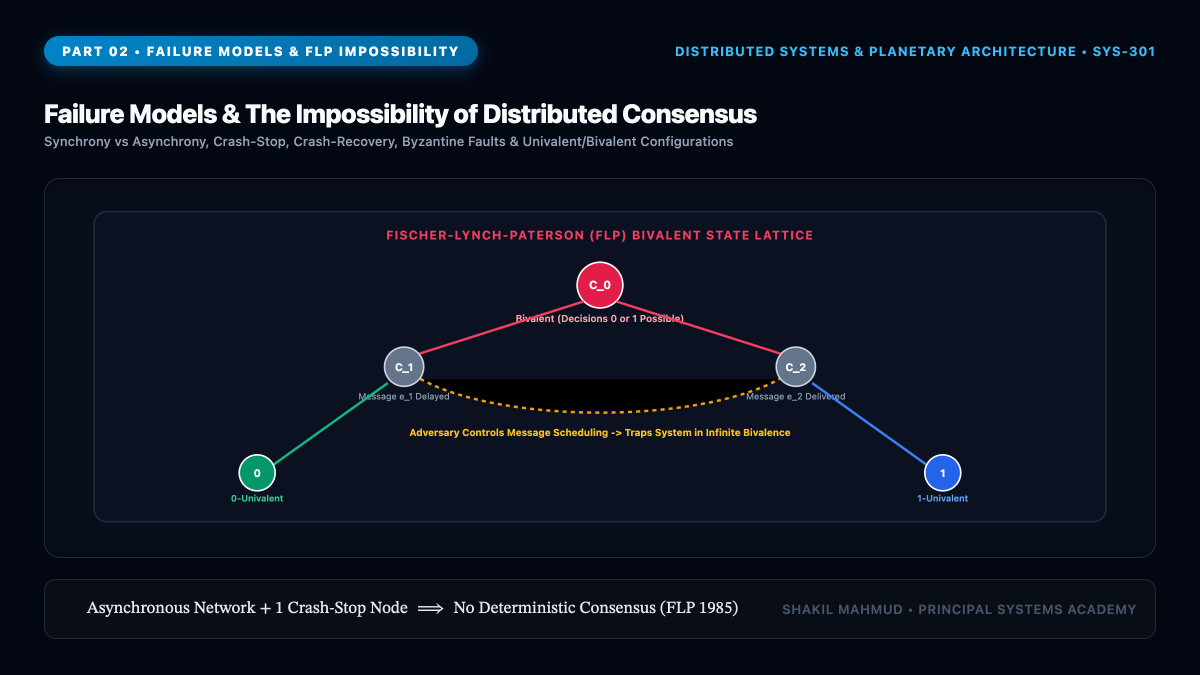
If time in distributed systems is fragmented, agreement is mathematically perilous. In 1985, three computer scientists—Michael Fischer, Nancy Lynch, and Michael Paterson—published a paper that permanently defined the theoretical boundaries of software engineering: “Impossibility of Distributed Consensus with One Unreliable Process” (known universally as the FLP Impossibility Theorem). It proved that in an asynchronous network, no deterministic algorithm can guarantee consensus if even a single node can silently crash.
1. The Taxonomy of Distributed Failure Models
Before analyzing the FLP result, system architects must formally specify the environmental assumptions under which nodes and communication channels operate:
- Network Timing Models:
- Synchronous: Message transmission delay $Delta$ and process execution speeds are strictly bounded and known. Timeouts can reliably detect crashes.
- Asynchronous: Message delays and process speeds are arbitrary and unbounded (though finite). A delayed message is indistinguishable from a crashed node.
- Partially Synchronous (DLS 1988): The system behaves asynchronously until an unknown Global Stabilization Time ($text{GST}$), after which bounds $Delta$ hold.
- Node Failure Hierarchy:
- Crash-Stop (Fail-Silent): A faulty node halts execution and remains halted forever.
- Crash-Recovery: A node halts but may recover with its non-volatile disk state intact.
- Omission Faults: A node fails to send or receive a subset of messages.
- Byzantine (Arbitrary/Malicious): A node behaves arbitrarily, transmitting conflicting, forged, or collusive information to different peers.
2. The Consensus Problem Formulated
In a consensus problem, $N$ processes begin with an initial binary input $x_i in {0, 1}$ and must decide upon an output value $y_i in {0, 1}$ satisfying three fundamental properties:
- Agreement (Safety): No two non-faulty processes decide different values ($y_i = y_j$).
- Validity / Integrity (Triviality Prevention): If all processes begin with input $v$, any decision must be $v$.
- Termination / Liveness: Every non-faulty process eventually decides an output value.
3. Step-by-Step Anatomy of the FLP Proof
The FLP proof constructs an adversarial execution in a completely asynchronous network where message queues operate non-deterministically. The proof proceeds through three foundational lemmas:
Lemma 1: The Existence of Bivalent Initial Configurations
A global configuration $C$ represents the vector of all internal process states and the multiset of undelivered in-flight network messages. A configuration is defined as:
- 0-univalent: Every possible future sequence of message deliveries forces a decision of $0$.
- 1-univalent: Every possible future sequence of message deliveries forces a decision of $1$.
- Bivalent: Both a $0$-decision and a $1$-decision remain reachable depending on message delivery order.
By contradiction, if no bivalent initial configuration existed, there must exist two adjacent initial configurations differing by only one process’s input (e.g., $C_0 = [0, 0, dots, 0]$ vs $C_1 = [1, 0, dots, 0]$) where one is 0-univalent and the other is 1-univalent. If the differing process crashes immediately, the remaining processes cannot distinguish between the two universes, violating validity.
Lemma 2: Commutativity of Disjoint Events
If events $e_1 = (p_1, m_1)$ and $e_2 = (p_2, m_2)$ involve distinct processes ($p_1 neq p_2$), their execution orders commute:
$$e_2(e_1(C)) = e_1(e_2(C))$$
Lemma 3: Preserving Bivalence Ad Infinitum
Starting from a bivalent configuration $C$, let $e = (p, m)$ be an event scheduled to be applied. The proof demonstrates that there exists a reachable configuration $C^prime$ where applying $e$ to $C^prime$ ($e(C^prime)$) remains strictly bivalent. If an adversary deliberately delays $e$ while scheduling concurrent events, the system can be steered into an infinite non-terminating cycle of bivalent states.
4. Engineering Implications: How Real Systems Evade FLP
FLP does not mean distributed systems cannot achieve consensus in practice; it means engineers must relax one of FLP’s strict theoretical assumptions:
- Relaxing Determinism (Randomization): Michael Ben-Or (1983) and Rabin introduced randomized consensus. By utilizing cryptographic coin-flips, consensus terminates with probability $1$ in $O(1)$ expected rounds.
- Failure Detectors (Chandra & Toueg 1996): Augmenting the asynchronous model with an unreliable failure detector (such as $diamondsuit mathcal{W}$ or $diamondsuit mathcal{P}$) that is eventually accurate allows deterministic consensus.
- Partial Synchrony (Paxos & Raft): Production consensus engines choose Safety over Liveness. Under network partitions or timing chaos, Paxos and Raft preserve absolute safety (never deciding conflicting values), postponing liveness until network stability ($text{GST}$) is restored.




