For millennia, natural philosophers divided reality into two ontologically distinct realms. Below the Moon was the sublunary sphere: a flawed, chaotic world of four terrestrial elements (earth, water, air, fire) governed by decay, friction, and straight-line mortal motion. Above the Moon was the superlunary celestial sphere: an incorruptible, divine heaven composed of Aristotle’s fifth element (the quintessence or aether), rotating in eternal, frictionless circular symmetry. In 1687, with the publication of the Philosophiae Naturalis Principia Mathematica, Isaac Newton eradicated this metaphysical division with a single, sweeping equation: the Law of Universal Gravitation.
1. The Cosmic Synthesis: The Apple and the Moon
The stroke of genius that struck Newton in the orchards of Woolsthorpe Manor was not simply that apples fall toward the ground, but the audacious leap of intuition that the exact same force that pulls the apple also holds the Moon in its monthly orbit around the Earth.
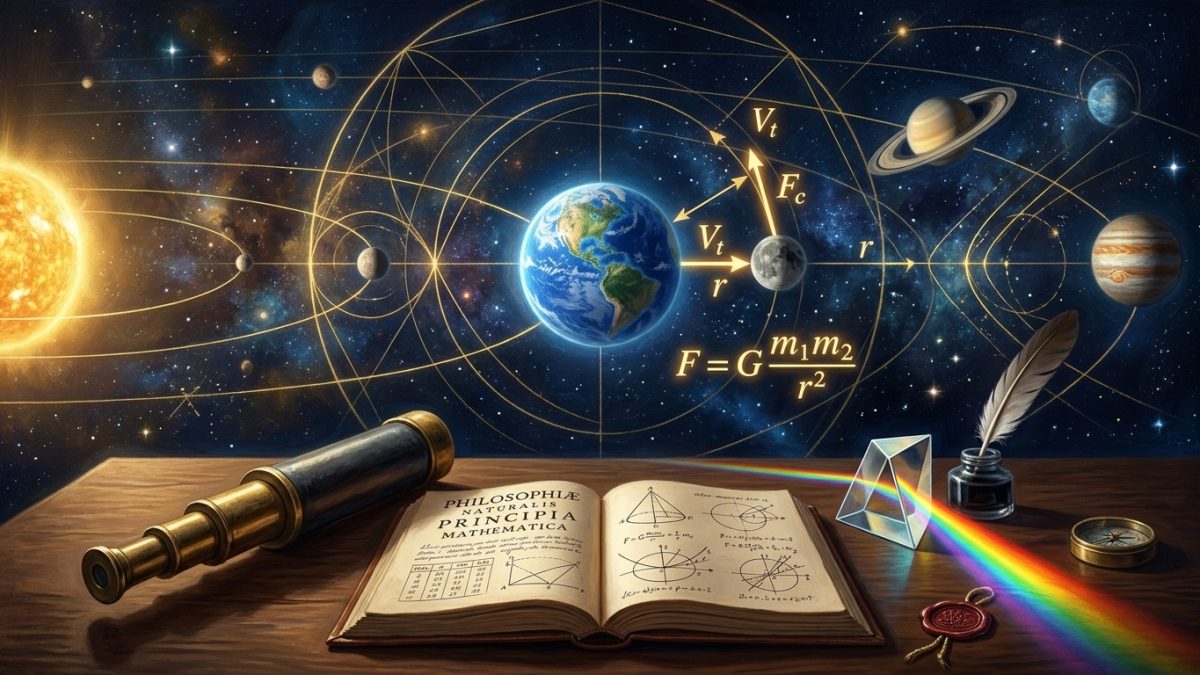
If the Earth did not exert an attractive pull on the Moon, the Moon’s inertia would carry it away along a straight tangential path into the cold void of space. To remain bound in its closed orbit, the Moon must continually “fall” toward the center of the Earth, deflecting from a straight line at every microsecond.
Newton compared the acceleration of an apple at the Earth’s surface ($g approx 9.8text{ m/s}^2$) with the centripetal acceleration of the Moon at a distance of approximately 60 Earth radii ($r_{text{moon}} approx 60 R_oplus$). He found that the acceleration of the Moon was approximately $1/3600$ that of the apple:
$$frac{a_{text{moon}}}{a_{text{apple}}} approx frac{1}{60^2} = frac{1}{3600}$$
This exact quadratic ratio revealed the fundamental truth: gravity does not weaken linearly; it dilutes precisely with the square of the distance. Every particle of matter in the universe attracts every other particle with a mutual force directly proportional to the product of their masses and inversely proportional to the square of the distance between their centers:
$$F = G frac{m_1 m_2}{r^2}$$
2. Deriving Kepler’s Empirical Laws from First Principles
Johannes Kepler had spent decades analyzing Tycho Brahe’s painstaking astronomical ledgers to formulate his three empirical laws of planetary motion: planets move in ellipses with the Sun at one focus; their radius vector sweeps out equal areas in equal times; and the square of their orbital period is proportional to the cube of their semi-major axis ($T^2 propto a^3$). But Kepler had no physical mechanism explaining why nature adhered to these geometric curves.
Armed with his newly forged calculus, Newton demonstrated that Kepler’s laws were not empirical accidents; they were mathematical imperatives of an inverse-square central force. By setting the gravitational force equal to mass times centripetal acceleration in a radial coordinate system:
$$frac{d^2 mathbf{r}}{dt^2} = -frac{G M}{r^2} hat{mathbf{r}}$$
Newton proved that the only stable bound orbits in three-dimensional space are conic sections: ellipses, parabolas, and hyperbolas. The clockwork predictability of Halley’s Comet returning every 76 years became the ultimate vindication of Newton’s mathematical universe.
3. The Ghost in the Machine: Action at a Distance and the Road to Einstein
Despite its breathtaking triumphs, Newton’s law contained a deep conceptual mystery that troubled Newton himself: Action at a Distance. How could the Sun, across 150 million kilometers of empty vacuum, exert an instantaneous pull on the Earth without any physical contact, rope, or intermediate medium?
“That one body may act upon another at a distance through a vacuum, without the mediation of anything else… is to me so great an absurdity that I believe no man who has in philosophical matters a competent faculty of thinking can ever fall into it. Hypotheses non fingo [I frame no hypotheses].”
For more than two centuries, physicists accepted Newton’s mathematics while bracketing its metaphysical paradox. In 1846, French astronomer Urbain Le Verrier noticed tiny anomalies in the orbit of Uranus; trusting Newton’s formula completely, he calculated where an unseen planet must reside. German astronomer Johann Galle pointed his telescope to the predicted coordinates and found Neptune on the first night of searching.
Yet a tiny residual precession of 43 arcseconds per century in the perihelion of Mercury remained stubbornly inexplicable under Newton’s formula. It was this tiny crack that Albert Einstein opened in 1915, revealing that gravity is not a Newtonian mechanical force transmitted across empty space, but the geometric curvature of spacetime itself.