Over sixty years of computer science, distributed systems evolved from primitive batch networks into planetary cloud infrastructures coordinating billions of concurrent threads across every continent. Yet as systems scale, the limits of human cognition become glaringly apparent: no software engineer, however brilliant, can mentally simulate the asynchronous concurrency permutations of thousands of nodes under arbitrary packet drops, clock skews, and network partitions. The frontier of distributed systems demands mathematically rigorous foundations: moving from empirical testing to Formal Verification with TLA+ (Leslie Lamport), memory-safe actor execution engines, and preparing for the ultimate architectural challenge: Galactic-Scale Delay-Tolerant Networking across interplanetary space.
1. The Limits of Empirical Testing & The Necessity of Formal Methods
Unit tests, integration tests, and even chaos engineering share a fundamental mathematical limitation famously articulated by Edsger W. Dijkstra: “Program testing can be used to show the presence of bugs, but never to show their absence.”
In a cluster of $N$ nodes exchanging asynchronous messages, the state space of possible interleavings scales super-exponentially:
$$Omega(k!) quad text{or} quad mathcal{O}(2^M)$$
A race condition that occurs only when three specific network packets are delayed, an SSD reboots, and an election timer expires at the exact same microsecond will evade millions of automated integration tests—only to manifest catastrophically in production under peak traffic. Eliminating such bugs requires formal mathematical verification.
2. Formal Specification with TLA+ and PlusCal
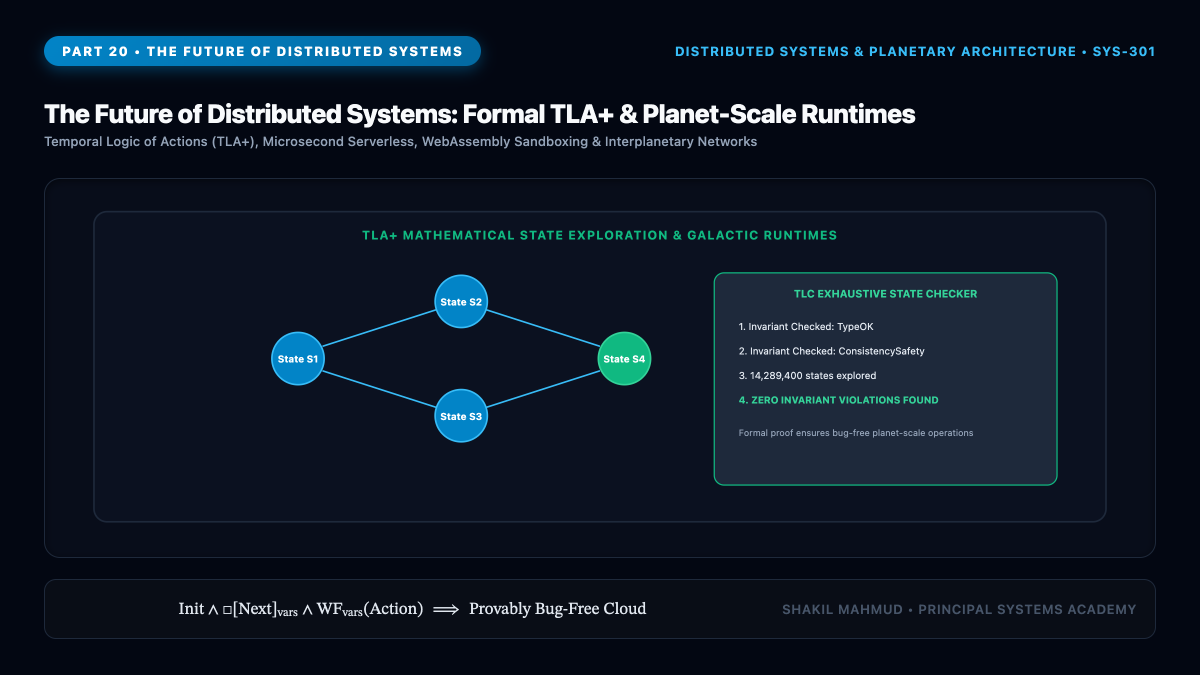
Invented by Turing Award laureate Leslie Lamport, TLA+ (Temporal Logic of Actions) is a formal mathematical language based on set theory, first-order logic, and temporal logic designed specifically for specifying and verifying concurrent and distributed systems.
Core Mathematical Primitives
- States: An assignment of values to variables.
- State Transitions (Actions): A mathematical relation between unprimed variables (current state) and primed variables (next state):
$$text{Next} triangleq exists i in text{Servers} : text{RequestVote}(i) lor text{AppendEntries}(i)$$ - Safety Invariants: Properties that must hold true in every reachable state (“something bad never happens”):
$$text{TypeOK} land forall s_1, s_2 in text{Servers} : text{Leader}(s_1) land text{Leader}(s_2) implies s_1 = s_2$$ - Liveness Properties: Temporal formulas asserting that the system eventually makes forward progress (“something good eventually happens”):
$$Box Diamond (text{ElectionSucceeds})$$
The TLC Model Checker systematically explores every single reachable state in the entire system graph, detecting deadlock, state-machine split-brain, and invariant violations before a single line of production code is written. Engineers at Amazon Web Services (AWS) famously used TLA+ to verify S3, DynamoDB, and EBS, uncovering subtle concurrency bugs that had survived years of intensive testing.
3. Correctness by Construction: The Actor Model & Memory Safety
Software implementation is undergoing a profound paradigm shift towards Correctness by Construction:
- Rust and Linear Types: Modern distributed systems engines (TiKV, CockroachDB storage layer, Vector, Linkerd) increasingly reject C++ and garbage-collected runtimes in favor of Rust. Rust’s affine type system and ownership semantics eliminate data races, null pointer dereferences, and memory corruption at compile time, eliminating an entire class of distributed vulnerabilities.
- The Actor Model (Erlang/OTP, Akka, Ray): Eliminating shared mutable state entirely by modeling computing entities as isolated autonomous actors communicating exclusively via asynchronous immutable message passing.
4. The Interplanetary Frontier: Delay/Disruption Tolerant Networking (DTN)
As humanity establishes permanent robotic and human outposts on the Moon and Mars, distributed systems face a new frontier: Interplanetary Distributed Systems. Between Earth and Mars, radio signals traveling at the speed of light incur a one-way latency ranging from 3 to 22 minutes (Round-Trip Time: 6 to 44 minutes). In addition, orbital mechanics cause planets to occlude line of sight, creating days of total communication blackout.
Every terrestrial networking protocol breaks down catastrophically across interplanetary space: TCP handshakes time out, Paxos heartbeats fail, and BGP routing collapses. The answer is Delay/Disruption Tolerant Networking (DTN) (RFC 5050), powered by the Bundle Protocol:
- Store-and-Forward Custody Transfer: Nodes store entire data bundles in non-volatile storage indefinitely, transferring cryptographic custody to orbital relay satellites only when a transient line-of-sight window opens.
- Asynchronous Eventual Consistency: State reconciliation across planets relies on CRDTs, Merkle trees, and causal partial orders, enabling Mars colonies to run autonomous local software that merges deterministically with terrestrial systems when orbital windows permit.
From Lamport’s logical clocks and Paxos quorums to planetary anycast and interplanetary delay-tolerant runtimes, distributed systems remain the ultimate grand convergence of mathematics, physics, and computer science—the nervous system of planetary civilization.