In monolithic software architectures, failure was treated as an exceptional pathology to be caught with error handlers. In planetary distributed systems spanning hundreds of thousands of heterogeneous commodity servers, transoceanic fiber cables, and shared power domains, failure is not an anomaly—it is a continuous, mathematical certainty. Hardware components fail constantly: disks crash, optic transceivers decay, and garbage collection freezes nodes without warning. Building survivable systems requires abandoning the delusion of fault-free hardware and designing software around Resiliency Patterns and proactive Chaos Engineering (Netflix, 2011).
1. The Anatomy of Cascading Failures
The most catastrophic failure mode in distributed architectures is the Cascading Failure: a localized transient hiccup that triggers a positive feedback loop, systematically bringing down the entire global infrastructure.
The Positive Feedback Death Spiral
- A single backend database server slows down due to a heavy query or garbage collection pause.
- Upstream microservices experience request timeouts. Instead of backing off, client libraries immediately retry failed calls.
- The incoming traffic on the struggling database server doubles ($2times to 4times$).
- Thread pools and connection pools exhaust memory; the database crashes completely.
- Traffic automatically spills over to neighboring database replicas, instantly overwhelming them and causing them to crash in domino succession.
2. The Circuit Breaker Pattern
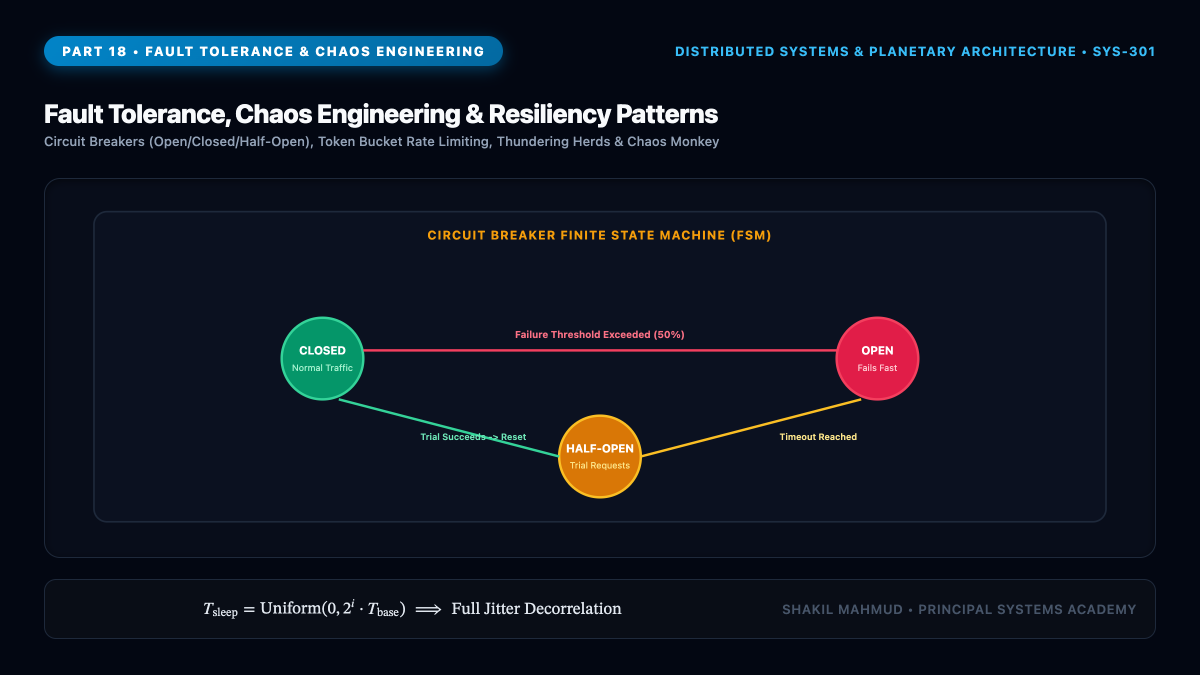
Formalized by Michael Nygard in Release It!, the Circuit Breaker wraps network calls in an adaptive finite state machine that prevents upstream services from hammering failing downstream dependencies:
State Machine Transitions
- Closed (Normal): Requests pass through to the dependency. A sliding time window tracks failures. If the failure rate remains below a threshold $theta_{text{fail}}$ (e.g. $50%$), the breaker stays Closed.
- Open (Tripped): When the failure rate exceeds $theta_{text{fail}}$, the breaker trips to Open. All subsequent requests fail immediately locally (fast-fail) without putting packets on the network, shielding the downstream dependency and returning graceful fallback responses to clients. A reset timer $T_{text{reset}}$ is started.
- Half-Open (Testing): When $T_{text{reset}}$ expires, the breaker transitions to Half-Open, allowing a small, throttled trial percentage of requests through. If the trial requests succeed, the dependency has recovered, and the breaker resets to Closed. If any trial fails, it reverts immediately to Open.
3. Mathematical Backoff: Exponential Growth with Full Jitter
When services retry failed calls simultaneously, their synchronized retry attempts form periodic destructive wave fronts termed retry storms. Naive fixed-interval or pure exponential backoff preserves this synchronization phase.
In 2015, Marc Brooker at AWS demonstrated that the mathematically optimal strategy for breaking synchronization resonance is Exponential Backoff with Full Jitter:
$$t_{text{sleep}} = mathcal{U}left(0, , min(M, , B cdot 2^i)right)$$
where $B$ is base backoff, $i$ is retry attempt, $M$ is maximum cap, and $mathcal{U}(0, X)$ draws a uniform random duration between $0$ and $X$. By distributing retries uniformly across the entire exponential window, full jitter completely flattens queue contention, maximizing overall system recovery throughput.
4. Isolation & Bulkheads
Originating from naval architecture where a ship’s hull is partitioned into watertight bulkheads so that a single hull breach cannot sink the vessel, the Bulkhead Pattern isolates distributed computing resources. Microservices segregate thread pools, memory arenas, and CPU quotas per tenant or dependency. If an external payment gateway locks up, only the dedicated payment thread pool exhausts; user authentication, product catalog browsing, and streaming video continue uninterrupted.
5. Chaos Engineering: The Netflix Simian Army
Traditional testing verifies that a system works when conditions are pristine. Chaos Engineering is the discipline of experimenting on a system in production to build confidence in the system’s capability to withstand turbulent conditions.
Pioneered by Netflix in 2011, the approach automated production failure injection through the Simian Army:
- Chaos Monkey: Randomly terminates production container instances and virtual machines during peak business hours, ensuring services tolerate server death invisibly.
- Chaos Gorilla & Chaos Kong: Simulates entire AWS Availability Zone (AZ) and complete regional datacenter outages, validating multi-region active-active traffic failover.
- Chaos Network: Injects synthetic latency, packet corruption, and asymmetric route partition drop rates into live network sockets.
By transforming catastrophic black-swan failure events into routine, automated background occurrences, engineers ensure that high-availability architectures remain resilient by construction.




