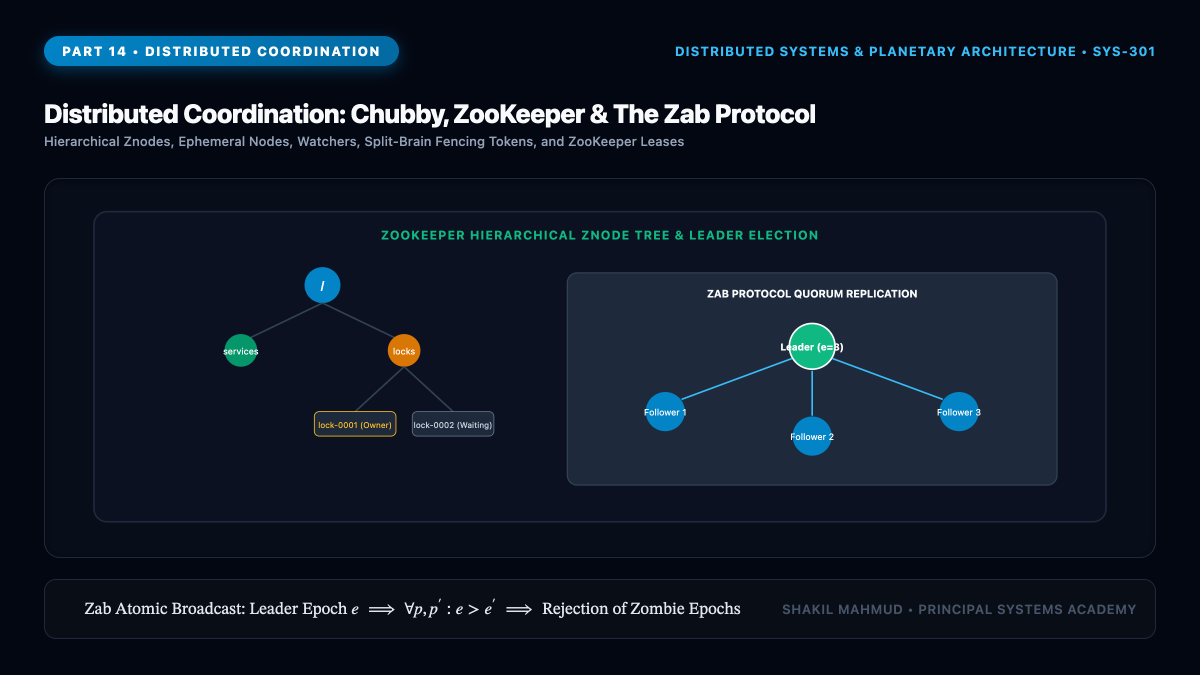
Building large-scale distributed applications requires solving fundamental primitive coordination problems: leader election, cluster membership discovery, distributed mutex locking, and dynamic configuration broadcast. Embedding consensus algorithms directly into every microservice leads to brittle, unmaintainable software architectures. In 2006, Google introduced Chubby (Burrows), a coarse-grained distributed lock service organized as a simple distributed filesystem. In 2010, Yahoo! open-sourced Apache ZooKeeper (Hunt et al.), providing a high-performance wait-free coordination kernel powered by a dedicated FIFO-preserving consensus engine: the Zab (ZooKeeper Atomic Broadcast) protocol.
1. The Philosophy of Coordination: Chubby’s Lock Service
Mike Burrows famously identified why coarse-grained lock services succeed: developers do not want to manage Paxos rounds; they want familiar, coarse-grained primitives like file advisory locks and event notifications. Google Chubby exposed a UNIX-like hierarchical filesystem with coarse-grained reader-writer locks, ephemeral sessions, and event callbacks. Chubby was deployed as the foundation for Google File System (GFS), Bigtable, and MapReduce.
2. Apache ZooKeeper Architecture: The Hierarchical Data Model
ZooKeeper reimagined coordination by providing a wait-free, high-throughput hierarchical data tree resembling a file system, where directories and files are unified into entities called znodes:
$$text{Root } / to text{/services} to text{/services/payment} to text{/services/payment/node-0001}$$
Znode Flavors
- Persistent: Explicitly created and retained until explicitly deleted by a client.
- Ephemeral: Bound directly to the client’s TCP session. If the client fails to send keep-alive heartbeats within the session timeout window, ZooKeeper automatically destroys the ephemeral znode, providing an instantaneous failure-detection primitive.
- Sequential: ZooKeeper appends a monotonically increasing 10-digit counter to the path name (e.g. `lock-0000000001`), establishing an unambiguous total order of client arrivals.
- Container & TTL Znodes: Automatically purged when their children become empty or when a time-to-live expires.
Watches: Push Notifications without Polling
ZooKeeper clients avoid expensive polling by setting Watches on znodes. When a znode is modified, deleted, or its children change, ZooKeeper pushes a one-time asynchronous notification event directly to the watching client.
3. The Zab Protocol: ZooKeeper Atomic Broadcast
ZooKeeper maintains state replication across a cluster of ensemble nodes using the Zab Protocol. Zab guarantees two foundational properties:
- Reliable Delivery: If a message is delivered by one server, it will eventually be delivered by all non-faulty servers.
- Total Order & Causal Consistency: If message $m$ is delivered before message $m’$, all servers deliver $m$ before $m’$. If a message is sent after another by the same leader, causal order is preserved strictly.
Epochs & The 64-Bit ZXID
Every state mutation is stamped with a 64-bit transaction identifier called a ZXID:
$$text{ZXID} = langle e, c rangle = (e ll 32) mid c$$
where the high-order 32 bits represent the Epoch $e$ (incremented each time a new leader is elected), and the low-order 32 bits represent a monotonic transaction counter $c$.
The Two Operating Modes of Zab
- Phase 1: Leader Election & Crash-Recovery: When the leader fails, ensemble nodes enter election mode. A node proposes itself, voting for the candidate with the highest epoch and largest ZXID. Once a leader secures a majority quorum, it synchronizes missing log entries with followers until all followers mirror the leader’s commit history, locking the new epoch.
- Phase 2: Atomic Broadcast: Operating as a specialized two-phase commit without aborts. The leader proposes a transaction $langle text{PROPOSE}, zxid, v rangle$, followers log it to disk and reply $text{ACK}$, and the leader broadcasts $langle text{COMMIT}, zxid rangle$ once a majority acknowledges.
4. Classical Coordination Recipes
Distributed Mutex Locking (Fair & Thundering-Herd-Free)
To acquire lock `/locks/resource` without triggering a thundering-herd storm:
- Client creates an ephemeral sequential znode: `/locks/resource/lock-seq`.
- Client fetches all children of `/locks/resource` without setting a watch on the root.
- If the client’s sequence number is the absolute minimum, it owns the lock!
- If not, the client sets a watch only on the znode with the next-smaller sequence number.
- When the preceding znode is released or its owner crashes, ZooKeeper notifies only the immediate successor, achieving fair $mathcal{O}(1)$ handover latency.




