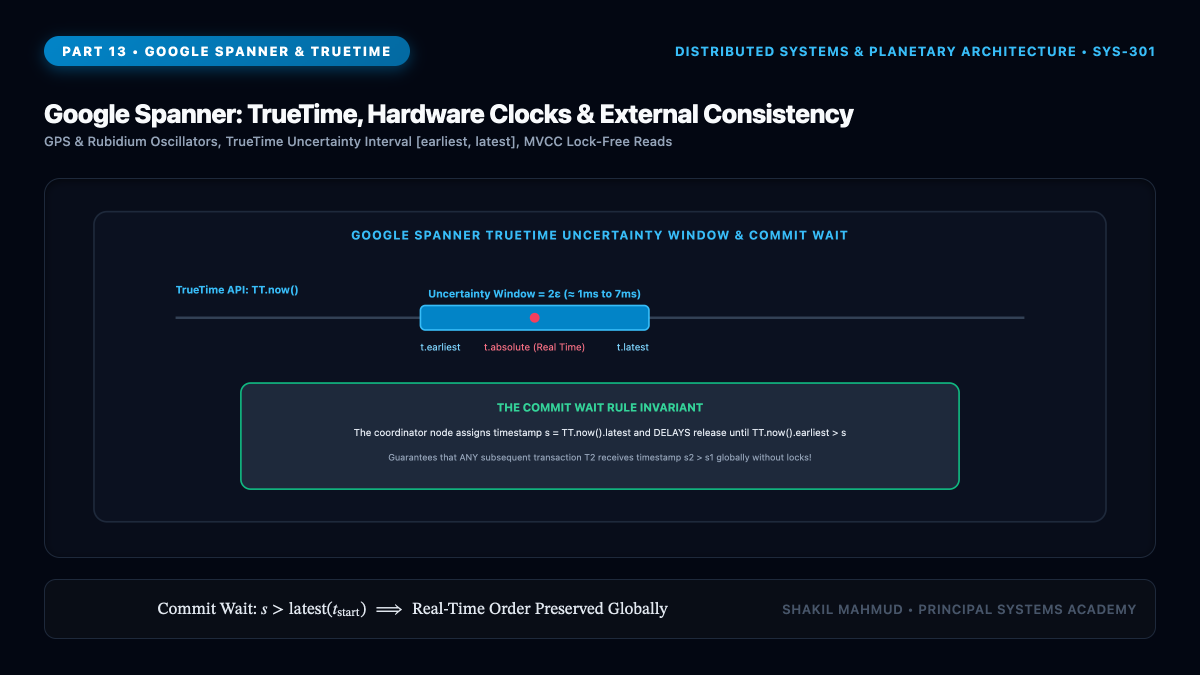
For decades, distributed systems theory treated physical clocks as unreliable oscillators plagued by unpredictable drift and NTP skew. In 2012, Google overturned this orthodoxy with the publication of Spanner (Corbett et al.), the first globally distributed, multi-version database to deliver External Consistency (strict serializability) at planetary scale. Spanner’s breakthrough was not merely algorithmic; it fundamentally integrated distributed software architecture with datacenter hardware physics through the TrueTime API—bounding clock uncertainty using satellite GPS receivers and atomic rubidium oscillators to enforce a physical Commit Wait rule.
1. The Problem of Global Wall-Clock Inaccuracy
In a standard Linux server, the Network Time Protocol (NTP) synchronizes system clocks over UDP. Due to network congestion, asymmetric packet routing, and local quartz crystal oscillator thermal drift, NTP clock uncertainty frequently spikes to hundreds of milliseconds. Relying on raw server timestamps to order distributed transactions inevitably leads to causality violations: a later transaction $T_2$ could be assigned a timestamp smaller than an earlier transaction $T_1$, destroying linearizability.
2. The TrueTime Architecture: Bounding Uncertainty ($epsilon$)
Google resolved this by directly installing dedicated time master servers in every Spanner datacenter. Each time master is equipped with either a GPS satellite receiver with dedicated antenna hardware or a Rubidium atomic clock oscillator.
Instead of returning a single discrete time value, the TrueTime API represents current physical time as a continuous uncertainty interval:
$$TT.text{now}() = [t_{text{earliest}}, t_{text{latest}}]$$
where the absolute, real-world physical time $t_{text{absolute}}$ is guaranteed to reside within the interval:
$$t_{text{earliest}} le t_{text{absolute}} le t_{text{latest}}$$
The half-width of this interval is the Clock Uncertainty Bound $epsilon$:
$$epsilon = frac{t_{text{latest}} – t_{text{earliest}}}{2}$$
In Google’s production datacenters, $epsilon$ typically hovers between $1,text{ms}$ and $7,text{ms}$. If GPS satellites lose lock, the atomic rubidium clocks drift at a strictly bounded rate ($le 1,mutext{s}/text{day}$), causing $epsilon$ to widen gracefully rather than failing abruptly.
3. External Consistency & The Commit Wait Invariant
Spanner guarantees External Consistency: if a transaction $T_2$ is initiated after transaction $T_1$ commits anywhere in the world, the timestamp assigned to $T_2$ must be strictly greater than the timestamp assigned to $T_1$:
$$t_{text{start}}(T_2) > t_{text{commit}}(T_1) implies s_2 > s_1$$
To enforce this without cross-datacenter message handshakes, Spanner implements the Commit Wait Rule:
The Commit Wait Algorithm
- The transaction coordinator acquires write locks via Two-Phase Locking (2PL) across Paxos participant groups.
- The coordinator invokes $TT.text{now}()$ and picks a commit timestamp $s ge t_{text{latest}}$. This guarantees that $s$ is strictly in the absolute future.
- Commit Wait: The coordinator delays releasing its locks and exposing the transaction’s commit to the client until:
$$TT.text{now}().t_{text{earliest}} > s$$ - The required wait duration is exactly $2epsilon$:
$$Delta t_{text{wait}} = 2epsilon$$
Because the coordinator intentionally waits out the uncertainty interval, by the time the client observes $T_1$’s commit, the real-world physical time is guaranteed to have passed $s_1$. Any subsequent transaction $T_2$ will read a clock whose $t_{text{earliest}} > s_1$, ensuring $s_2 > s_1$ with absolute certainty.
4. Lock-Free Snapshot Reads
The TrueTime abstraction enables Spanner to execute read-only queries—even those spanning thousands of machines across multiple continents—without acquiring a single lock and without blocking incoming writes. A client simply issues a read at timestamp $t_{text{read}} = TT.text{now}().t_{text{latest}}$. Replicas evaluate their Paxos safe time and return a completely consistent Multi-Version Concurrency Control (MVCC) snapshot at $t_{text{read}}$, completely eliminating read contention.




