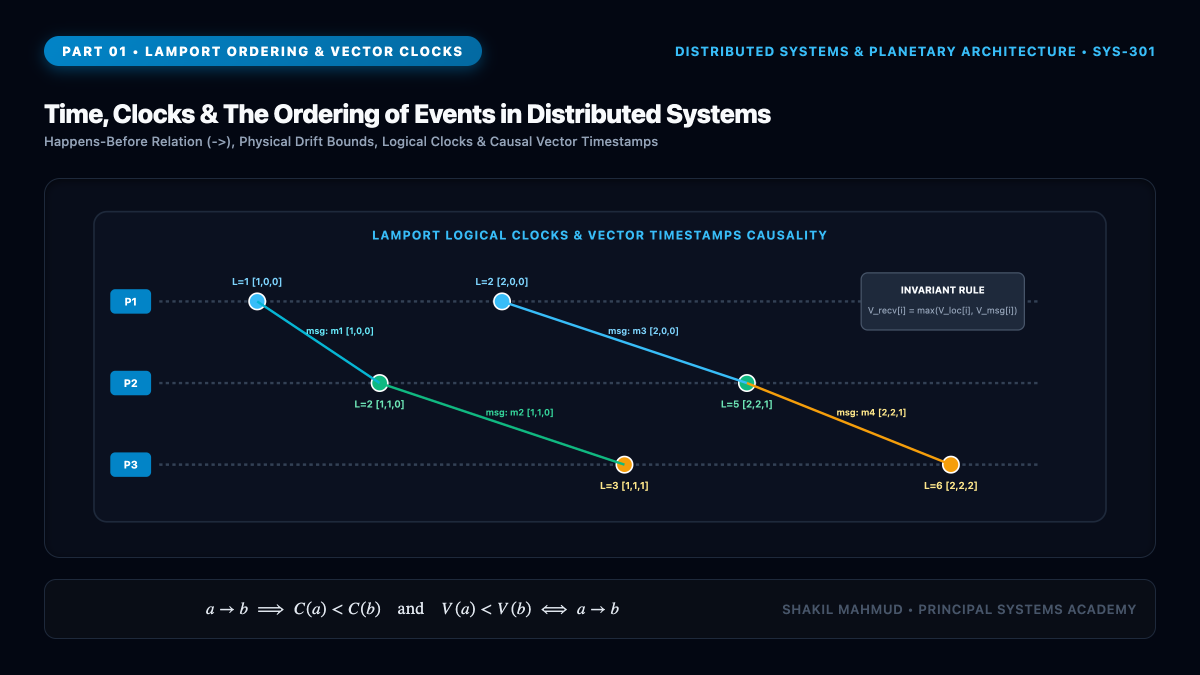
At the heart of distributed computing lies a profound, counter-intuitive reality: there is no such thing as a global, objective physical time across independent machines. In a single-threaded CPU or a centralized shared-memory computer, a monotonic hardware counter orders every instruction sequentially. But the moment computation is partitioned across physically separated servers linked by packet networks, time shatters into relativistic subjectivity.
1. The Physics of Clock Drift & The Illusion of Synchrony
Every server motherboard relies on a quartz crystal oscillator. Due to thermal fluctuations, supply voltage ripple, component aging, and manufacturing variance, real-world quartz clocks exhibit an inescapable clock drift rate $rho$, typically on the order of:
$$rho approx 10^{-5} text{ to } 10^{-6} implies 1 text{ to } 10 text{ microseconds of drift per second}$$
Left unsynchronized for a single day, two server clocks drift by nearly a full second ($86.4text{ ms}$ to $864text{ ms}$). While the Network Time Protocol (NTP) attempts to discipline clocks over UDP socket exchanges, asymmetric network routing, packet queuing jitter, and variable kernel interrupt latencies make bounded clock synchronization across the public Internet inherently non-deterministic. If Server A receives a message from Server B bearing a physical timestamp from the “future,” naive clock comparisons cause causal inversions, silent data corruption, and catastrophic failure in financial ledgers and distributed databases.
2. Lamport’s Breakthrough: The Happens-Before Relation ($rightarrow$)
In his seminal 1978 paper “Time, Clocks, and the Ordering of Events in a Distributed System”, Leslie Lamport realized that distributed coordination does not require measuring physical seconds; it requires determining causal precedence. Lamport defined the partial order happens-before (denoted by $rightarrow$) over the set of all system events via three axioms:
- Local Sequence: If events $a$ and $b$ occur within the same process, and $a$ occurs before $b$, then $a rightarrow b$.
- Message Causality: If event $a$ is the sending of a message by one process, and event $b$ is the receipt of that same message by another process, then $a rightarrow b$.
- Transitivity: If $a rightarrow b$ and $b rightarrow c$, then $a rightarrow c$.
Crucially, if neither $a rightarrow b$ nor $b rightarrow a$ holds, the events are mathematically concurrent ($a parallel b$). Concurrent events possess no causal entanglement; neither could have influenced the occurrence of the other.
3. Logical Clocks & The Clock Condition
Lamport mapped this partial order onto monotonically increasing scalar integers. Let $C_i(a)$ represent the logical clock value assigned to event $a$ by process $P_i$. The system satisfies the Clock Condition if:
$$a rightarrow b implies C(a) < C(b)$$
To enforce this condition, every process follows two deterministic rules:
- Rule 1 (Internal Event): Before executing an internal event, process $P_i$ increments its local clock:
$$C_i leftarrow C_i + 1$$ - Rule 2 (Message Exchange): When process $P_i$ sends message $m$, it attaches its current clock value $C_i$. Upon receiving message $m$ with timestamp $C_m$, process $P_j$ advances its clock beyond the sender’s timestamp before recording the receipt event:
$$C_j leftarrow max(C_j, C_m) + 1$$
4. The Limitation of Scalar Clocks & The Genesis of Vector Clocks
While Lamport clocks guarantee that $a rightarrow b implies C(a) < C(b)$, the converse does not hold. If $C(a) < C(b)$, one cannot infer whether $a rightarrow b$ or $a parallel b$. Scalar integers compress multi-dimensional distributed causality into a single scalar dimension, erasing concurrency information.
To solve this, Colin Fidge and Friedemann Mattern independently formulated Vector Clocks (1988). In a system of $N$ processes, each process maintains a vector $V_i = [v_1, v_2, dots, v_N]$ of size $N$, where $V_i[j]$ denotes the latest event count that $P_i$ knows has occurred at $P_j$.
The update rules for Vector Clocks operate as follows:
- Prior to generating a new event, process $P_i$ increments its own component:
$$V_i[i] leftarrow V_i[i] + 1$$ - When process $P_i$ transmits a message, it attaches its entire vector $V_i$.
- Upon receiving message with vector $V_m$, process $P_j$ computes the element-wise maximum across all components and then increments its own:
$$V_j[k] leftarrow max(V_j[k], V_m[k]) quad forall k in {1, dots, N}, quad text{followed by } V_j[j] leftarrow V_j[j] + 1$$
Vector Clocks achieve the ultimate mathematical property of strong causal consistency:
$$V(a) < V(b) iff a rightarrow b$$
Where $V(a) < V(b)$ is defined as: $forall k: V(a)[k] le V(b)[k]$ and $exists k: V(a)[k] < V(b)[k]$. If neither $V(a) le V(b)$ nor $V(b) le V(a)$ holds, the system establishes with mathematical certainty that events $a$ and $b$ are concurrent ($a parallel b$), providing the exact mathematical foundation used by Amazon Dynamo, Riak, and modern peer-to-peer distributed systems to detect concurrent data conflicts.




