In mathematics, beauty is not subjective ornament; it is the unexpected crystallization of profound unity from seemingly disparate domains of thought. When the legendary Swiss mathematician Leonhard Euler published his masterwork Introductio in analysin infinitorum in 1748, he unveiled an equation so conceptually dazzling that mathematicians and physicists have spent centuries admiring its poetry. Richard Feynman famously dubbed it “our jewel” and “the most remarkable formula in mathematics.” In a single, tranquil line, it binds together the five most fundamental constants of human thought—zero, one, pi, e, and the imaginary unit i—along with the three basic algebraic operations of addition, multiplication, and exponentiation:
$$e^{ipi} + 1 = 0$$
1. The Cast of Five Universal Constants
To grasp why this equation causes genuine intellectual chills, one must reflect on the wildly independent origin stories of each constituent character:
- $0$ (Additive Identity): The threshold of nothingness, conceptualized by ancient Indian mathematicians like Brahmagupta, without which arithmetic cannot establish a base or coordinate origin.
- $1$ (Multiplicative Identity): The bedrock atom of discrete counting, the starting point of the natural numbers.
- $pi approx 3.14159dots$ (The Circle): The transcendental ratio of a circle’s circumference to its diameter, born of classical Euclidean geometry and curved spatial boundaries.
- $e approx 2.71828dots$ (Continuous Growth): The base of the natural logarithm, discovered through compound interest and differential calculus—the unique base whose exponential function equals its own derivative: $frac{d}{dx} e^x = e^x$.
- $i = sqrt{-1}$ (The Imaginary Unit): The square root of negative one, once dismissed by René Descartes as a fictitious impossibility, which unlocks the two-dimensional complex plane $mathbb{C}$.
Each of these five numbers was discovered centuries apart, by different cultures, pursuing completely unrelated problems in geometry, financial accounting, number theory, and algebraic roots. That they should coalesce into a simple relation with no coefficients, no extraneous factors, and zero remainder is nothing short of mathematical sorcery.
2. The Taylor Series Bridge and Euler’s Formula
The mathematical bridge connecting continuous exponential growth to periodic trigonometric oscillation lies in the infinite Taylor series expansions around $x = 0$. Consider the Maclaurin series for the exponential, cosine, and sine functions:
$$e^x = 1 + x + frac{x^2}{2!} + frac{x^3}{3!} + frac{x^4}{4!} + frac{x^5}{5!} + dots$$
$$cos x = 1 – frac{x^2}{2!} + frac{x^4}{4!} – dots$$
$$sin x = x – frac{x^3}{3!} + frac{x^5}{5!} – dots$$
Euler took the daring step of substituting the imaginary variable $ix$ into the exponential series. Remembering that $i^2 = -1, i^3 = -i, i^4 = 1, i^5 = i$:
$$e^{ix} = 1 + ix – frac{x^2}{2!} – ifrac{x^3}{3!} + frac{x^4}{4!} + ifrac{x^5}{5!} – dots$$
Grouping the real terms and imaginary terms separately revealed the miracle:
$$e^{ix} = left( 1 – frac{x^2}{2!} + frac{x^4}{4!} – dots right) + i left( x – frac{x^3}{3!} + frac{x^5}{5!} – dots right)$$
$$e^{ix} = cos x + i sin x$$
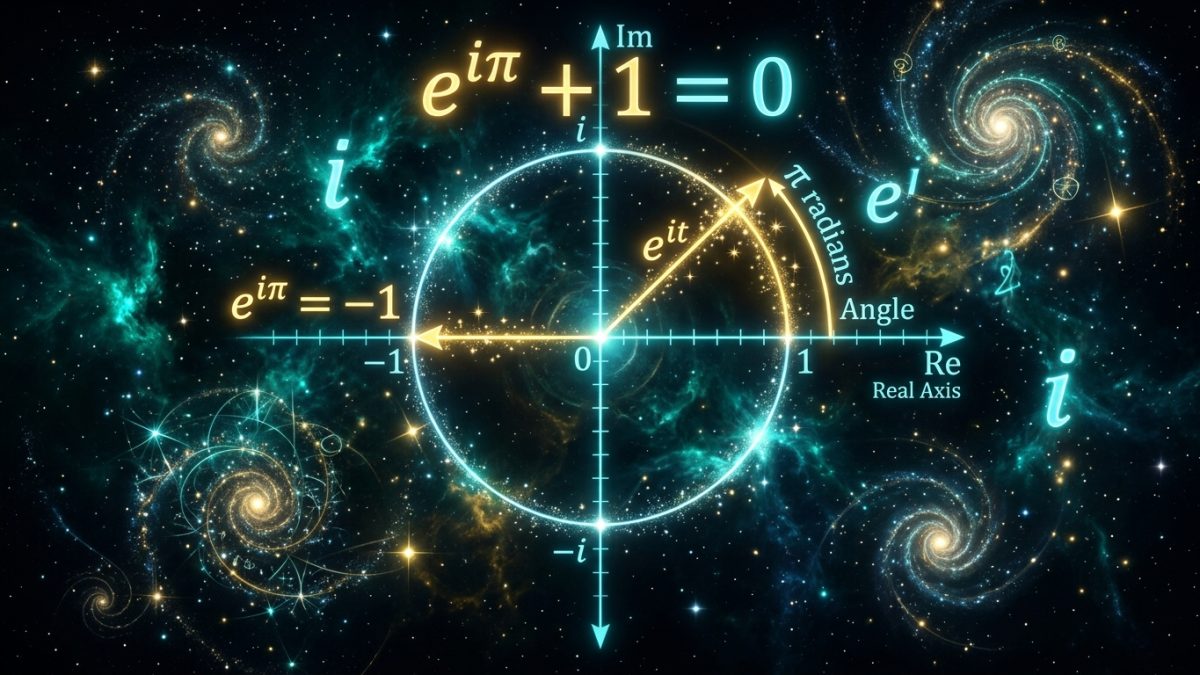
This is Euler’s Formula. When evaluated at the angle $x = pi$ radians ($180^circ$):
$$e^{ipi} = cos pi + i sin pi = -1 + i(0) = -1$$
Adding $1$ to both sides yields the timeless jewel:
$$e^{ipi} + 1 = 0$$
3. Geometric Rotation and Modern Physics
On the complex Argand plane, multiplying any number by $e^{itheta}$ is geometrically equivalent to rotating that vector counterclockwise through an angle $theta$. When $theta = pi$, an arrow pointing along the positive real axis rotates a full half-circle, arriving precisely at $-1$.
This geometric rotation is the computational backbone of modern physical reality:
- Quantum Mechanics: Every quantum wavefunction evolves in time via a complex phase factor dictated by the Hamiltonian operator: $psi(t) = psi(0) e^{-iEt/hbar}$. The interference of matter waves in double-slit experiments is directly governed by complex phase rotation.
- Electrical Engineering & Signal Processing: Alternating current (AC) impedance, electromagnetic waves, and the Fast Fourier Transform (FFT) treat sinusoidal signals as rotating phasors $e^{iomega t}$, simplifying messy differential equations into elementary algebra.
Euler’s identity reminds us that beneath the messy contingencies of the physical universe lies an interconnected mathematical architecture of breathtaking elegance and profound unity.