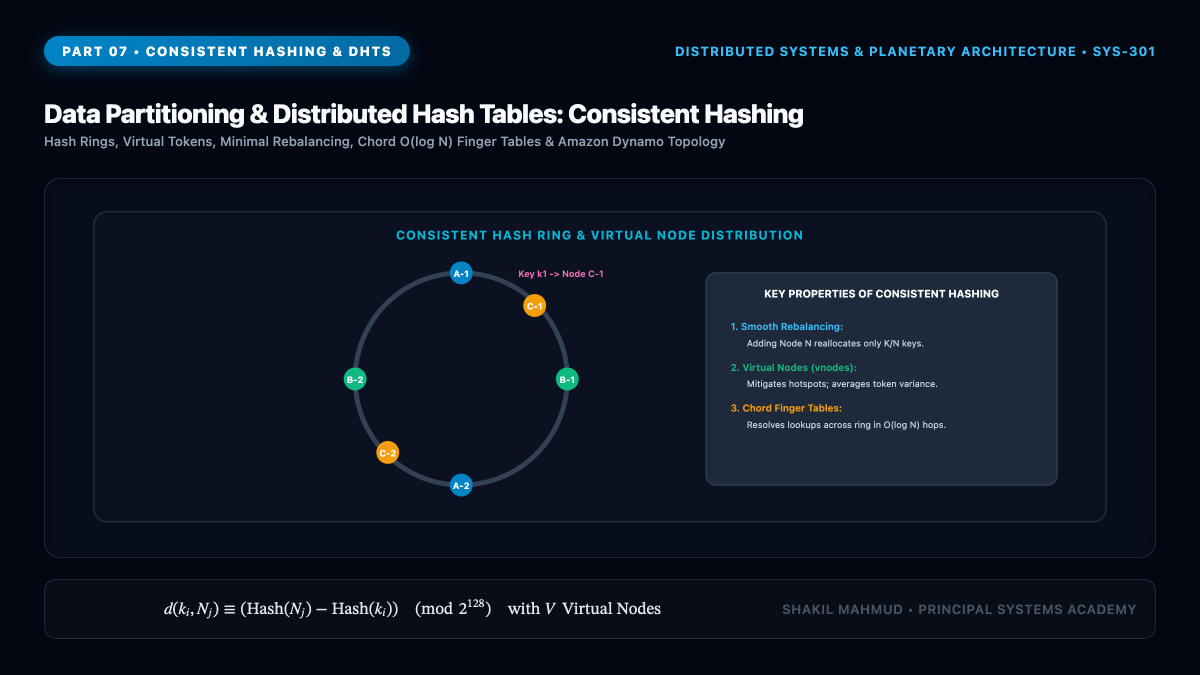
At planetary scale, storage systems cannot rely on a centralized directory to map billions of keys to physical storage servers: central routers become catastrophic single points of failure and performance bottlenecks. The naive distribution mechanism, modular hashing—mapping key $k$ to node index $h(k) pmod N$—suffers from an algorithmic catastrophe: when the node count $N$ increments or decrements by even 1, almost all keys ($O(K)$) are assigned to new servers, triggering devastating network cascades. In 1997, David Karger et al. published Consistent Hashing, an algorithmic foundation that bounds data movement to $O(K/N)$ upon cluster resizing, enabling resilient distributed key-value stores from Amazon Dynamo and Apache Cassandra to Akamai CDN and BitTorrent.
1. The Failure of Modulo Hashing & The Consistent Ring
Modulo hashing maps a key space to $N$ servers via:
$$ ext{Node}(k) = mathcal{H}(k) pmod N$$
When a server fails or an operator provisions additional capacity ($N o N pm 1$), the modulo operator changes for almost all hash values. Statistically, the fraction of keys that must be relocated across the network is:
$$mathcal{P}( ext{Relocation}) = rac{N}{N+1} pprox 1 – rac{1}{N} quad ( ext{approaching } 100% ext{ as } N ext{ scales})$$
The Consistent Hashing Circular Space
Consistent hashing decouples key distribution from cluster size by mapping both storage nodes and data keys onto the identical continuous 1D cyclic identifier space (the Hash Ring). Using a cryptographic hash function such as SHA-1 ($2^{160}$) or MD5 ($2^{128}$), the ring wraps around from $0$ to $2^b – 1$:
$$mathcal{S} = [0, 2^b – 1] pmod{2^b}$$
- Node Mapping: Physical servers are hashed using their IP address or hostname: $h_n = mathcal{H}( ext{“192.168.1.10:8080”})$. Each node occupies a fixed discrete coordinate on the perimeter of the circle.
- Key Mapping: A key $k$ is hashed to coordinate $h_k = mathcal{H}(k)$.
- Routing Invariant: Key $k$ is assigned to the first node encountered moving clockwise around the ring whose identifier is greater than or equal to $h_k$:
$$ ext{Node}(k) = rgmin_{n in mathcal{N}} {h_n mid h_n ge h_k} quad ( ext{wrapping around to } min(mathcal{N}) ext{ if } h_k > max_{n in mathcal{N}} h_n)$$
When a new node $n_{ ext{new}}$ is inserted between node $n_{A}$ and $n_{B}$, it only takes custody of keys belonging to the interval $(h_{n_A}, h_{n_{ ext{new}}}]$. All other keys on the ring remain completely unaffected. The expected fraction of keys relocated is bounded by:
$$mathbb{E}[ ext{Relocated Keys}] = rac{K}{N+1}$$
2. Non-Uniformity & Virtual Nodes (Vnodes)
While elegant, placing physical servers directly onto the ring suffers from two severe practical issues: hash clustering (hot spots where one node inherits an unusually large angular segment) and hardware heterogeneity (fast machines cannot be assigned more work than slow machines).
Distributed storage engines resolve this through Virtual Nodes (Vnodes). Instead of assigning a physical machine to a single ring coordinate, physical node $P_i$ is mapped to $V$ distinct virtual tokens distributed pseudorandomly across the ring:
$$v_{i, j} = mathcal{H}( ext{NodeID}_i mathbin{Vert} ext{“#vnode_”} mathbin{Vert} j) quad ext{for } j in {1, 2, dots, V}$$
By the Central Limit Theorem, as $V$ increases (typically $V = 128 ext{ to }256$ in Cassandra and Dynamo), the angular variance between neighboring tokens decays rapidly, achieving near-perfect load balance:
$$sigma_{ ext{load}} propto rac{1}{sqrt{V}}$$
Furthermore, when physical server $P_i$ fails, its $V$ virtual ranges are dispersed evenly among all surviving physical servers in the cluster, completely avoiding the thundering-herd effect where a single successor node is overwhelmed by an entire failed node’s traffic.
3. Structured Distributed Hash Tables: Chord DHT
While consistent hashing dictates where keys belong, routing a query to the responsible node in a completely decentralized peer-to-peer overlay network without a central routing table requires a structured topology. The Chord protocol arranges nodes on an $m$-bit ring and maintains a routing table called a Finger Table.
Each node $n$ maintains an $m$-entry finger table where entry $k$ points to the first node succeeding $n$ by at least $2^{k-1}$ on the circle:
$$ ext{Finger}[k] = ext{Successor}((n + 2^{k-1}) pmod{2^m}) quad ext{for } 1 le k le m$$
Using these exponential finger jumps, a lookup query halves the remaining circular distance at each routing step, guaranteeing lookup time complexity:
$$mathcal{O}(log N) quad ext{hops across the network}$$
4. Kademlia DHT & The XOR Distance Metric
Modern decentralized networks (including BitTorrent Mainline DHT, Ethereum’s Discovery Protocol, and IPFS) overwhelmingly favor Kademlia over Chord. Kademlia introduces a radically simpler, symmetric distance metric based on the bitwise exclusive-OR (XOR) operation between node identifiers $x$ and $y$:
$$d(x, y) = x oplus y$$
Properties of the XOR Metric
- Identity of Indiscernibles: $d(x, y) = 0 iff x = y$
- Symmetry: $d(x, y) = d(y, x) quad ( ext{Chord is unidirectional, Kademlia is bidirectional})$
- Triangle Inequality: $d(x, z) le d(x, y) oplus d(y, z)$
- Unidirectional Invariance: For any given coordinate $x$ and distance $Delta$, there exists exactly one point $y$ such that $d(x, y) = Delta$.
Kademlia partitions the identifier space into binary subtrees and stores contact information in $k$-buckets. Each $k$-bucket stores $k$ known peers (typically $k=20$) residing at a distance between $[2^i, 2^{i+1})$ from the local node. Because nodes continuously update $k$-buckets from incoming query traffic, Kademlia dynamically learns network topology without explicit background polling, offering unprecedented resilience against massive churn and Sybil attacks.




