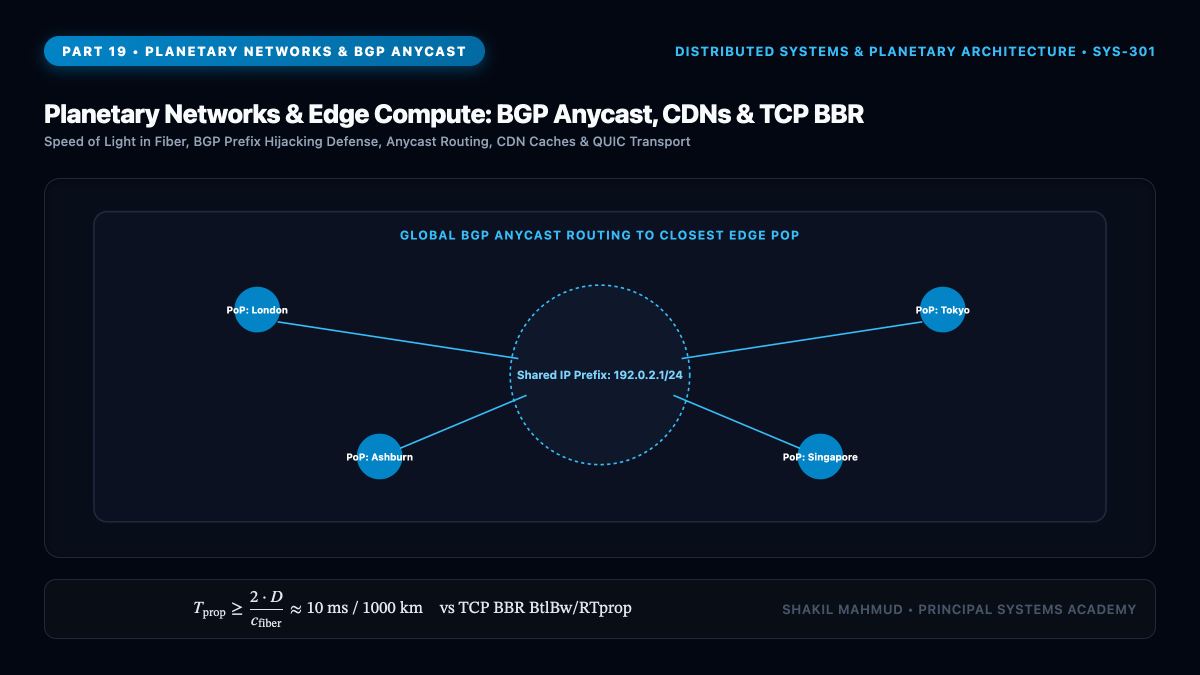
Computer architects routinely optimize algorithms for memory bandwidth and CPU clock cycles, yet at planetary scale, the ultimate immutable constraint governing distributed software is not silicon—it is special relativity. Light in a vacuum travels at $c approx 300{,}000,text{km/s}$, but inside terrestrial fiber-optic silica glass, light refracts through core glass with refractive index $n approx 1.47$, slowing velocity to approximately $200{,}000,text{km/s}$ ($sim 5,mutext{s}$ per kilometer). Transoceanic round-trip times between London and Tokyo can never drop below physical lower bounds. Planetary architectures overcome these physical barriers using BGP Anycast Routing, Edge TCP Termination, and lightweight distributed runtimes (V8 Isolates, WebAssembly).
1. The Physical Speed-of-Light Latency Floor
Consider two datacenters separated by a physical great-circle distance $d$ across the Earth’s surface. The fundamental physical Round-Trip Time (RTT) lower bound is:
$$text{RTT}_{min} = frac{2d}{v_{text{fiber}}} = frac{2d cdot n}{c} approx frac{2d}{204{,}000,text{km/s}}$$
For a transatlantic fiber connection between New York and London ($d approx 5{,}570,text{km}$), the absolute theoretical lower limit for a single photon round trip is $sim 55,text{ms}$; accounting for terrestrial cable detours and optical repeater amplifiers, real-world RTT rarely drops below $70,text{ms}$. For transpacific paths (San Francisco to Singapore, $d approx 13{,}600,text{km}$), physical RTT hovers between $160,text{ms}$ and $180,text{ms}$.
Every sequential synchronous network round-trip across oceans imposes an inescapable physical latency penalty that no software optimization can circumvent. Planetary systems must minimize cross-continental round-trips by shifting computation directly to the physical edge.
2. The Architecture of BGP Anycast
In standard IP unicast routing, a single IP address maps to exactly one physical network interface on a single server. In BGP Anycast, a global fleet of hundreds of distributed Points of Presence (PoPs) located in edge datacenters worldwide announce the identical IP prefix over the Border Gateway Protocol (BGP) to Tier-1 Internet Service Providers (ISPs).
$$text{PoP}_{text{London}}, , text{PoP}_{text{Tokyo}}, , text{PoP}_{text{New York}} xrightarrow{text{BGP Broadcast}} text{Announce: } 1.1.1.1/32$$
Internet routers evaluate BGP path metrics and naturally route an end-user’s packets along the shortest Autonomous System (AS) path. A user in Frankfurt hits the Frankfurt edge PoP; a user in Sydney hits the Sydney edge PoP—all communicating with the exact same IP address.
Solving Anycast Route Flapping
A classic risk of Anycast is route flapping: if network congestion causes BGP routers to shift routing mid-stream, subsequent TCP packets might land on a different physical PoP that lacks the connection’s TCP socket state, resetting the connection. Edge networks mitigate this by terminating TCP and TLS handshakes locally at the edge PoP, translating client requests into multiplexed, long-lived HTTP/2 or HTTP/3 QUIC connection pools back to origin datacenters.
3. Edge Computing: V8 Isolates & WebAssembly (Wasm)
Historically, edge content delivery networks (CDNs) were restricted to static file caching. Modern planetary architectures (Cloudflare Workers, Fastly Compute@Edge, AWS Lambda@Edge) execute dynamic business logic within sub-millisecond proximity to the client.
Why Traditional Containers Fail at the Edge
Deploying heavy Docker containers or virtual machines across 300 global edge cities is economically and architecturally unviable: cold-boot times (hundreds of milliseconds to seconds) and massive memory overhead (hundreds of megabytes per instance) would overwhelm edge servers.
The V8 Isolate Paradigm
Edge runtimes leverage V8 Isolates or WebAssembly (Wasm) sandboxes:
- An Isolate represents a completely independent instance of the V8 JavaScript runtime with its own private heap and call stack.
- Thousands of independent customer isolates run inside a single OS process without container boundaries.
- Instant Cold Starts: An isolate boots in under $5,text{milliseconds}$ with less than $3,text{MB}$ of memory footprint.
- Dynamic edge routing, authentication checks, A/B testing, and local key-value lookups execute locally at the nearest edge PoP, cutting end-user latency from $200,text{ms}$ down to $15,text{ms}$.