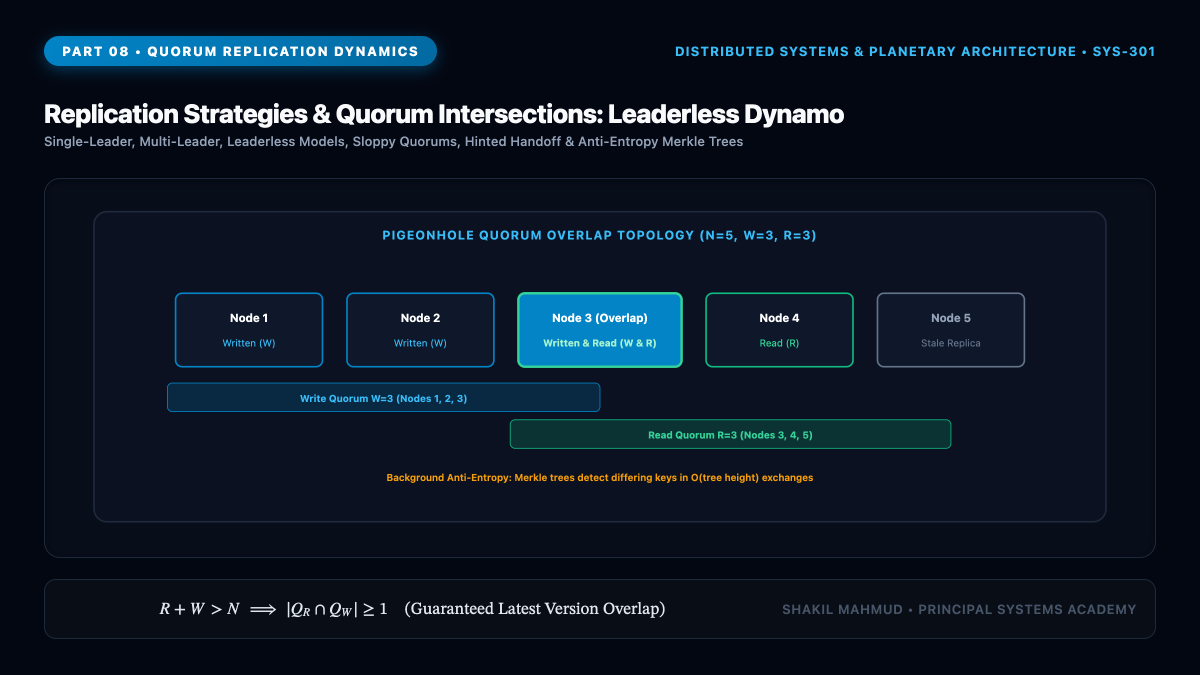
In an ideal distributed world, data replication would be instantaneously synchronous and universally consistent across all nodes. In the reality of global public cloud infrastructure, network partitions, transient hardware stalls, and speed-of-light propagation delays make strict synchronous replication prohibitively slow for latency-critical e-commerce platforms. In 2007, Amazon published the architecture of Dynamo, a highly available, decentralized key-value storage system deliberately optimized for write-availability and multi-datacenter survival. Dynamo formalized the modern paradigm of Quorum Replication, combining configurable consistency parameters, sloppy quorums, hinted handoff, and background anti-entropy via Merkle trees.
1. The Quorum Overlap Invariant
In a quorum-replicated storage system, each key is replicated across a Preference List of $N$ distinct physical nodes. Client interactions are parameterized by two fundamental variables:
- $W$: The Write Quorum—the minimum number of successful replica acknowledgments required before a write operation is marked successful to the client.
- $R$: The Read Quorum—the minimum number of replica responses required before returning a value to the read client.
To guarantee strong, linearizable read-your-writes consistency, the read and write sets must overlap by at least one non-faulty replica. This gives rise to the classic Quorum Intersection Invariant:
$$R + W > N$$
By the Pigeonhole Principle, if $R + W > N$, any read quorum of size $R$ and write quorum of size $W$ chosen from a cluster of $N$ nodes must intersect in at least one common replica:
$$|mathcal{Q}_{ ext{read}} cap mathcal{Q}_{ ext{write}}| ge R + W – N ge 1$$
The common replica in the intersection is guaranteed to hold the latest write. As long as each write is accompanied by a monotonically increasing timestamp or version vector, the reading client can identify and return the freshest state.
Latency vs. Consistency Tuning
By adjusting $R$ and $W$, distributed architects tune the system across the performance-consistency spectrum:
- Fast Reads ($R=1, W=N$): Reads return in a single local hop, but writes are brittle; if a single replica is down, writes fail.
- Fast Writes ($W=1, R=N$): Extremely resilient writes with minimal latency; reads must query all nodes and perform coordination.
- Symmetric Majorities ($R = lfloor N/2
floor + 1, W = lfloor N/2
floor + 1$): Balances read and write latencies while tolerating $lfloor (N-1)/2
floor$ replica crashes.
2. Sloppy Quorums & Hinted Handoff
Strict quorum systems reject writes if fewer than $W$ healthy nodes in the key’s designated top-$N$ preference list are reachable. Amazon’s retail shopping cart cannot afford to drop writes under any operational circumstance, famously formulating the design motto: “Writes must never be rejected.”
Dynamo relaxes strict quorums to Sloppy Quorums: if the primary nodes in the preference list are temporarily unreachable due to network partitions or hardware reboots, the coordinator routes write operations to alternate healthy nodes residing further down the consistent hash ring outside the preference list.
Hinted Handoff
The surrogate node accepts the write and marks it with a special metadata tag (“hint”) indicating its true target destination. The surrogate retains this data locally until network telemetry reveals that the primary node has recovered. It then delivers the accumulated updates via Hinted Handoff and deletes the local surrogate replica, restoring proper cluster topology.
3. Concurrency Tracking: Vector Clocks & Dotted Version Vectors
Because sloppy quorums allow concurrent writes across isolated network partitions without synchronous coordination, data versions naturally diverge. To track causal relationships without central clocks, Dynamo tags every object mutation with a Vector Clock:
$$ec{V} = [ (s_1, c_1), (s_2, c_2), dots, (s_m, c_m) ]$$
When comparing two object versions with vector clocks $ec{V}_A$ and $ec{V}_B$:
- $ec{V}_A$ causally precedes $ec{V}_B$ ($ec{V}_A < ec{V}_B$) if for every node $k$, $ec{V}_A[k] le ec{V}_B[k]$ and there exists at least one node $j$ where $ec{V}_A[j] < ec{V}_B[j]$. Version $ec{V}_B$ safely overwrites $ec{V}_A$.
- If neither dominates ($ec{V}_A
otle ec{V}_B$ and $ec{V}_B
otle ec{V}_A$), the writes occurred concurrently in disconnected branches.
When concurrent divergence occurs, Dynamo retains both versions (creating a “sibling” branch). During subsequent reads, the client receives all conflicting siblings and resolves the semantic conflict at the application layer (for instance, performing a union of items in an e-commerce shopping cart).
4. Background Anti-Entropy via Merkle Trees
Hinted handoff is a best-effort recovery mechanism: if a surrogate node crashes before handing off its data, replicas become permanently out of sync. To achieve eventual consistency, distributed nodes perform continuous background Anti-Entropy synchronization.
Comparing gigabytes of keys over a WAN by sending raw records would saturate network interfaces. Dynamo employs Merkle Trees (cryptographic hash trees):
- Replicas partition their assigned key range into buckets and compute a binary hash tree: leaves are cryptographic hashes of individual keys, while parent nodes are hashes of their concatenated children:
$$ ext{Node}_{ ext{parent}} = mathcal{H}( ext{Child}_{ ext{left}} mathbin{Vert} ext{Child}_{ ext{right}})$$ - To detect divergence, two nodes exchange only the root hash of their corresponding Merkle trees ($mathcal{O}(1)$ bandwidth).
- If the roots match, the replicas are identical. If they differ, nodes recursively traverse the tree, comparing child hashes down to the specific divergent leaves in $mathcal{O}(log M)$ network round-trips, transmitting only the divergent keys.