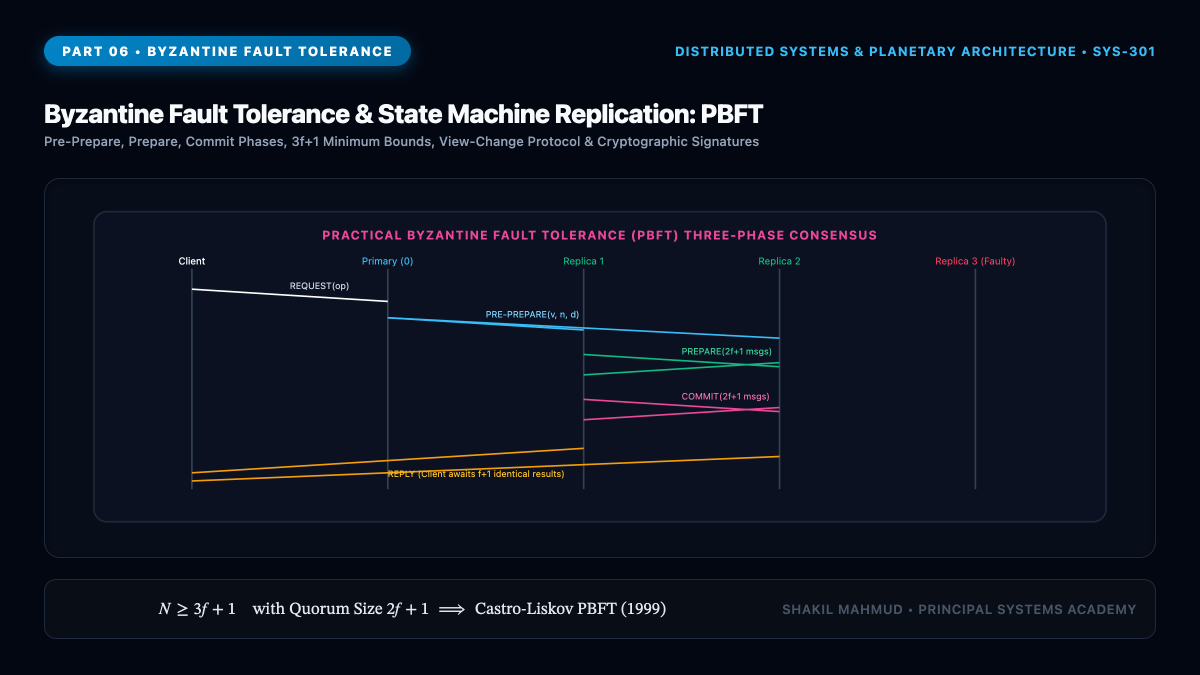
Crash-fault-tolerant consensus engines such as Paxos and Raft operate under a benign operational assumption: nodes either execute their prescribed state machine faithfully or crash silently (fail-stop). In adversarial environments, permissioned financial ledgers, and decentralized consensus networks, nodes can be compromised, act maliciously, forge arbitrary payloads, or send contradictory messages to different peers. Tolerating such malicious behavior requires solving the Byzantine Generals Problem. In 1999, Miguel Castro and Barbara Liskov introduced Practical Byzantine Fault Tolerance (PBFT), demonstrating for the first time that state-machine replication under Byzantine failures could achieve high performance in asynchronous networks with sub-millisecond latencies.
1. The Byzantine Failure Model & The $N ge 3f + 1$ Lower Bound Proof
In a Byzantine fault model, up to $f$ nodes out of a total cluster of $N$ nodes can exhibit arbitrary, potentially coordinated, malicious behavior (equivocation, collusion, silence, state corruption). Cryptographic primitives (digital signatures and cryptographic hashes) prevent impersonation and undetectable payload tampering, but cannot prevent a node from telling lies or withholding messages.
The Lower Bound Proof
To understand why a cluster requires at least $3f + 1$ nodes to withstand $f$ Byzantine adversaries, consider an asynchronous network where messages experience arbitrary network delays:
- A consensus quorum must make progress even if $f$ nodes are completely dead or unresponsive. Therefore, the system must reach decisions based on responses from at most:
$$N – f quad ext{nodes}$$ - Among those $N – f$ nodes that responded, up to $f$ could be active Byzantine traitors delivering deceptive or contradictory messages.
- To ensure that the non-faulty nodes strictly outnumber the Byzantine nodes in the responding quorum, the number of non-faulty nodes ($N – 2f$) must be strictly greater than the number of faulty nodes ($f$):
$$(N – f) – f > f iff N – 2f > f iff N > 3f implies N ge 3f + 1$$
Thus, for $f = 1$ Byzantine traitor, a minimum of $N = 4$ nodes is mathematically required; for $f = 2$, $N = 7$ nodes.
2. The Three-Phase PBFT Protocol Architecture
PBFT proceeds through successive configuration epochs termed Views ($v in mathbb{N}$). In each view, a single designated node acts as the Primary (leader), determined deterministically by $p = v pmod N$, while the remaining nodes act as Backups. Client operations execute across three synchronized phases:
Phase 1: Pre-Prepare
A client sends an operation $m$ to the primary. The primary assigns a monotonically increasing sequence number $n$, computes the cryptographic digest $d = mathcal{H}(m)$, and multicasts a signed message to all backup replicas:
$$langle ext{PRE-PREPARE}, v, n, d
angle_{sigma_p}, quad m$$
Backups verify the primary’s signature, verify that $v$ matches their current view, ensure $n$ falls within an acceptable sliding sequence window $[h, H]$, and verify that no conflicting pre-prepare exists for $langle v, n
angle$.
Phase 2: Prepare
Upon accepting the pre-prepare, backup $i$ enters the prepare phase and multicasts to all peers:
$$langle ext{PREPARE}, v, n, d, i
angle_{sigma_i}$$
Every node collects prepare messages in its local log. A node achieves a Prepared Certificate $mathcal{P}(v, n, d)$ when it holds:
- The original request $m$ matching digest $d$.
- The primary’s pre-prepare message for $langle v, n, d
angle$. - $2f$ valid, non-conflicting prepare messages from distinct replicas matching the same view, sequence number, and digest.
Together with the primary’s pre-prepare, this represents a quorum of $2f + 1$ distinct nodes agreeing on an absolute ordering of requests within view $v$.
Phase 3: Commit
Once node $i$ attains a prepared certificate $mathcal{P}(v, n, d)$, it multicasts a signed commit message to all peers:
$$langle ext{COMMIT}, v, n, d, i
angle_{sigma_i}$$
A replica achieves a Committed Certificate when it collects $2f + 1$ commit messages from distinct replicas matching $langle v, n, d
angle$. Once committed, the node executes the command on its local deterministic state machine and transmits the result directly to the client.
The client considers the request committed when it receives matching responses from $f + 1$ distinct replicas, guaranteeing that at least one honest, non-faulty replica executed the operation.
3. Cryptographic Quorum Overlap Dynamics
The mathematical safety of PBFT relies on the intersection of any two commit quorums of size $2f + 1$. In a system of $N = 3f + 1$ nodes, the intersection of two quorums $mathcal{Q}_1$ and $mathcal{Q}_2$ satisfies:
$$|mathcal{Q}_1 cap mathcal{Q}_2| ge 2(2f + 1) – (3f + 1) = f + 1$$
Because there are at most $f$ Byzantine nodes in the entire network, any two quorums must share at least one non-faulty, honest replica:
$$|mathcal{Q}_1 cap mathcal{Q}_2| – f ge (f + 1) – f = 1$$
This honest node prevents contradictory sequence numbers from ever securing valid commit certificates in the same view or across subsequent views.
4. View Change Recovery: Deposing Malicious Primaries
If a primary becomes Byzantine—dropping messages, proposing conflicting requests, or intentionally delaying consensus—backups trigger a View Change via a timeout mechanism:
- Backup $i$ starts a timer when it receives a request. If the timer expires before the request commits, the backup stops accepting messages for view $v$ and broadcasts:
$$langle ext{VIEW-CHANGE}, v+1, s, mathcal{C}, mathcal{P}, i
angle_{sigma_i}$$
where $s$ is the sequence number of the last stable checkpoint, $mathcal{C}$ is a set of $2f + 1$ signed checkpoint proofs, and $mathcal{P}$ is the collection of prepared certificates accumulated since checkpoint $s$. - The new primary $p’ = (v + 1) pmod N$ collects $2f$ valid view-change messages from distinct peers, constructs a new view proof, and broadcasts:
$$langle ext{NEW-VIEW}, v+1, mathcal{V}, mathcal{O}
angle_{sigma_{p’}}$$
where $mathcal{O}$ reconstructs the sequence of uncommitted requests based on the highest-view prepared certificates.
5. Algorithmic Complexity & Modern Evolution
Because every node multicasts prepare and commit messages to all peers, PBFT exhibits communication complexity of:
$$mathcal{O}(N^2) quad ext{messages per transaction}$$
While optimal for small clusters ($N pprox 4 ext{ to }16$), $O(N^2)$ message storms degrade WAN throughput. Modern BFT protocols—such as Tendermint (gossip-based voting), HotStuff (linear view change via threshold signatures $mathcal{O}(N)$ chaining), and DAG-based consensus like Narwhal/Bullshark—trace their theoretical foundations directly to Castro and Liskov’s PBFT.




