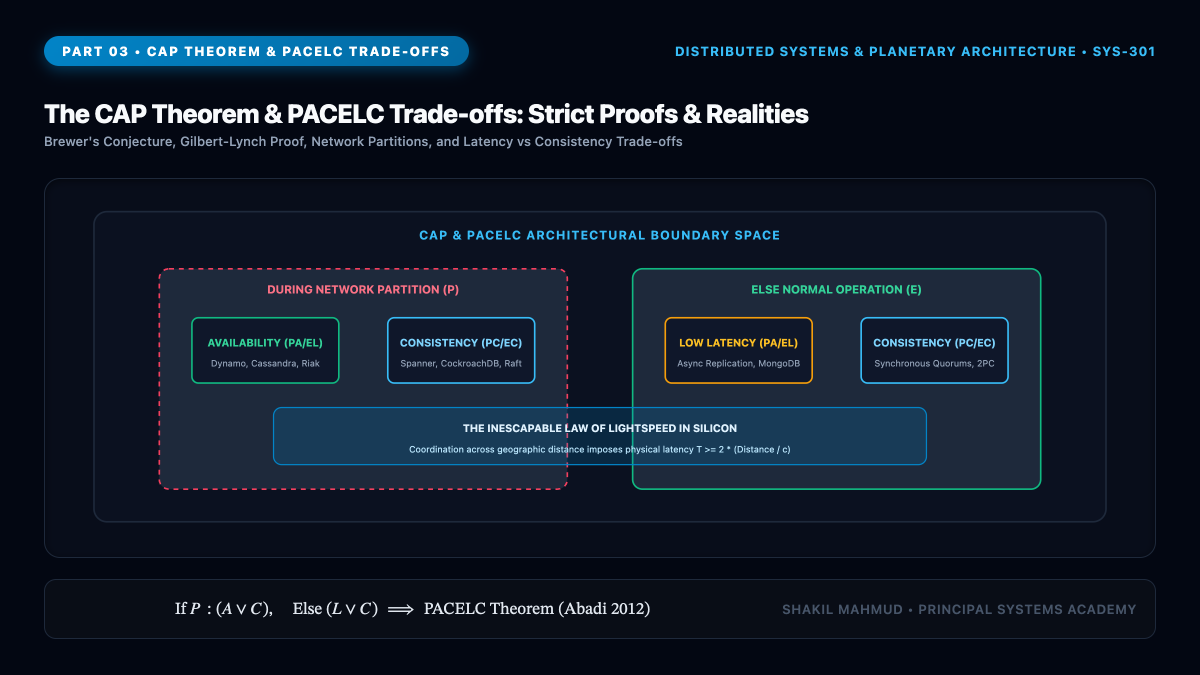
In 2000, Eric Brewer proposed a conjecture at the ACM Symposium on Principles of Distributed Computing (PODC) that would become the most cited law of modern systems architecture: the CAP Theorem. Formally proven in 2002 by Seth Gilbert and Nancy Lynch, CAP establishes that a distributed data store can simultaneously provide at most two of three guarantees: Consistency, Availability, and Partition Tolerance.
1. Formal Definitions Under Gilbert & Lynch (2002)
To prevent hand-waving architectural debates, Gilbert and Lynch mathematically formalized the three terms under an asynchronous network model with read/write registers:
- Consistency ($mathcal{C}$): Strictly defined as Linearizability (atomic consistency). There must exist a total order over all read and write operations such that each operation appears to take effect instantaneously at some point in real physical time between its invocation and its response. Every read must return the value of the most recent write.
- Availability ($mathcal{A}$): Every non-failing node must return a non-error response to every request it receives. Returning a timeout, an HTTP 500 error, or an explicit failure does not constitute availability.
- Partition Tolerance ($mathcal{P}$): The network may lose an arbitrary number of messages transmitted between nodes, effectively partitioning the network into disconnected components ($G_1$ and $G_2$) for an arbitrary duration.
2. The Gilbert & Lynch Proof by Contradiction
The proof of CAP is breathtakingly elegant in its simplicity:
- Assume a distributed system claims to achieve both Consistency ($mathcal{C}$) and Availability ($mathcal{A}$) in the presence of Network Partitions ($mathcal{P}$).
- Let the network partition split the cluster into two disjoint subgraphs: $G_1$ and $G_2$. All communication across the boundary between $G_1$ and $G_2$ is dropped by the network adversary.
- A client connects to a node in $G_1$ and executes a write operation: $text{write}(x, v_1)$. Because the system is Available ($mathcal{A}$), the node in $G_1$ must eventually acknowledge the write as successful without waiting indefinitely.
- Concurrently, another client connects to a node in $G_2$ and executes a read operation: $text{read}(x)$. Because the system is Available ($mathcal{A}$), the node in $G_2$ must return a response.
- However, because the network is partitioned, no message regarding the write $text{write}(x, v_1)$ could cross from $G_1$ to $G_2$. The node in $G_2$ has no information about $v_1$ and must return the old value $v_0$ (or an uninitialized state).
- This violates Linearizability ($mathcal{C}$), because the read completed strictly after the write had completed in physical time, yet failed to observe the new value.
- Therefore, no distributed system can achieve both Consistency and Availability under a partition: $mathcal{P} implies (mathcal{A} oplus mathcal{C})$.
3. Daniel Abadi’s PACELC Extension (2012)
While the CAP theorem captures catastrophic network splits, partitions are relatively rare in well-engineered intra-datacenter networks. Yale professor Daniel Abadi pointed out that CAP fails to describe how systems behave during normal, healthy operations. He formulated the PACELC Theorem:
$$text{If Partition } (P): quad text{Choose between } A text{ and } C; quad text{Else } (E): quad text{Choose between } L text{ (Latency) and } C text{ (Consistency)}$$
When there is no partition, if a system chooses strong Consistency ($C$), every write or read must execute synchronous multi-node round-trip coordination (e.g., Paxos quorums, 2-phase commits), inevitably inflating Latency ($L$). If a system optimizes for minimal Latency ($L$), it must execute operations asynchronously against local memory or single nodes, sacrificing absolute consistency for eventual consistency.
4. Architectural Classification of Real-World Engines
| System Classification | Database Engines | Operational Behavior |
|---|---|---|
| PC / EC | Google Spanner, CockroachDB | Prefers consistency under partitions; synchronous coordination during normal runtime. |
| PA / EL | Amazon Dynamo, Apache Cassandra | Accepts writes during partitions; serves local reads at sub-millisecond latencies normally. |
| PA / EC | MongoDB (Configurable) | Maintains consistency normally, but may serve stale reads or fail over during partitions. |
5. The Speed of Light in Fiber: The Ultimate Physical Latency Barrier
Modern cloud architects must contend with the fundamental laws of relativistic physics. In standard silica optical fiber, light propagates at a refractive index of $n approx 1.47$:
$$v_{text{fiber}} = frac{c}{n} approx frac{300,000text{ km/s}}{1.47} approx 204,000text{ km/s} implies approx 4.9text{ microseconds per kilometer}$$
For a round-trip between data centers separated by $10,000text{ km}$ (e.g., California to London or Tokyo), the absolute minimum theoretical lightspeed transit time is:
$$text{RTT}_{text{min}} = frac{2 times 10,000text{ km}}{204,000text{ km/s}} approx 98text{ milliseconds}$$
No software algorithm, compiler optimization, or quantum computer can circumvent this $100text{ ms}$ lower bound. A strongly consistent distributed database spanning transatlantic regions must pay this tax on every synchronized transaction.




