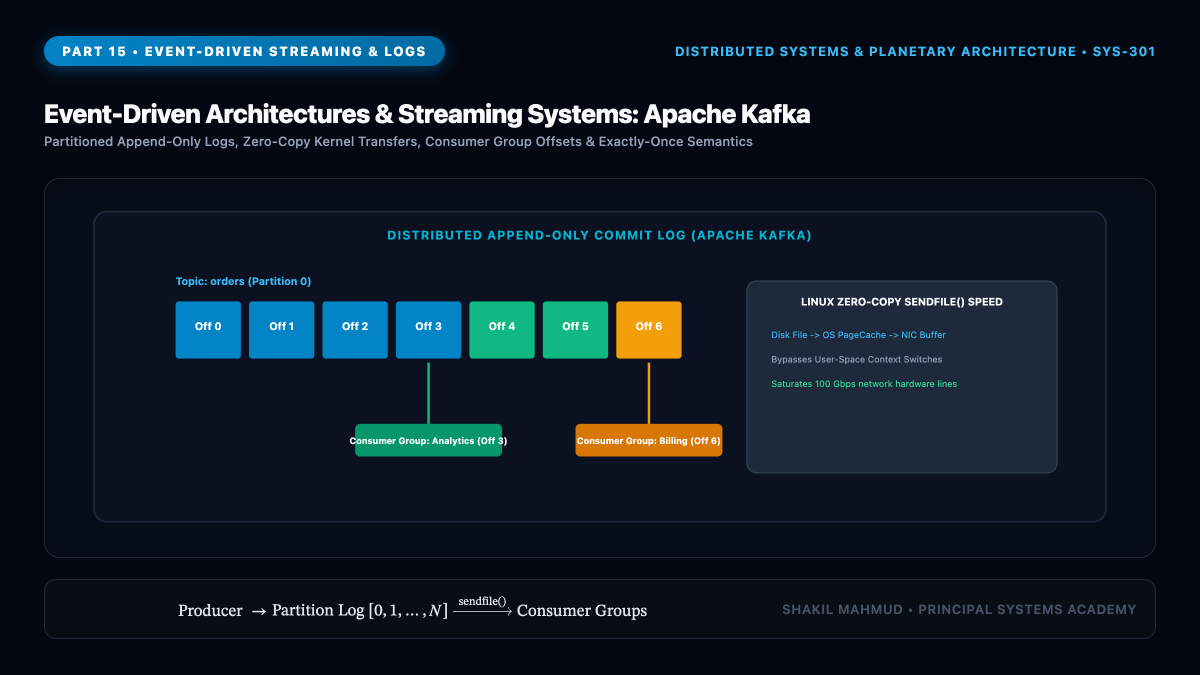
Traditional distributed middleware relied heavily on message queues (JMS, AMQP) where messages were ephemeral entities destroyed upon consumer acknowledgment. In 2011, Jay Kreps, Neha Narkhede, and Jun Rao at LinkedIn reimagined distributed data integration with Apache Kafka. Grounded in Kreps’ famous architectural thesis “The Log: What every software engineer should know about real-time data’s unifying abstraction”, Kafka decoupled producers and consumers by modeling state as a strictly ordered, immutable, persistent distributed Commit Log. Combining partition sharding, zero-copy OS kernel streaming, and In-Sync Replica (ISR) quorums, Kafka transformed enterprise event-driven architectures.
1. The Commit Log Abstraction: Decoupled Temporal State
Unlike transient queues where queues track consumer state, a distributed commit log is an append-only, sequentially ordered sequence of records:
$$mathcal{L} = [ r_0, r_1, r_2, dots, r_k ]$$
Each record is assigned a monotonic integer identifier: its Offset. Crucially, the log is completely agnostic to consumers. Consumers are merely sequential readers tracking their own cursor offset $mathcal{O}_c in mathbb{N}$. Multiple independent downstream services can stream, replay, or rewind the identical event history at their own autonomous throughput rates without placing memory pressure on the broker.
2. Physical Storage Anatomy: Segments, Indexes & Sparse Lookups
A Kafka Topic is partitioned into multiple physical Partitions distributed across cluster brokers. Each partition is mapped directly to a local directory on disk composed of immutable Log Segments (typically 1 GB files):
- `00000000000000000000.log`: Contiguous raw binary message payloads appended sequentially to disk.
- `00000000000000000000.index`: A memory-mapped Sparse Offset Index mapping message offsets to physical byte offsets in the `.log` file.
- `00000000000000000000.timeindex`: A sparse timestamp index mapping Unix epoch timestamps to record offsets, enabling temporal queries.
Because the offset index is sparse (recording an entry every 4 KB of data), the entire index fits effortlessly in the operating system’s page cache. Finding a record at offset $K$ requires an in-memory binary search on the sparse index to locate the nearest physical byte offset, followed by a minimal sequential scan through at most 4 KB of contiguous disk blocks.
3. High-Throughput Kernel Optimization: Zero-Copy I/O
A traditional web application reading a file from disk and sending it over a network socket incurs four context switches and three memory copies:
$$text{Disk} xrightarrow{text{DMA}} text{OS Pagecache} xrightarrow{text{CPU}} text{User App Buffer} xrightarrow{text{CPU}} text{Socket Buffer} xrightarrow{text{DMA}} text{NIC Buffer}$$
Kafka bypasses userspace entirely using the Linux `sendfile()` system call (Zero-Copy):
$$text{Disk} xrightarrow{text{DMA}} text{OS Pagecache} xrightarrow{text{DMA Gather}} text{Network Interface Card (NIC)}$$
Data transfers directly from the OS pagecache into the network card buffer via Direct Memory Access (DMA), completely eliminating CPU memory copying and CPU-context switching overhead. Consequently, Kafka’s throughput is bounded solely by physical network interface cards and NVMe sequential bus speeds.
4. Distributed Replication Dynamics: In-Sync Replicas (ISR)
Each partition has one designated Leader Replica and multiple Follower Replicas. Unlike Paxos or Raft which require a majority of all configured nodes, Kafka dynamically tracks an active subset of replicas known as the In-Sync Replicas (ISR) pool:
$$text{ISR} subseteq text{Assigned Replicas}$$
A follower remains in the ISR if it fetches messages from the leader within the configured time window (`replica.lag.time.max.ms`). If a slow or partitioned follower falls behind, the leader evicts it from the ISR.
The High Watermark (HW) & Log End Offset (LEO)
- Log End Offset (LEO): The offset of the next record to be written to a replica’s log.
- High Watermark (HW): The minimum LEO across all replicas currently in the ISR pool:
$$text{HW} = min_{r in text{ISR}} text{LEO}(r)$$
Only records up to the High Watermark are visible to consumers. This guarantees that consumers never observe uncommitted records that could be lost if the partition leader experiences an unrecoverable hardware failure.
Producer Acknowledgments & Idempotence
Producers configure consistency semantics via the `acks` parameter:
- `acks=0`: Fire-and-forget. Maximum speed, potential message loss.
- `acks=1`: Leader writes to local log and responds. Tolerates follower lag, vulnerable to leader crash before replication.
- `acks=all (-1)`: Leader acknowledges only after all replicas in the ISR have appended the record to their local logs. In conjunction with `min.insync.replicas=2`, this guarantees zero data loss under single-node failure.




