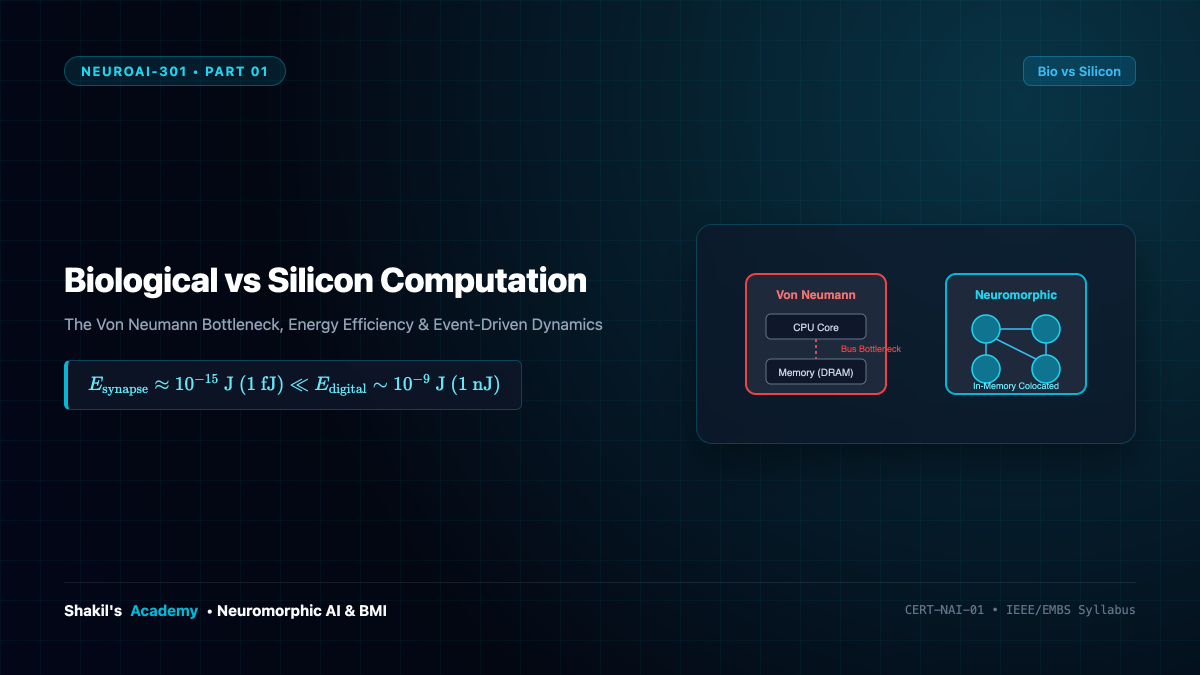
Modern artificial intelligence relies on massive deep neural networks executed on conventional digital microprocessors (CPUs, GPUs, and TPUs). While these systems achieve superhuman performance in narrow domains, they consume hundreds of kilowatts to megawatts of electrical power. In stark contrast, the human biological brain operates on approximately 20 watts of metabolic power while simultaneously executing real-time multimodal perception, motor control, reasoning, and continual learning. Understanding this astronomical seven-orders-of-magnitude energy disparity is the founding imperative of Neuromorphic Engineering.
1. The Von Neumann Bottleneck and Memory Separation
In standard computing architecture formalized by John von Neumann in 1945, computation and memory are physically segregated across distinct hardware domains:
- The Central Processing Unit (ALU and registers) performs arithmetic and logic.
- High-capacity Dynamic Random-Access Memory (DRAM) stores instruction sets and numerical tensor weights.
- Communication between them occurs over a shared, finite-bandwidth physical bus.
In deep learning workloads, every multiply-accumulate (MAC) operation requires shuttling weight matrices across this bus. Moving a 32-bit floating-point number across a printed circuit board consumes roughly (2000 imes) more energy than the arithmetic operation itself:
[
E_{ ext{DRAM access}} approx 2.5 imes 10^{-9} ext{ J (2.5 nJ)} quad ext{vs} quad E_{ ext{32-bit FLOP}} approx 1.2 imes 10^{-12} ext{ J (1.2 pJ)}
]
This Von Neumann Memory Wall throttles throughput, generates immense heat, and limits battery-powered edge autonomy.
2. Biological In-Memory and Distributed Co-Location
The human brain features roughly 86 billion biological neurons interconnected by approximately (10^{14}) to (10^{15}) physical synapses. It possesses no centralized CPU and no separate memory bank:
[
ext{Architecture} = ext{Non-Separable, Massive In-Memory Computing}
]
A biological synapse simultaneously functions as the primary non-volatile memory cell (storing synaptic strength or conductance (w_{ij})) and the local analog arithmetic processor (performing immediate Ohm’s-law current scaling upon arrival of an action potential):
[
I_j(t) = sum_{i} w_{ij} delta(t – t_i^{(k)})
]
Because computation and memory are co-located at nanometer scales within the synaptic cleft, data movement energy is virtually eradicated.
3. Energy Metrics: Femtojoules vs Gigawatts
The metabolic efficiency of the mammalian neocortex is staggering when evaluated in physical energy units:
| Metric / System | Human Biological Brain | NVIDIA H100 Hopper GPU | Frontier Exascale Supercomputer |
|---|---|---|---|
| Total Power Consumption | (approx 20 ext{ Watts}) | (700 ext{ Watts}) | (22.7 ext{ Megawatts}) |
| Synaptic / MAC Event Energy | (1 ext{ to } 10 ext{ fJ } (10^{-14} ext{ J})) | (10 ext{ to } 50 ext{ pJ } (10^{-11} ext{ J})) | (100 ext{ to } 500 ext{ pJ } (10^{-10} ext{ J})) |
| Synaptic Operations / sec | (sim 10^{16} ext{ SynOps/s}) | (sim 4 imes 10^{15} ext{ FP8 FLOP/s}) | (sim 1.2 imes 10^{18} ext{ FLOP/s}) |
| Clock Paradigm | Asynchronous Event-Driven ((sim 10 ext{ Hz})) | Synchronous Global Clock ((1.8 ext{ GHz})) | Synchronous Global Clock |
| Volume & Mass | (1.3 ext{ kg}, approx 1300 ext{ cm}^3) | (0.8 ext{ kg}) (board only) | (> 100 ext{ tons}, 680 ext{ m}^2) |
4. Synchronous Clocks vs Asynchronous Event-Driven Spiking
Digital microprocessors rely on a global square-wave clock ticking at gigahertz frequencies. On every clock cycle, hundreds of millions of transistors toggle regardless of whether new sensory information has arrived, dissipating dynamic switching power:
[
P_{ ext{dynamic}} = alpha C_{ ext{load}} V_{ ext{dd}}^2 f_{ ext{clock}}
]
Biological neural circuits, in contrast, operate completely asynchronously without any global clock. Neurons remain quiescent (consuming only tiny leakage currents) until an informative threshold crossing occurs. When a neuron fires, it emits a discrete, binary, all-or-none voltage spike (Action Potential) lasting (sim 1 ext{ ms}):
[
S(t) = sum_{k} delta(t – t_k)
]
Computation occurs solely upon the arrival of events, resulting in ultra-sparse spatio-temporal activity patterns where fewer than (1%) to (2%) of cortical neurons are active simultaneously.
5. Axonal Propagation Delays and Temporal Coding
Unlike electronic copper traces where electrical signals propagate near the speed of light ((c approx 2 imes 10^8 ext{ m/s})), unmyelinated biological axons conduct action potentials at leisurely velocities of (0.5 ext{ to } 2 ext{ m/s}) (and up to (100 ext{ m/s}) in heavily myelinated fibers):
[
Delta t_{ ext{axon}} = rac{d}{v_{ ext{conduction}}} sim 1 ext{ to } 50 ext{ ms}
]
Far from being a flaw, this axonal propagation latency is actively exploited by the brain as a computational resource. By utilizing Delay Lines and Coincidence Detection (Jeffress model), the auditory cortex decodes microsecond interaural time differences (ITD) to localize sound sources in 3D space with sub-millimeter precision. Neuromorphic computing embraces these physics: replacing dense matrix multiplication with asynchronous, event-driven, time-as-computation architectures.