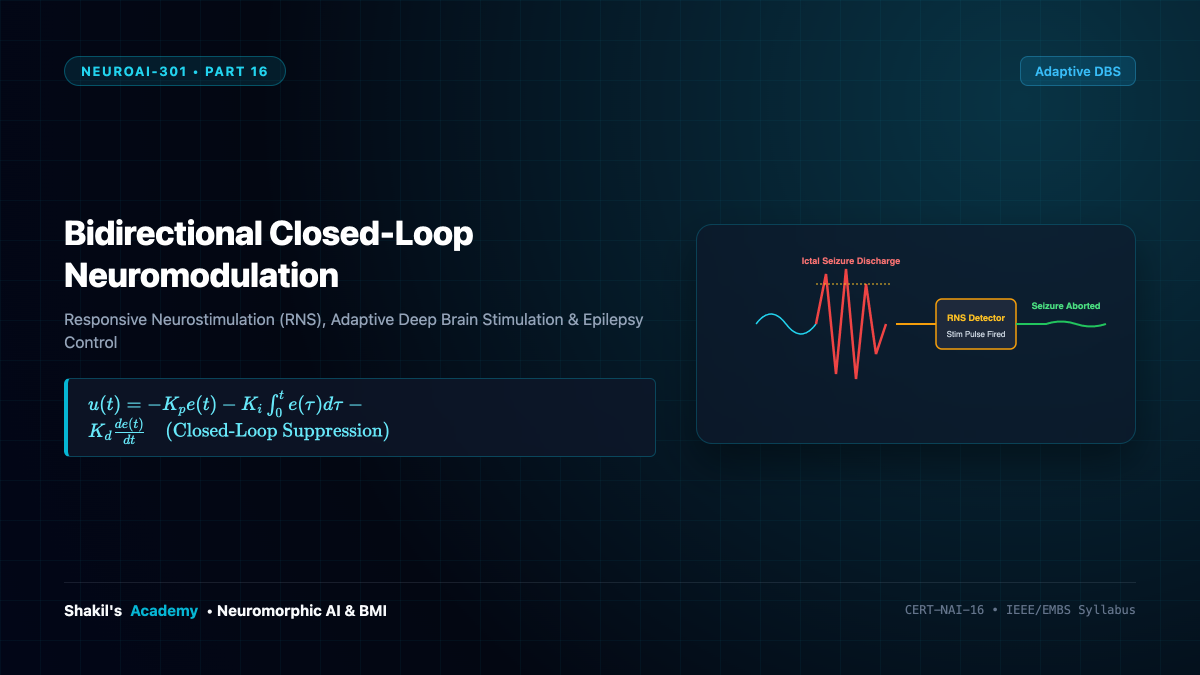
Conventional implantable medical devices—such as classic cardiac pacemakers or standard deep brain stimulators—deliver continuous, invariant electrical stimulation 24 hours a day (open-loop paradigm). This brute-force approach wastes battery energy, accelerates tissue habituation, and causes debilitating off-target side effects (e.g., speech impairment, dyskinesias, and mood alterations). Modern bioelectronic medicine has transitioned to Bidirectional Closed-Loop Neuromodulation: smart implantable systems that continuously record local neurophysiological biomarkers, execute edge AI detection algorithms, and deliver precisely calibrated electrical therapy only when pathologically necessary.
1. Responsive Neurostimulation (RNS) for Drug-Resistant Epilepsy
Epilepsy affects over 50 million people worldwide, with roughly one-third suffering from pharmacoresistant epilepsy. Approved by the FDA in 2013, the NeuroPace RNS System was the world’s first commercially approved closed-loop brain-responsive neurostimulator:
- A microprocessor-controlled titanium neurostimulator is implanted flush within the cranium, connected to two 4-contact depth leads or subdural cortical strips placed at the patient’s personalized epileptogenic foci.
- Continuous Biomarker Sensing: The onboard DSP continuously analyzes electrocorticographic activity across four channels using three feature extraction engines:
- Bandpass Energy: Measures amplitude shifts in specific frequency bands.
- Line Length: Measures fractal waveform complexity and high-frequency fragmentation:
[
L(k) = sum_{i=1}^{N-1} |x[k – i] – x[k – i + 1]|
] - Area Engine: Tracks rectified waveform envelope integration.
- Autonomous Triggering: Within (100 ext{ to } 300 ext{ ms}) of detecting an electrographic seizure onset (ictal discharge), the RNS delivers an imperceptible burst of high-frequency charge-balanced biphasic stimulation ((100 ext{–}200 ext{ Hz})), instantly disrupting synchronized hypersynchronous rhythms and aborting the seizure before clinical convulsions manifest.
2. Adaptive Deep Brain Stimulation (aDBS) for Parkinson’s Disease
In Parkinson’s disease, the degeneration of dopaminergic substantia nigra neurons causes pathological synchronization within the subthalamic nucleus (STN) and internal globus pallidus (GPi). Standard open-loop DBS delivers constant (130 ext{ Hz}) stimulation, consuming excessive battery power and causing speech dysfunction during medication “ON” states.
Adaptive DBS (aDBS) tracks a definitive electrophysiological biomarker: STN Beta-Band Oscillations (13 to 35 Hz):
[
P_beta(t) = int_{13 ext{ Hz}}^{35 ext{ Hz}} |X(f, t)|^2 df
]
- When medication wanes and motor symptoms (rigidity and tremor) emerge, STN beta burst durations and power spike. The closed-loop controller automatically ramps up stimulation amplitude.
- When medication takes effect, beta oscillations subside naturally. The controller scales down stimulation voltage to zero, saving up to (50%) battery power and eliminating stimulation-induced dyskinesia.
3. Control-Theoretic Architectures: PID and Model Predictive Control
Closing the loop between neural sensing and stimulation requires robust feedback control architectures:
[
u(t) = K_p e(t) + K_i int_0^t e( au) d au + K_d rac{de(t)}{dt}
]
where the error is the divergence from target biomarker power: (e(t) = P_{ ext{target}} – P_{ ext{meas}}(t)). Advanced controllers incorporate Model Predictive Control (MPC) and reinforcement learning, adjusting stimulation parameters in anticipation of circadian circadian cycles and physical sleep-wake states.
4. The Stimulation Artifact Cancellation Challenge
The primary engineering bottleneck in bidirectional closed-loop systems is the colossal dynamic range disparity between stimulation and recording:
[
V_{ ext{stim}} sim 1 ext{ to } 5 ext{ Volts} quad ext{vs} quad V_{ ext{neural}} sim 10 ext{ to } 100 mu ext{V}
]
Delivering a stimulation pulse saturates standard high-gain analog front-end amplifiers by up to (100,000 imes) (stimulation artifact), blinding the sensor for hundreds of milliseconds. Modern neuromorphic ASICs conquer this via:
- Hardware front-end blanking switches that disconnect the amplifier during pulse injection.
- Real-time active digital template subtraction modeling the electrochemical double-layer transient decay.
- Symmetric differential recording architectures rejecting common-mode stimulation voltages with (> 100 ext{ dB}) CMRR.