Severe brainstem stroke or advanced neurodegenerative diseases like ALS can cause complete anarthria—the inability to produce articulate speech—leaving individuals trapped in a locked-in state. Conventional assistive spelling devices (such as eye-gaze tracking or P300 spellers) are excruciatingly slow, typically yielding only 5 to 10 words per minute. Over the past five years, Speech Neuroprosthetics has achieved an extraordinary clinical breakthrough: decoding vocal tract articulatory representations directly from the cortical surface in real time, synthesizing natural spoken audio and fluent text at speeds exceeding 60 to 80 words per minute.
1. Electrophysiology of the Vocal Tract in the Ventral Sensorimotor Cortex
Human speech is one of the most complex motor activities in biology, requiring coordinated microsecond-level synchronization of over 100 distinct vocal tract muscles (lips, tongue tip, tongue body, jaw, larynx, and vocal folds).
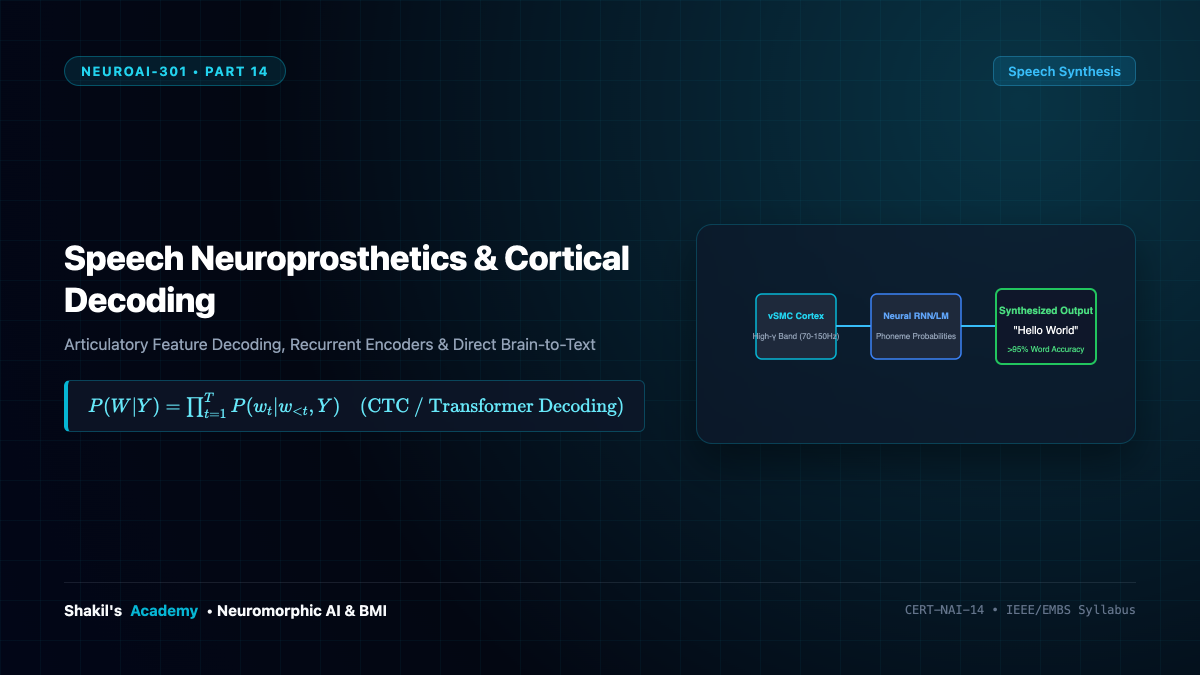
Pioneering electrocorticography research by Edward Chang and colleagues at UCSF revealed that the Ventral Sensorimotor Cortex (vSMC) does not encode abstract phonemes or written acoustic letters; instead, it directly coordinates the physical articulatory kinematics of the vocal articulators:
- High-gamma band power (70–150 Hz) in dorsal vSMC maps to lip closure and mouth opening (bilabial consonants: /p/, /b/, /m/).
- Medial vSMC regions coordinate tongue tip elevation (coronal consonants: /t/, /d/, /s/).
- Ventral vSMC regions coordinate tongue dorsum positioning and vocal fold tension (vowels and velar consonants: /k/, /g/).
2. Two-Stage Biomimetic Acoustic Synthesis Pipeline
Rather than mapping brain signals directly to acoustic waveforms in a single end-to-end black box, Anumanchipalli, Chartier, and Chang (Nature, 2019) introduced a biologically grounded two-stage architecture:
- Stage 1: Cortical Activity to Articulatory Kinematics: A recurrent bidirectional LSTM neural network decodes high-gamma ECoG envelopes into continuous geometric vocal tract parameters:
[
mathbf{k}(t) = mathcal{F}_{ ext{RNN}}left( mathbf{P}_{ ext{HG}}(t – au : t + au)
ight)
]
where (mathbf{k}(t)) describes pitch, tongue coordinates, lip aperture, and formants. - Stage 2: Articulatory Kinematics to Acoustic Waveforms: A second neural synthesis network maps the intermediate articulatory trajectories into a spectral representation (mel-frequency cepstral coefficients or mel-spectrograms), which a neural vocoder (WaveGlow or HiFi-GAN) synthesizes into audible human speech:
[
mathbf{S}_{ ext{audio}}(t) = ext{Vocoder}left( mathcal{G}_{ ext{synth}}(mathbf{k}(t))
ight)
]
This intermediate kinematic constraint acts as a powerful regularizer, enabling the system to synthesize intelligible speech even from individuals who have not spoken in over a decade.
3. Direct Brain-to-Text Decoding via Connectionist Temporal Classification (CTC)
In parallel, Willett, Henderson, Shenoy et al. (Stanford BrainGate, Nature, 2021) demonstrated that an individual with tetraplegia attempting to handwrite letters generated distinct spatio-temporal trajectories in premotor cortex area 6v. Using a recurrent neural network trained with Connectionist Temporal Classification (CTC) Loss combined with an (n)-gram language model:
[
mathcal{L}_{ ext{CTC}} = -ln sum_{pi in mathcal{B}^{-1}(l)} P(pi | mathbf{X})
]
the patient achieved a record-breaking typing speed of 90 characters per minute (approx 18 words/min) with (99.1%) accuracy with autocorrect.
4. Clinical Reality: Real-Time Multimodal Communication
In 2023, Chang’s team achieved the ultimate clinical milestone (Metzger et al., Nature, 2023): a woman paralyzed by a brainstem stroke communicated via a digital avatar at 78 words per minute. The system decoded her intended speech into written text, synchronized facial animations on an expressive avatar, and synthesized her pre-injury voice, completely eliminating the communicative barrier of locked-in syndrome.